Getting around · Bus-first travel, planned properly
Public transport in Cyprus: can you get around without a car?
Cyprus buses can make a resort or city break easy without a car. Learn which operator to use, where buses work well, airport transfers and when a car is still the better choice.
- Filed under
- Plan your trip
- Updated
- 17 July 2026
- By
- The editors
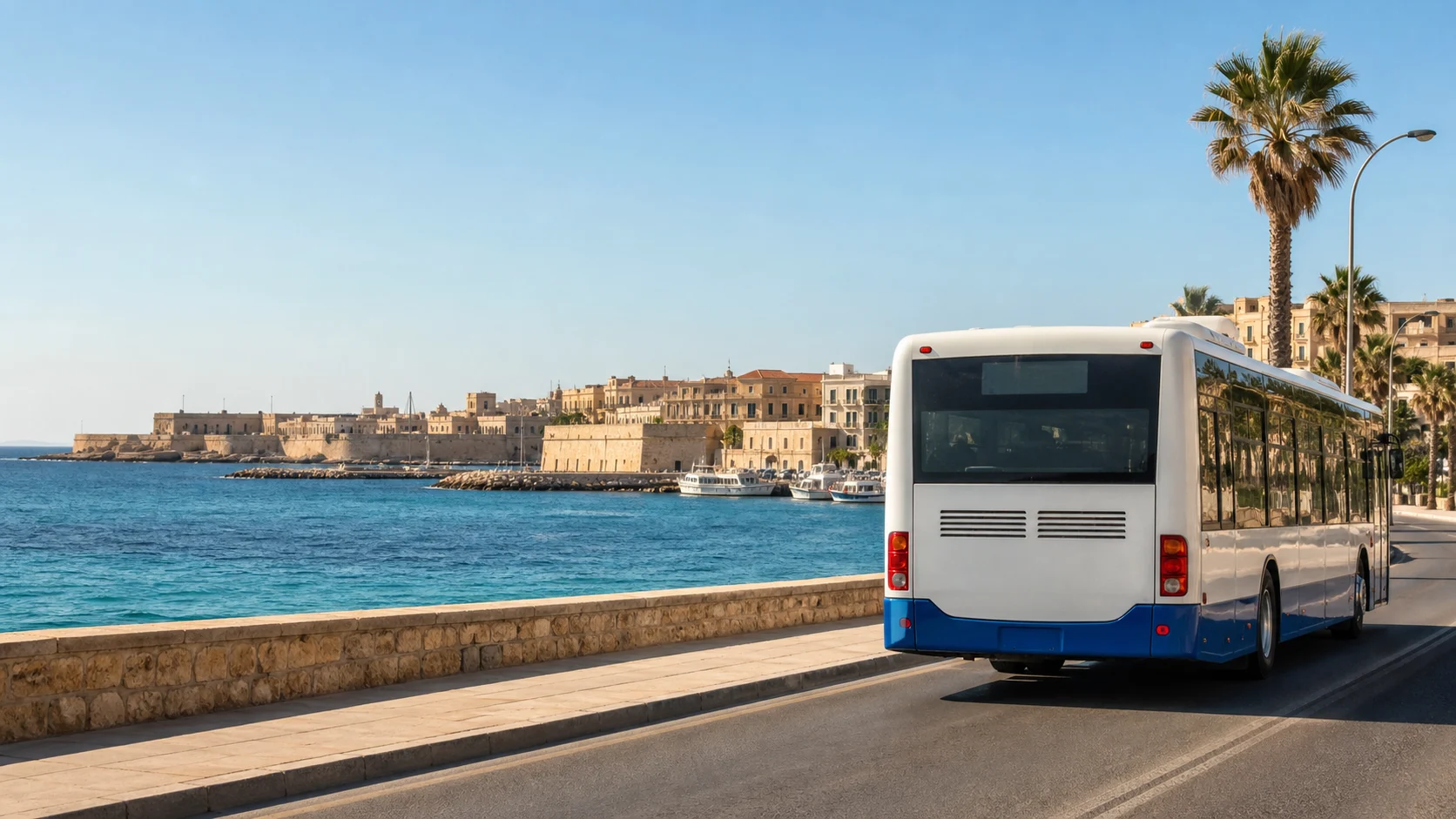
Yes, you can use public transport in Cyprus without turning a holiday into a timetable exercise — if you choose the right kind of trip. Buses work best for a stay based in Paphos, Larnaca, Limassol, Ayia Napa or Protaras, where your hotel, beach, restaurants and a few sights sit on established routes. They are much less convincing for the Troodos Mountains, the Akamas Peninsula or a week built around quiet coves and villages.
The key is to treat Cyprus as several connected bus systems, not one island-wide metro network. There is no train or underground system. Local buses, intercity services and airport coaches each do a different job, and their live timetables can change. Check the operator before you book a non-refundable activity or build a same-day connection around a bus.
That distinction is especially useful for a cross-island arrival: our Larnaca Airport to Paphos guide shows why the scheduled airport shuttle and the final Paphos local bus should be planned as separate legs.
When a bus solves most of the route but not the bags, late arrival or final uphill walk, a taxi can be the right last leg. Our Cyprus taxi guide explains the current urban-meter rules, apps and the checks that matter for a fixed airport transfer.
If you are still choosing a base, start with our Cyprus holiday guide. This guide answers the next question: whether a car-free version of that holiday is realistic.
The quick answer: when buses work — and when they do not
| Your plan | Can buses work? | What to plan for |
|---|---|---|
| Larnaca city break or nearby beach stay | Usually, yes | Check the local route and your airport connection |
| Paphos harbour, archaeological sites and central beaches | Usually, yes | Use the Paphos operator’s live timetable; keep wider west-coast days flexible |
| Ayia Napa or Protaras resort holiday | Usually, yes | Local routes are practical in season; confirm late-evening and shoulder-season services |
| Limassol city and seafront | Often, yes | Choose accommodation near the areas you will use most |
| One or two journeys between main towns | Yes | Use Intercity Buses, not an urban route |
| Troodos villages, Akamas or remote beaches | Usually not | Consider a guided trip, taxi or a hire car for that day |
| Two bases and lots of unplanned stops | Probably not | A car earns its cost through flexibility |
Public holidays are the other thing that moves a timetable. Holiday services are set by each operator rather than nationally, so a date from our Cyprus public holidays guide is a prompt to check the operator’s own schedule rather than assume a normal weekday.
This is why a “no car needed” answer can be both true and misleading. A beach-and-harbour holiday and a self-led nature itinerary are not the same transport problem.
Know which bus network you need
The official Cyprus tourism transport guide divides bus services into airport transfers, interurban routes, urban services and rural buses. That is the most useful starting point for visitors.
Urban buses: the network for your base
Urban buses move around a town and its surrounding resort area. Visit Cyprus lists separate operators for Nicosia and Larnaca, Limassol, Paphos and the Ayia Napa–Protaras/Paralimni area. In practical terms, do not assume that an app or ticket arrangement in one district automatically covers every journey on the island.
- Nicosia and Larnaca: Cyprus Public Transport publishes routes, service notices and travel-card information. Its journey planner is specifically for journeys within Nicosia and Larnaca districts, so it is useful there but not a universal Cyprus route planner.
- Paphos: use Pafos Buses. It is the source to check for stops, routes and any changes before a day from the harbour or your hotel. For the most common beach journey, our Paphos to Coral Bay bus, taxi and car guide explains the 615 route and the harbour change; pair it with our Paphos guide when you are deciding which neighbourhood makes a car-free base easiest.
- Limassol: EMEL runs the district network. It can suit a seafront and Old Town stay, but a mountain-village day is a separate plan.
- Ayia Napa, Protaras and Paralimni: OSEA is the local operator. Its timetable matters especially outside peak season, when resort rhythms change.
For a simple local day, search the route before breakfast, screenshot the relevant return journeys and leave margin for a missed bus. A timetable is a plan, not a guarantee that a tight restaurant or boat reservation will wait for you.
Intercity Buses: for moving between the main towns
Intercity Buses links the principal towns. Its published routes include Nicosia–Limassol, Nicosia–Paphos, Larnaca–Limassol, Limassol–Paphos and services involving Ayia Napa and Paralimni. That makes it sensible for a deliberate point-to-point journey, such as changing base from Larnaca to Paphos. Our Paphos to Limassol guide works through one of those routes in full, including the published fares and why the terminal at each end is rarely where you are staying.
It is not the same as an airport coach or a local beach bus. Check three things on the operator’s own route page:
- The departure stop — stations and city-centre stops are not interchangeable.
- The day type — weekday, weekend and public-holiday timetables can differ.
- The final connection — a late intercity arrival may leave you needing a taxi to your hotel.
Avoid building a flight, an intercity bus and a pre-paid activity into one narrow chain. Give yourself enough time that a delay is an inconvenience rather than the day’s defining event.
Airport buses are a separate decision
Cyprus has airports at Larnaca and Paphos, and the tourism board describes airport transfer buses as their own category. Before booking a car-free arrival, identify the exact destination: an airport coach may take you to a town centre or a specific resort area, while an intercity bus may not begin at the terminal at all.
For a practical Paphos Airport arrival to the resort coast, our Paphos Airport to Coral Bay guide maps the official 612-to-615 bus change and the ticket issue that can make a transfer the better choice.
For a central Paphos stay, the choice comes one step earlier: Paphos Airport to Paphos by bus, taxi or car explains when to use route 612 for the harbour-side coast and when route 613/Karavela is the more useful fit.
For the capital, Larnaca Airport to Nicosia explains why the direct airport shuttle is a different proposition from piecing together Larnaca local and intercity buses, and where a taxi makes the arrival simpler.
For a quiet north-west stay, the distinction matters even more: Paphos Airport to Latchi sets out the three public-transport legs via Karavela and Polis, and when a direct transfer or hire car is the more sensible start.
For the south-east coast, our Larnaca Airport to Protaras guide distinguishes the direct scheduled airport shuttle from the local and intercity bus connection, so you can choose around your flight time and hotel address.
For Ayia Napa, use our Larnaca Airport to Ayia Napa guide: the direct shuttle and the local Larnaca airport buses are different services, so a low-cost connection needs more planning than a through airport transfer.
For a short break, compare the complete journey rather than the headline fare: airport coach or local bus, walk to the hotel, luggage, arrival time and the return journey for an early flight. Sometimes public transport is the easy choice; sometimes a pre-booked transfer is worth it for the first and last kilometres. Our Cyprus currency guide has the practical card-and-cash checks to make before paying for transport on arrival.
Tickets, fares and live information: use the operator, not a blog
Fares, ticket types and service notices are unstable details, so this is one place where a generic travel article ages quickly. Cyprus Public Transport currently publishes single tickets, multi-trip options and travel cards on its official travel-cards page; it also notes the terms for transfers and evening tickets. Other districts and intercity services have their own arrangements.
Use this order of operations:
- Find the operator for the district or intercity route.
- Check the live timetable and service alerts on the day before travel.
- Check the ticket or fare page for that operator, not a copied price in a search result.
- Save the return timetable and the operator’s contact details offline.
That small amount of preparation is more valuable than memorising a fare that may no longer apply. It also prevents the common mistake of buying a local ticket for a journey that actually needs an intercity service.
Where public transport is genuinely useful
Public transport is at its best when it removes a car you would otherwise barely use. Consider it positively when your trip looks like this:
- Larnaca: promenade, town, nearby beaches and a short-stay hotel near where you want to spend time.
- Paphos: harbour, central archaeological sights, a hotel close to a useful stop and perhaps one planned local day. For sea time beyond town, our Paphos boat-trips guide can help you decide whether an organised departure fits better than a complicated bus day.
- Ayia Napa or Protaras: hotel, beach, evening restaurants and one or two planned outings rather than a different secluded cove every morning.
- Limassol: a city-and-seafront break where walking fills much of the day and buses handle the longer urban stretches.
For the airport arrival, the scheduled Larnaca–Limassol coach is a separate service from local and intercity buses. Our Larnaca Airport to Limassol guide explains its stops and when a door-to-door transfer is the more practical choice.
Choose accommodation with transport in mind. A cheaper villa far up a hill can turn an otherwise viable bus trip into repeated taxis; a slightly more central room may cost less once transfers and car hire are removed. The same comparison appears in our Cyprus holiday budget guide.
When to hire a car instead
A car is not automatically better, but it is the more realistic tool for a holiday based on rural walks, unserved beaches, villages, inland wineries or the Akamas. It also gives a family more control over heat, luggage, naps and return times.
Read our Cyprus car-hire guide before comparing rentals: it helps you decide whether a car earns its cost, what to compare in the quote and which agreement checks matter. Then use our driving in Cyprus guide for UK licences, left-side driving, road conditions and the separate insurance questions around the Green Line. The useful choice is not “car versus bus” in the abstract; it is the option that lets you do the actual days you have planned without either idle hire costs or missed connections.
FAQs
Is Cyprus easy to visit without a car?
It can be. Pick one well-connected base, arrange the airport journey in advance and make one or two bus-friendly day plans. It is harder when every day depends on an isolated beach, village or nature trail.
Are buses reliable in Cyprus?
Treat the current operator timetable as the source of truth, and allow extra time for any important connection. Services, stops and frequencies can change, particularly by season, route or day type.
Can you use one ticket across Cyprus?
Do not assume so. Urban, intercity and airport services are distinct; confirm the ticket conditions with the operator that runs the journey.
Is there a bus from Paphos to Limassol?
Intercity Buses publishes a Paphos–Limassol route. Check its live route page for the current stops, day type and departure times before making plans.
Are buses practical for the Troodos Mountains or Akamas?
They are usually not the simplest choice for a short holiday. A car, organised tour or taxi arrangement gives far more flexibility for those areas.
Quick answers
Frequently asked questions
Is public transport good in Cyprus?
It is useful for a one-base holiday in the main towns and resorts, but it is not a substitute for a car on every route. Check the local operator’s live timetable before committing to a day trip.
Is there a train in Cyprus?
No. Cyprus has no train or underground network; buses and taxis are the principal public-transport options.
Can I travel between Cyprus cities by bus?
Yes. Intercity Buses connects the principal towns, but airport coaches and local urban services are separate networks with their own timetables and tickets.
Can I get from Larnaca Airport to a resort by bus?
Often, but first check whether the relevant airport coach or local service fits your arrival time and accommodation. An airport transfer is a separate service from an intercity bus.
Do I need a car in Cyprus?
Not for every trip. A car is most valuable for the Troodos villages, Akamas, remote beaches and multi-stop itineraries; a resort or city break can often work without one.