Planning · The wildlife question, answered with hospital data
Snakes in Cyprus: which are dangerous, and when you might meet one
Cyprus has eight snake species and only one, the blunt-nosed viper, is dangerous to people. Hospital data show bites peak in September, not midsummer, and cluster around Paphos. How to tell them apart and what to do.
- Filed under
- Plan your trip
- Updated
- 1 October 2026
- By
- The editors
Yes, Cyprus has snakes: eight species, according to the island’s own herpetological atlas. Three carry venom and only one, the blunt-nosed viper, is dangerous to people. The part most guides miss is timing. Public-hospital records show snakebite admissions peak in September, not in the heat of July and August, and half of all patients were treated at Paphos General Hospital. If you are walking in the countryside this autumn, that is the context worth having.
The pages that currently answer this question are a 2012 car-hire blog, a translated property-portal article, Reddit and several Facebook groups. Between them they cannot agree whether Cyprus has eight, ten or eleven species, and none of them uses the one piece of hard evidence that exists: a peer-reviewed study of every snakebite admission to the Republic’s public hospitals over seven years. This guide is built on that study and on the species atlas run by the Open University of Cyprus with the Herpetological Society of Cyprus.
For the wider safety picture, including the risks that are statistically far more likely to spoil a holiday, see our guide to whether Cyprus is safe.
The eight snakes of Cyprus at a glance
HerpAtlas.cy lists eight species. The descriptions below are summarised from its individual species pages.
| Snake | Venom | Size | How to recognise it |
|---|---|---|---|
| Blunt-nosed viper | Dangerous, front fangs | Thick, heavy body | Sand-coloured, dark brown blotches along the back, triangular head, very short tail |
| Eastern Montpellier snake | Mild, rear fangs | Up to 2 m | Adults uniform grey to olive green, yellowish belly |
| European cat snake | Mild, rear fangs | Under 1 m | Grey-beige with dark bands, vertical pupils, hisses loudly when disturbed |
| Large whip snake | Harmless | Rarely over 2 m in Cyprus | Adults glossy black; young are olive with dark flecks |
| Cyprus whip snake | Harmless | Up to 1 m, very thin | Black adults with fine white cross-stripes and a white ring round the eye |
| Coin snake | Harmless | Up to 1.5 m | Pale with dark brown diamond markings; defensive if cornered |
| Cyprus grass snake | Harmless | Up to 1 m | Lives in and around freshwater; very rare |
| Worm snake | Harmless | 30 to 35 cm | Pink or beige, looks like an earthworm, lives underground |
Why do other sites say ten or eleven? The longer lists, including Wikipedia’s, also name the dwarf snake and Dahl’s whip snake, which the current atlas does not include. For a visitor the difference is irrelevant: neither is venomous, and the dangerous species is the same on every list.
The only one that matters: the blunt-nosed viper
The blunt-nosed viper (Macrovipera lebetina), called fina in Greek, is the one snake on the island that can cause a serious medical emergency. HerpAtlas notes that Cyprus is the only European Union country where the species occurs.
What makes it worth knowing about is not aggression but camouflage. It is thick-bodied and sandy, with darker brown rectangular markings, so it disappears against dry earth, stone walls and leaf litter. It hunts rats and other small animals, often by waiting under shrubs, and it turns up in every habitat from the coast to the Troodos peaks, including close to houses and usually near water.
One identification warning: vertical pupils are not a reliable giveaway. The harmless-to-people cat snake has them too, and the coin snake carries a patterned back that can look viper-like at a glance. If you are not sure, treat it as a viper and walk away. That is the correct response to every snake in Cyprus anyway.
What the hospital records actually show
In 2022, researchers from German universities and the Cyprus Ministry of Health’s Health Monitoring Unit published the first epidemiological study of snakebite in the Republic of Cyprus in the Journal of Occupational Medicine and Toxicology. It covers every snake envenomation admitted to a public hospital from 2013 to 2019.
| Finding (2013 to 2019) | Figure |
|---|---|
| Admissions over seven years | 288, an average of 41 a year |
| Admissions between April and October | 266 (92%) |
| Busiest single month | September, with 88 cases (31%) |
| Share treated at Paphos General Hospital | 51% |
| Share treated at Limassol General | 30% |
| Discharged within four days | 84% |
| Average hospital stay | 2.65 days |
| Deaths linked to snakebite, 2000 to 2018 | Two (one directly, one indirectly) |
Three things stand out.
September is the peak. Most people assume snake risk tracks the summer heat, but the busiest month by a distance was September, at the end of the long dry season. The authors describe the hazard as highest in August and September. October still sits inside the active window, so a walk in the Cyprus autumn is not out of season.
Paphos district carries the most risk. Half of all admissions went to Paphos General, and the authors conclude that envenomation risk appears highest in Paphos district. That matters because Paphos, Coral Bay and the Akamas Peninsula are where a large share of UK visitors stay and walk.
It is rarely fatal. Short hospital stays point to mostly non-severe cases, and the people at highest risk were men aged 60 to 69 and outdoor workers such as farmers, shepherds and hunters, not tourists on marked paths. The data cover public hospitals in the Republic only, so bites treated privately or in the north are not counted.
How to avoid a bite
Snakes in Cyprus detect ground vibration and almost always move off before you see them. Most bites happen when someone steps on, picks up or corners one. The practical habits are simple:
- Wear closed shoes and long trousers on rural paths, especially through long grass, scrub and stony ground. Sandals on a gorge walk are the classic mistake.
- Walk with a firm step and, in thick vegetation, tap the ground ahead with a stick. Advice carried by Knews recommends exactly this, because snakes sense the vibration and move away.
- Look before you put your hands down on dry-stone walls, rock ledges, log piles or into bushes, which is also where vipers wait for rats.
- Use a torch on summer and autumn evenings. The viper and the cat snake have night vision and are active after dark.
- Never try to catch, move or kill a snake. It is illegal, and it is how many bites happen.
For route planning, our hiking in Cyprus guide covers official trail grades and the checklist that prevents most bad walking days. Gorge and river walks deserve extra attention, because the viper favours ground near water.
If someone is bitten
Call 112, the Cyprus emergency number. Then follow the NHS snake bite guidance, which is written for the UK but applies equally here:
- keep calm and keep the bitten limb as still as you can
- take off rings, watches and anything tight near the bite in case of swelling
- remember the snake’s colour and pattern, or photograph it from a safe distance
- do not cut or suck the wound, and do not tie anything tightly round the limb
- do not take aspirin or ibuprofen, which can worsen bleeding
- do not drive yourself to hospital
In Cyprus, antivenom is given at public hospitals when the bite shows signs of envenomation, such as swelling, inflammation or tissue damage, rather than automatically, because the treatment carries its own risks. Expect to be observed rather than sent straight home. Make sure your travel insurance is sorted before you fly, because that is what decides how smoothly any treatment goes.
Black snakes, beaches and gardens
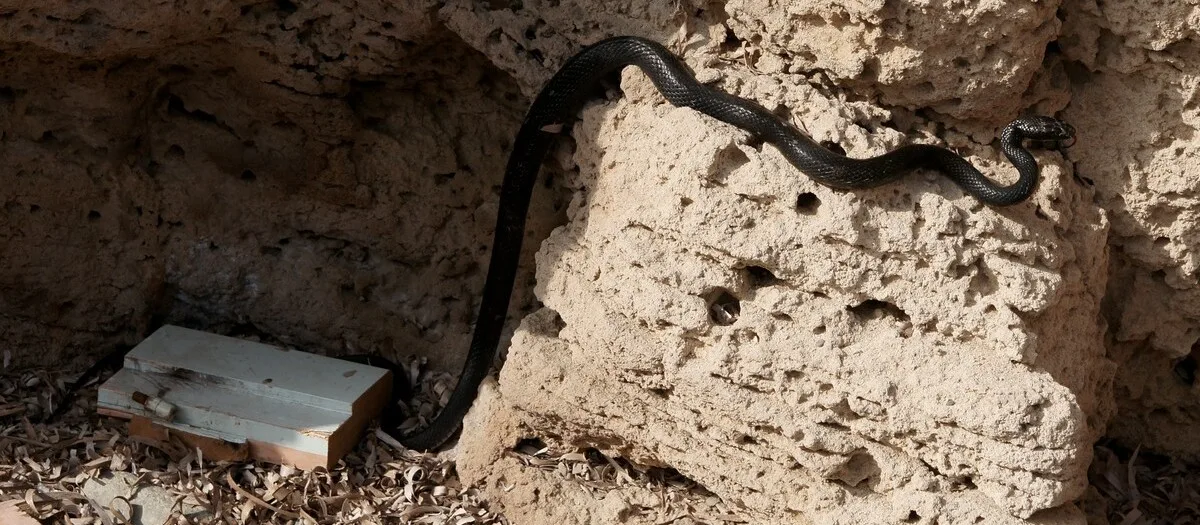
The Cyprus snake that makes the news is usually black. Video of black snakes on a small Protaras beach circulated in July 2026, and “are black whip snakes venomous” is one of the most common follow-up searches. The answer is reassuring: the large black snakes are almost always the large whip snake, which is harmless to people, fast and inclined to flee. The smaller, slimmer black snake is the Cyprus whip snake, an endemic species that HerpAtlas lists as endangered and which has an unfortunate habit of freezing on dirt roads as cars approach.
Every species on the island is protected by the 2003 Protection and Management of Nature and Wildlife Law and by EU legislation. The Department of Forests, marking World Snake Day in July 2026, made the point that snakes control rodent populations and that killing them is prohibited. If one appears in a villa garden, keep children and pets away, let it leave on its own, and ask your accommodation to arrange removal if it stays. Our Cyprus family holiday guide covers the rest of the outdoor checklist for children.
The short answer
Cyprus has snakes, and one of them deserves respect. Your realistic chance of meeting the viper is low and your chance of dying from it is close to nil, but the risk is not evenly spread. It is highest in the countryside of Paphos district in late summer and early autumn, which is exactly when many walkers head out. Closed shoes, a firm step, eyes before hands, and 112 if anything goes wrong.
If insects are the bigger worry, our guide to mosquitoes in Cyprus covers that much more common nuisance.
Sources: species list and descriptions from HerpAtlas.cy (Open University of Cyprus and the Herpetological Society of Cyprus); hospital data from Jestrzemski et al., “Hospital admissions due to snake envenomation in the Republic of Cyprus: a 7-year retrospective review”, Journal of Occupational Medicine and Toxicology, 2022; legal protection from the Department of Forests via Knews, 16 July 2026; first aid from the NHS, reviewed July 2026. This article is general information and not medical advice.
Hero image: a large whip snake (Dolichophis jugularis) in Cyprus, photographed by Mboesch, via Wikimedia Commons, licensed CC BY-SA 4.0. Cropped.

Quick answers
Frequently asked questions
Are there dangerous snakes in Cyprus?
One. Cyprus has eight snake species according to the island's herpetological atlas, and three of them carry venom, but only the blunt-nosed viper is considered medically dangerous to people. The cat snake and the eastern Montpellier snake have fangs at the back of the mouth and venom intended for small prey. Bites from the viper need hospital treatment, but deaths are very rare: a peer-reviewed study linked two deaths in the Republic of Cyprus to snakebite between 2000 and 2018.
Is the black snake in Cyprus venomous?
No. The long black snakes people photograph on walls, roads and beaches are almost always the large whip snake, which is harmless to people, or the smaller endemic Cyprus whip snake, which is also harmless and classed as endangered. Both are protected by law. The dangerous viper is not black: it is a thick, sand-coloured snake with darker brown blotches.
When are snakes most active in Cyprus?
From roughly April to October. Public-hospital data for 2013 to 2019 show 92 per cent of snakebite admissions fell in those months, and September alone accounted for 31 per cent, more than any other month. Snakes slow down from November to March, but they do not vanish completely, and some can be seen on mild winter days.
What should I do if I am bitten by a snake in Cyprus?
Call 112, keep calm and keep the bitten limb as still as possible. Remove rings, watches and tight clothing near the bite in case it swells, and take a photo of the snake only if you can do it safely from a distance. Do not cut or suck the wound, do not apply a tourniquet, do not take aspirin or ibuprofen, and do not drive yourself to hospital.
Is it illegal to kill a snake in Cyprus?
Yes. Every snake species in Cyprus is protected under the Protection and Management of Nature and Wildlife Law of 2003 and under European legislation, and killing or deliberately harming them is prohibited. Trying to kill a snake is also one of the most reliable ways to get bitten by one.