Before you fly · The three-pin answer
Cyprus plugs and adapters: do UK travellers need one?
Cyprus uses UK-style Type G plugs. Here is who needs an adapter, when voltage matters and the simple charging setup to pack for Cyprus.
- Filed under
- Plan your trip
- Updated
- 19 July 2026
- By
- The editors
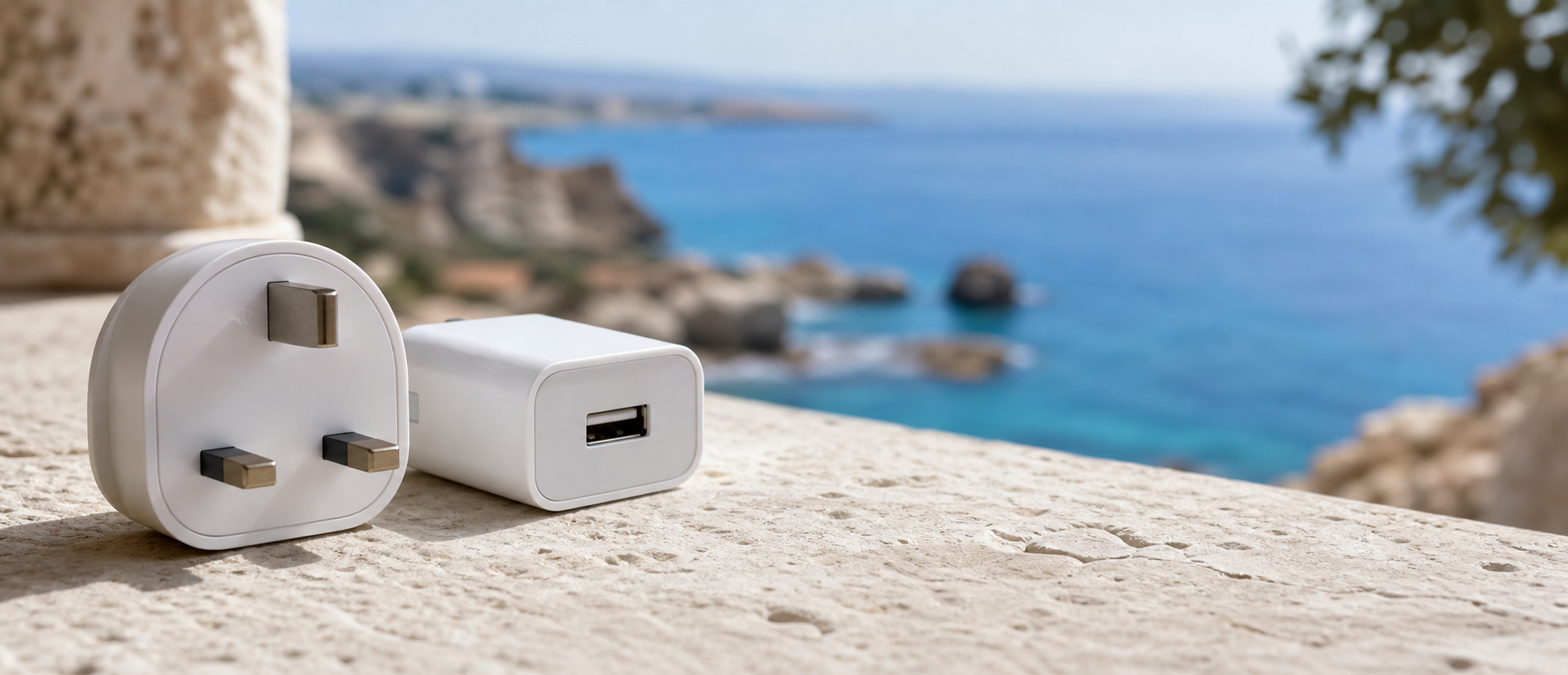
Cyprus uses the same Type G, three-pin plug as the UK. If you are travelling with ordinary British plugs, they fit the wall sockets used in Cyprus, so you do not need a travel adapter or voltage converter just because you are going on holiday.
That is the short answer. The useful second answer is that an adapter changes the plug shape, not the electricity supply. Visitors from mainland Europe, North America and elsewhere may need a Type G adapter; whether they also need a converter depends on the voltage printed on the appliance or charger. Electrical Safety First’s Cyprus advice confirms the local Type G standard and a 230V, 50Hz supply.
If you are still sorting the wider practicalities, start with our Cyprus holiday guide. This page is the device-and-charger check to make before you zip the suitcase.
The Cyprus plug answer at a glance
| Where your plug is from | Will it fit a Cyprus socket? | What to pack |
|---|---|---|
| United Kingdom or Ireland | Yes | Your normal plug and charger |
| Mainland Europe | No | A Type G travel adapter |
| United States, Canada or Japan | No | A Type G travel adapter; check the voltage label too |
| Australia, New Zealand or China | No | A Type G travel adapter; check the voltage label too |
| A USB device with a detachable cable | Usually | A Type G USB charger, or an adapter for your existing charger |
The socket is the familiar British pattern: three rectangular pins arranged in a triangle, with a fuse in the plug. It is often called Type G. Do not buy a continental two-pin adapter for Cyprus by mistake; the important destination side of the adapter is Type G.
UK travellers: take your normal plug
For a UK visitor, the practical answer is refreshingly uncomplicated. Your phone charger, laptop charger, hair straighteners and travel kettle plug into the same shaped socket they do at home, provided the item is in safe working order.
You do not need a universal adapter merely to use a British plug in a Cyprus hotel, villa or apartment. A compact multi-USB Type G charger can still be worth packing if you will charge several devices from one bedside socket, but it is a convenience choice rather than a Cyprus requirement.
The shared plug type comes from the island’s long use of British electrical standards. It applies to the normal visitor setup in Paphos, Larnaca, Limassol, Protaras and Ayia Napa; you do not need a different arrangement for one resort town.
One small habit helps on any trip: do not rely on a single charging point or one frayed cable. Put a spare cable in hand luggage and charge the power bank before leaving for the airport. That is more useful than carrying an adapter you will never use.
Visitors from Europe and the US: adapter first, then check voltage
It is easy to merge two different questions into one:
- Will the plug fit? This is the adapter question.
- Can the appliance handle the local electricity supply? This is the voltage and frequency question.
An adapter solves only the first one. Cyprus operates at 230V and 50Hz. Look for the tiny rating on the plug-in charger or appliance before you travel. A label reading “Input 100–240V, 50/60Hz” normally means the charger is designed for a wide range of supplies. In that case, you need a Type G adapter but not a voltage converter.
That is common for phones, laptops, tablets, cameras, e-readers and many USB chargers. It is not safe to assume the same for every high-powered appliance. A US-only 120V hair dryer, curling tool or small kitchen appliance may need a suitable transformer, and some are simply not worth travelling with. Electrical Safety First notes that using equipment at a voltage different from its rating can be dangerous, and that converters have their own maximum power rating.
The cautious rule is simple: read the label; do not guess from the brand or where you bought it. If the input range does not include 230V, leave the appliance at home or get model-specific advice from its maker.
What to buy — and what not to overbuy
For European or North American visitors, one well-made Type G travel adapter is usually the correct starting point. Choose one that is appropriate for the device you are taking and has the required safety marking for the market where you buy it. If you need to charge several low-power USB devices, a reputable Type G USB charger may be tidier than stacking multiple adapters.
Avoid treating a cheap adapter as a universal cure-all. It does not make a 120V-only appliance safe on a 230V supply, and it does not increase the maximum output of a hotel socket. A powered USB hub does not replace a transformer either.
For a simple seven-night break, a sensible setup is:
- your ordinary charger if it already has a UK plug, or one Type G adapter if it does not;
- a spare USB cable in your hand luggage;
- a charged power bank for travel days; and
- only the devices you will genuinely use.
That last point matters. The Cyprus currency guide explains the card-and-cash side of arrival; making sure your phone can charge is a good companion check, especially if you use it for boarding passes, maps or contactless payments.
Hotel rooms, villas and USB sockets
Accommodation photographs can make this look more complicated than it is. Some newer rooms have USB-A or USB-C ports built into lamps, bedside tables or wall plates. Treat those as a bonus, not as the only way you will charge overnight. Their output and reliability vary, and you still need the correct cable.
The dependable plan is to bring your normal wall charger and use the Type G socket. If a room has limited sockets, decide before bed which device needs a full charge for the next day: usually a phone, camera battery or mobility-related device takes priority over a second tablet.
For medical equipment, electric mobility aids or anything safety-critical, do not let a general travel article make the final decision. Check the manufacturer’s electrical requirements and ask the airline and accommodation about your specific equipment before booking. This is also a good time to confirm the airport journey; our public transport guide explains why airport coaches, local buses and intercity services are separate systems.
A note on hair tools and other high-wattage devices
Hair dryers, straighteners, curling tools, steamers and compact kitchen appliances deserve more care than a phone charger. They can draw much more power, and some versions are made for one voltage only.
Check the item’s label well before departure. If it says 100–240V, it may be designed for travel across both common voltage ranges, but you should still follow the manufacturer’s instructions and use a suitable adapter. If it says 110–120V only, a basic travel adapter is not enough. A transformer must be rated for the appliance’s load, which is precisely the sort of calculation best avoided on a short holiday.
In many cases, the simplest answer is to use the accommodation’s hair dryer where one is supplied, or buy a device made for the local supply once you know you need one. Do not force a plug, use damaged adaptors, daisy-chain extension leads or leave charging equipment under bedding.
Before you fly: a 60-second check
- Look at each charger’s input label.
- If it is not a UK/Ireland plug, pack a Type G adapter.
- If the label does not include 230V, do not assume the appliance will work.
- Put the adapter, a cable and a charged power bank in hand luggage.
- Check your accommodation’s listing only for special equipment needs — not for the ordinary plug standard.
The result is straightforward: UK plugs work in Cyprus; everyone else needs to match Type G, and only some appliances raise a voltage question. Once that is sorted, you can get back to the enjoyable decisions: which coast to choose, whether you need a car, and how much of the trip to leave unscheduled.
Quick answers
Frequently asked questions
Are plugs in Cyprus the same as in the UK?
Yes. Cyprus uses the British Type G three-pin socket, so a normal UK plug fits and a UK visitor does not need a travel adapter for plug shape.
Do European travellers need an adapter for Cyprus?
Usually, yes. A European Type C or Type F plug will not fit a Type G socket without a suitable Type G travel adapter. Check the appliance label separately for voltage compatibility.
Do US travellers need a voltage converter in Cyprus?
Many modern phone, laptop and camera chargers accept 100–240V and need only a Type G adapter. An appliance marked for 120V only is not suitable for a 230V supply without the correct transformer; check its label rather than guessing.
Does Ayia Napa use UK plugs?
Yes. The Type G setup applies in Ayia Napa just as it does elsewhere in Cyprus, including the main holiday areas.