Places · The Venetian monastery in the middle of town
Ayia Napa Monastery: opening hours, history and what to see
Ayia Napa Monastery explained: free entry, the summer and winter opening hours (closed at weekends from November to April), the cave church, Venetian fountain and 600-year-old sycamore, and how it fits into a day in Ayia Napa.
- Filed under
- Places
- Updated
- 18 October 2026
- By
- The editors
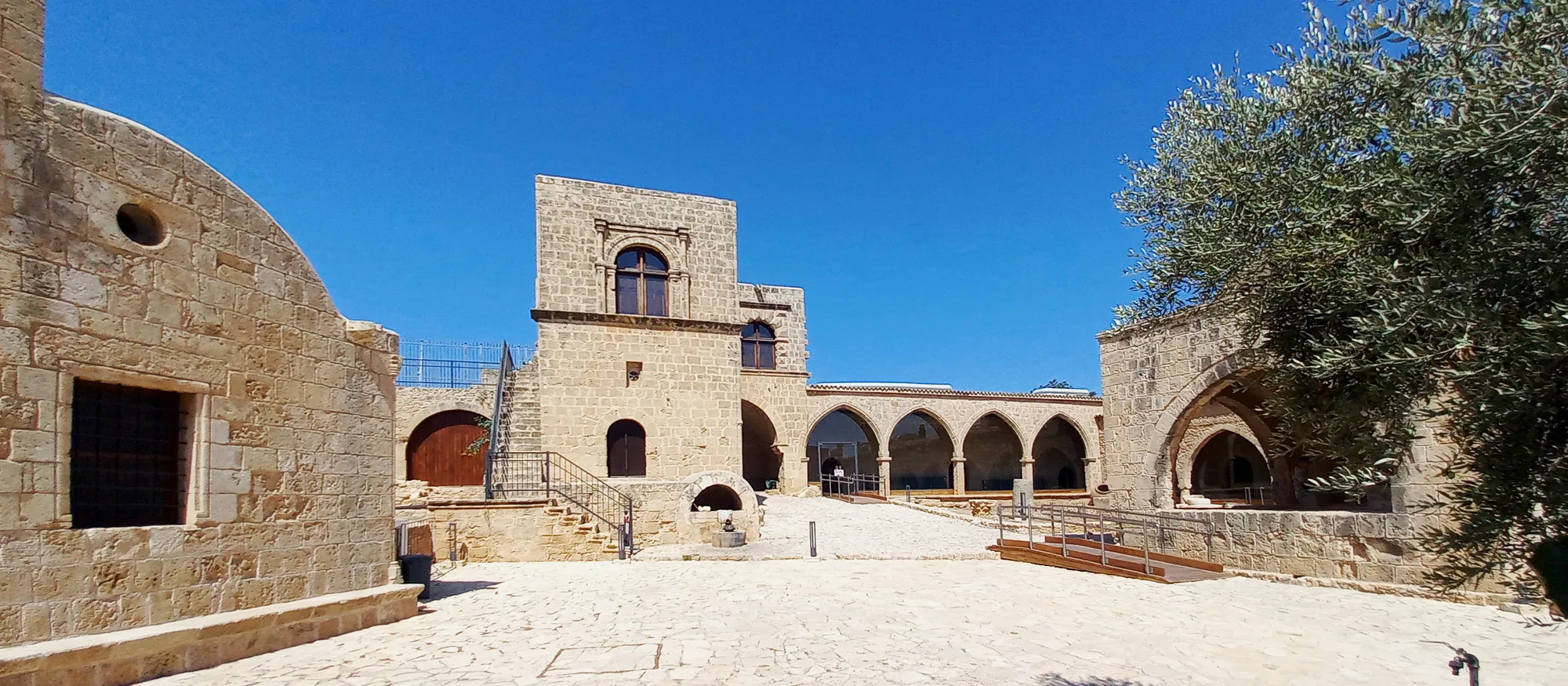
Ayia Napa Monastery is a Venetian-era monastery built around a rock-cut cave church in the centre of Ayia Napa, right beside the main square. Entry is free. From May to October it opens Monday to Friday from 09:30 to 20:00 and at weekends from 11:00 to 20:00. From November to April it opens weekdays only, from 10:00 to 15:00, and is closed on Saturdays and Sundays.
That winter weekend closure is the detail to plan around. It is on the monastery’s own website, but the travel pages that rank for the monastery still describe it as open every day, and from 1 November a Saturday visit will find the gate shut. The rest of this guide covers what you will see inside, the history behind the legends, and how to fit the monastery into a day with the beaches and Cape Greco.
Ayia Napa Monastery at a glance
| Where | Centre of Ayia Napa, on Georgios Seferis Square; entrance by the south gate |
| Entry | Free |
| Summer hours (May to October) | Mon to Fri 09:30 to 20:00; Sat and Sun 11:00 to 20:00 |
| Winter hours (November to April) | Mon to Fri 10:00 to 15:00; closed Sat and Sun |
| Time needed | 30 to 45 minutes |
| Run by | Holy Metropolis of Constantia and Ammochostos (since 2007) |
| Feast day | 8 September, the Nativity of the Virgin |
Opening hours in 2026, and why weekends catch people out
The official visit page splits the year into two seasons. In summer the courtyard stays open into the evening, which is the best time to go in July and August, when the stone paving holds the afternoon heat. In winter the window shrinks to five hours on weekdays.
| Season | Monday to Friday | Saturday and Sunday |
|---|---|---|
| Summer, May to October | 09:30 to 20:00 | 11:00 to 20:00 |
| Winter, November to April | 10:00 to 15:00 | Closed |
Several sources disagree. The page ranking first in Google for the monastery lists 09:00 to 21:00 in summer and 09:00 to 15:00 “daily” in winter, while Google’s own business panel showed an 11:00 opening on the Sunday we checked, which matches the official weekend start. Go by the official hours above. The official site does not say whether public holidays follow the weekday or weekend pattern, so on days such as 28 October or 25 December check before you go; the Cyprus public holidays guide lists the dates.
The monastery is a working religious site. The Orthodox church inside is still used for services, baptisms and weddings, and the official site asks visitors to show “absolute respect for its sacred character”. Covered shoulders and a quiet voice in the church are the normal courtesy. Ordinary holiday photos are fine, but professional photography or filming needs written permission from the Metropolis in advance.
What to see inside
The monastery is a rectangle of honey-coloured limestone buildings around a paved courtyard, with the church on the west side. You can see it all in under an hour.
The cave church. The heart of the site is a small natural cave that, according to local tradition, sheltered an icon of the Virgin Mary. The story says a hunter’s dog chased a rabbit into the cave and would not stop barking, and the hunter found the icon glowing inside. The icon was probably hidden there during the iconoclast period, and it gave the place its name: the monastery translates Ayia Napa as the “Holy Lady of the Forest”, from an ancient Greek word for a wooded glen. The original icon has not survived. The icon to the right of the iconostasis, in a bronze casing, replaced it in the 18th century. You reach the cave by going down a few steps through the larger church built in front of it.
The Latin chapel. The church has two naves. The narrower one on the right was used as a Roman Catholic chapel in the 16th century, which explains the faded 15th-century wall paintings of three women saints with a clear Italian influence. Orthodox and Latin worship sharing one roof is unusual in Cyprus and dates the building firmly to the Venetian period.
The fountain-house. In the centre of the courtyard stands an octagonal limestone fountain under a dome on four pointed arches, with stone benches around its base. The carved faces on its sides are said to show the monastery’s Venetian founder and her parents. A second fountain shaped like a boar’s head, possibly Roman, sits on the north side. Both were fed by a medieval aqueduct, about two kilometres long according to Visit Cyprus, parts of which the Department of Antiquities has excavated and conserved.
The 1530 building. Facing the courtyard’s north side is a two-storey building with Venetian arched windows, dated by a Latin inscription the English traveller Alexander Drummond copied in the 1740s. The inscription itself has since been lost.
The sycamore and the square. Outside the south gate, by the old water cistern, grows a huge sycamore fig that Visit Cyprus describes as around 600 years old and listed by the Department of Forests among the island’s veteran trees. Tradition credits the Venetian founder with planting it. A small monument in its shade remembers the Greek poet George Seferis, who visited and wrote a poem called “Agianapa”. Some older guides place the tree inside the courtyard; it is outside the gate, by the steps up from the square.
The museum space. Excavations during restoration in 2019 turned up new finds, and the former monks’ cells are being turned into the Ayia Napa Monastery Museum. It is not fully open yet. Until it is, the rooms host temporary exhibitions; “Myths and Tales of Cyprus”, from the Press and Information Office, runs until 8 November 2026 with its own hours (weekdays 10:00 to 14:00 and 17:00 to 19:00, weekends 16:00 to 20:00).
A short history
Nobody knows exactly when the monastery was founded. A chronicle mentions the name Ayia Napa in 1366, but the buildings you see today date from around 1500, under Venetian rule. Local legend credits their construction to a Venetian noblewoman from Famagusta who withdrew here after her father refused to let her marry a commoner, though the official site is careful to say this rests on oral tradition rather than evidence.
The monastery was a convent when the traveller Pietro della Valle visited in 1625 and had become a men’s monastery by 1668. It owned land as far away as Kato Lefkara but seldom housed more than a handful of monks, and regular monastic life faded in the 18th century. The village of Ayia Napa grew up around its walls from about 1790. After 1974 refugees from the north lived in the old buildings for a few years, and in 1978 the site reopened as an ecumenical conference centre for the churches of Cyprus and the Middle East. Since 2007 it has belonged to the Holy Metropolis of Constantia and Ammochostos, the Orthodox diocese named after Famagusta and ancient Constantia, the Christian-era name of Salamis. Both now lie across the Green Line, as does Varosha, about 18 km up the coast.
Getting there and fitting it into a day
The monastery is in the middle of town, so most visitors walk. It is about 800 m and 11 minutes on foot from the harbour, and about 3 km from Nissi Beach, a seven-minute drive or roughly 40 minutes’ walk. The bus stops on Archiepiskopou Makariou III beside it are named after the monastery.
| From | Distance by road | Drive time |
|---|---|---|
| Nissi Beach | 2.9 km | 7 min |
| Cape Greco | 8.7 km | 14 min |
| Fig Tree Bay, Protaras | 10.6 km | 16 min |
| Larnaca seafront | 49 km | 47 min |
| Larnaca Airport | 60 km | 51 min |
| Limassol | 113 km | 1 hr 35 min |
Drive times are free-flow estimates from OSRM routing. If you are arriving by air, our Larnaca Airport to Ayia Napa guide covers shuttles, taxis and buses.
The easiest plan in summer is a morning at the beach, then the monastery in the early evening when the courtyard is in shade, followed by dinner near the harbour. In winter go on a weekday morning, perhaps combined with the cliff walk at Cape Greco. Two annual events use the monastery and square: the three-day Ayia Napa Festival in September and the Medieval Festival every October, which ran from 14 to 18 October in 2026. The feast of the Virgin on 8 September is celebrated at the large modern church just south-west of the monastery.
For the rest of the resort, see things to do in Ayia Napa. If you are staying in Protaras and deciding where to spend your evenings, our Protaras or Ayia Napa comparison explains how the two differ.
Is Ayia Napa Monastery worth visiting?
Yes, especially if your idea of Ayia Napa is beaches and clubs. It is free, central and quiet, and almost everything around it was built after 1974, so the courtyard, fountain and cave church are the clearest sense you will get of the place before tourism. Pair it with a walk across the square at night: our Ayia Napa nightlife guide explains how the club streets fan out from the monastery walls. If monasteries are the main reason for your trip, the larger mountain monasteries such as Kykkos are a bigger day out, but none is this easy to reach from the beach.
Sources for changing details: Opening hours, entry, history, museum and exhibition details from the official Ayia Napa Monastery website (visit, church, historic site, museum and ceremonies pages), checked 18 October 2026. Architectural details from the Deputy Ministry of Tourism’s Agia Napa Monastery audio guide written tour. 2026 Medieval Festival dates from Cyprus Mail. Drive and walk times from OSRM. Confirm hours locally before you travel, especially on public holidays.
Hero photo: Ayia Napa Monastery courtyard, September 2025, by Josef Moser, via Wikimedia Commons, released under CC0. Cropped.

Quick answers
Frequently asked questions
Is Ayia Napa Monastery free to visit?
Yes. Entry to the monastery is free all year. You go in through the south gate from the central square, Georgios Seferis Square. Professional photography and filming need written permission from the Holy Metropolis of Constantia and Ammochostos, but ordinary visitor photos are fine.
What are the opening hours of Ayia Napa Monastery?
From May to October it opens Monday to Friday from 09:30 to 20:00 and at weekends from 11:00 to 20:00. From November to April it opens Monday to Friday from 10:00 to 15:00 and is closed on Saturdays and Sundays. These are the hours on the monastery's official website, checked on 18 October 2026.
How old is Ayia Napa Monastery?
The present buildings date from about 1500, when Cyprus was ruled by Venice, and a Latin inscription recorded in the 1740s dated building work to 1530. The rock-cut cave at the heart of the church is older, and the name Ayia Napa appears in a chronicle as early as 1366.
How long do you need at Ayia Napa Monastery?
Most visitors need 30 to 45 minutes to see the courtyard, the fountain-house, the cave church and the old sycamore outside the gate. Allow longer if a temporary exhibition is on in the former monks' cells.
Is Ayia Napa Monastery near the nightlife?
Yes. It stands on the edge of the main square, with the club streets running off the other side. By day the courtyard is quiet. The gates close at 20:00 in summer and 15:00 in winter, well before the bars fill up.