Places · The ancient city north of Famagusta
Salamis, Cyprus: tickets, opening hours and how to visit the ruins
Salamis opening hours and ticket prices for 2026, which nearby sites are open or closed, drive times from Famagusta, Protaras, Ayia Napa and Larnaca, and what to see in the ruins.
- Filed under
- Places
- Updated
- 12 October 2026
- By
- The editors
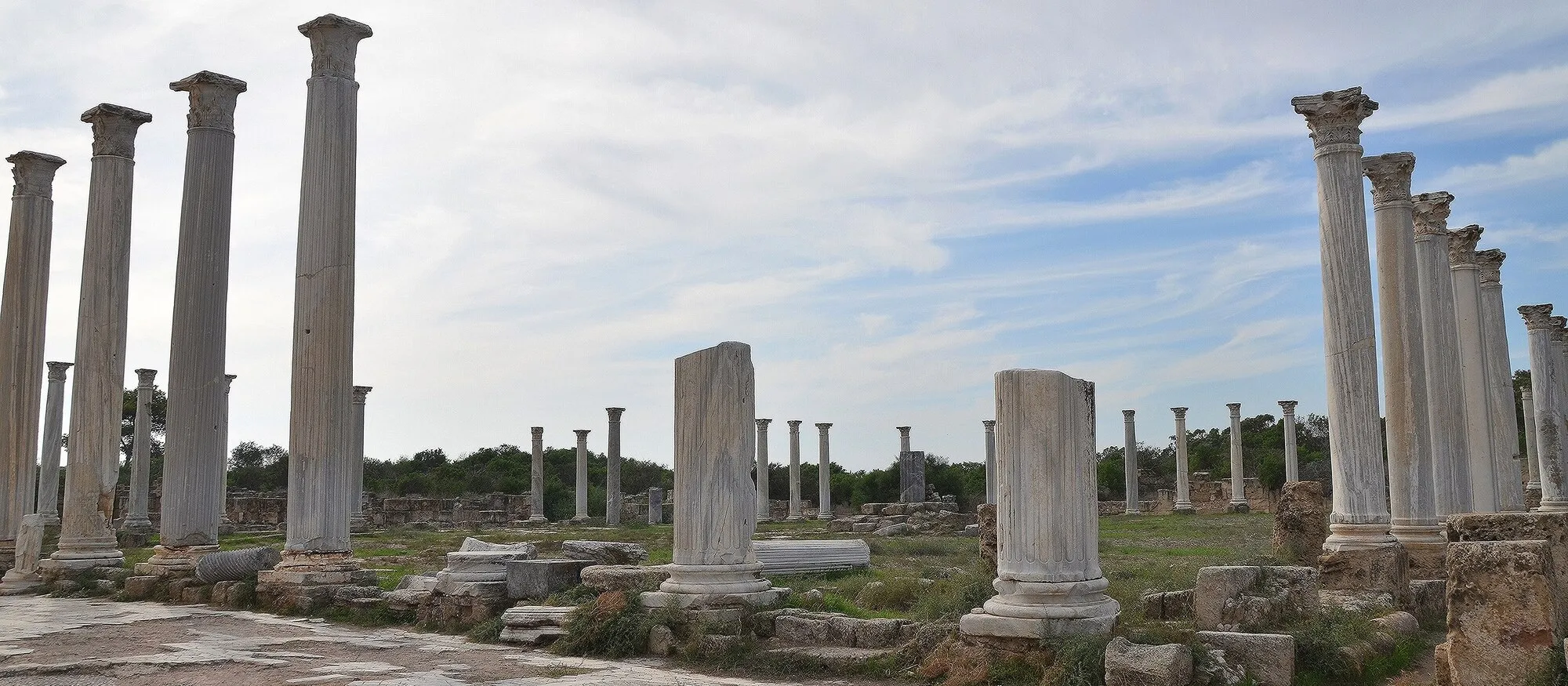
Salamis is the largest ancient city in Cyprus, a spread of Greek, Roman and early Christian ruins on the coast about 6 km north of Famagusta. Until 31 October 2026 it opens daily from 08:00 to 19:00 (last entry 18:00), and a full ticket costs 150 Turkish lira, about £2.30. Allow two hours. The neighbouring Royal Tombs are listed as closed this year, which most guides have not caught up with.
Salamis was one of the city-kingdoms of ancient Cyprus and, for long stretches, its most important city. What you see today is mostly Roman and Byzantine: a colonnaded gymnasium, baths, a theatre for 15,000 people and two great basilicas, spread over about a square mile of scrub running down to the sea. It lies in the north, under Turkish Cypriot administration, so from Protaras, Ayia Napa or Larnaca you cross the Green Line to get there. This guide covers the official hours and prices, which nearby sites are actually open, the drive and what to see once you are inside.
Salamis at a glance
| Where | East coast, 6 km north of Famagusta, Famagusta district, northern Cyprus |
| Hours, 1 Apr to 31 Oct 2026 | 08:00 to 19:00, daily, last entry 18:00 |
| Ticket, summer 2026 | 150 TL full, 50 TL student |
| Run by | Department of Antiquities and Museums (Eski Eserler ve Müzeler Dairesi) |
| Currency | Turkish lira |
| Time to allow | About 2 hours |
| From Fig Tree Bay | 29.6 km, about 40 minutes plus the checkpoint |
| Reviews | 4.4 on Tripadvisor (1,374) |
Tickets and opening hours in 2026
The figures come from the visiting-hours page of the Turkish Cypriot Department of Antiquities and Museums, which runs the site. The summer schedule covers 1 April to 31 October 2026. A full ticket is 150 lira and a student ticket 50 lira, the same price as Bellapais Abbey and Kyrenia Castle. At the European Central Bank reference rate on 9 October 2026, 150 lira is about £2.31 or €2.72. Our guide to money in Cyprus explains why the north uses a different currency from the south.
The same page lists every antiquities site around Famagusta, and it shows something no page-one guide mentions: the Salamis area is not one ticket and not one timetable.
| Site near Salamis (summer 2026) | Hours | Last entry | Full ticket |
|---|---|---|---|
| Salamis ruins | 08:00 to 19:00, daily | 18:00 | 150 TL |
| St Barnabas Icon and Archaeology Museum | 08:00 to 18:00, daily | 17:00 | 150 TL |
| Royal Tombs | Closed | ||
| Enkomi (Engomi) | 08:00 to 15:30, weekdays only | 15:00 | 100 TL |
| Othello Castle, Famagusta | Closed for restoration | ||
| Namık Kemal Museum, Famagusta | 08:00 to 15:30, weekdays only | 15:00 | 100 TL |
Three things follow from that table:
- The Royal Tombs are off the itinerary. Tour listings and older guides still send you there after the ruins. The department gives no reason and no reopening date, so treat them as closed unless the official page changes.
- Salamis plus St Barnabas costs 300 lira, about £4.60, because the monastery museum is a separate ticket.
- Enkomi only works on a weekday. The Bronze Age city a few kilometres inland closes at weekends and on public holidays, and stops admitting visitors at 15:00.
Two dates matter for an October visit. The summer schedule ends on 31 October, and the winter 2026 to 2027 hours had not been posted when we checked on 12 October, so confirm them before a November trip. The clocks go back on 25 October. By our calculation, sunset at Salamis falls at 18:13 on 12 October, 17:58 on 24 October and 16:57 on 25 October. In the last week of the summer schedule, last entry at 18:00 is an hour after dark, so arrive by early afternoon. Our Cyprus time zone guide has the details.
What to see
The modern entrance is at the northern end of the site, next to the Roman civic centre, so the most impressive ruins come first. The north’s official tourism site, visitncy.com, suggests a good two hours.
The gymnasium. The photograph above shows its palaestra, the colonnaded courtyard where athletes trained, with tall marble columns around it and a display of statues, most of them missing their heads. In one corner is a semicircular communal latrine with room for 44 people, which tends to get more photographs than the statues.
The baths. Beside the gymnasium are the Roman baths, part of the same northern complex that also held an amphitheatre and a stadium. Look for the remains of the underfloor heating and fragments of decoration.
The theatre. Built in the reign of Augustus, it held up to 15,000 spectators according to Wikipedia’s Salamis article. It was badly damaged in the 4th century and has been extensively restored, so it is the easiest building on the site to picture in use.
The southern ruins. A longer walk south takes you to the remains of the basilica of St Epiphanios, the bishop of Salamis from 367 to 403, who is buried at its southern apse; the Kampanopetra basilica; a large Byzantine cistern known as the Vouta, which was fed by an aqueduct from Kythrea; the agora; and the Temple of Zeus, which has barely been excavated. This half of the site is quieter, flatter and has almost no shade.
Wear proper shoes, carry water and a hat, and expect rough paths rather than walkways. The area around the gymnasium and theatre is reasonably level, but much of the rest is uneven ground.
A short history
According to tradition, Salamis was founded after the Trojan War by Teucer, an exile from the Greek island of the same name, which is why the bare search term brings up both places. Archaeologists date the city to around the 11th century BC. Over the next thousand years it was ruled in turn by Assyria, Egypt, Persia, the Ptolemies and Rome.
It has a place in the New Testament too. In Acts 13, Paul and Barnabas land at Salamis on their first missionary journey and preach in its synagogues. Barnabas was a Cypriot, and tradition holds that he was later killed at Salamis and buried nearby. He is regarded as the founder of the Church of Cyprus.
Earthquakes in the 4th century AD wrecked the city, and it was rebuilt under Emperor Constantius II and renamed Constantia. It remained the island’s leading city and seat of its leading bishop until the Arab raids of the 7th century, after which its people moved south to what became Famagusta. Systematic excavation ran from 1952 until 1974, when the war stopped it. Many of the best finds, including some of the Salamis statues, are in the Cyprus Museum in Nicosia, in the south.
Getting there
From a holiday in the south, the usual route is the Deryneia crossing, which takes cars and pedestrians. From there you drive round the edge of Famagusta and north up the coast road. Our Green Line crossing guide covers documents, which crossings take cars and what you can bring back.
These times come from the OSRM routing engine and run to the Salamis entrance. They do not include time at a checkpoint, which can range from a few minutes to much longer in summer.
| Starting point | Distance | Drive time (no queue) |
|---|---|---|
| St Barnabas monastery | 3.5 km | 8 min |
| Famagusta walled city | 10.3 km | 16 min |
| Ayia Napa | 27.5 km | 38 min |
| Protaras (Fig Tree Bay) | 29.6 km | 40 min |
| Nicosia, Ledra Palace crossing | 58.0 km | 1 hr 1 min |
| Larnaca Airport | 63.4 km | 1 hr 9 min |
| Kyrenia harbour | 76.6 km | 1 hr 16 min |
| Limassol old port | 116.8 km | 1 hr 53 min |
| Paphos harbour | 185.4 km | 2 hr 47 min |
By hire car. The UK Foreign Office warns that cars hired in the Republic often have no insurance cover in the north. Check your rental contract allows the trip before you buy insurance at the crossing; our car hire guide explains what to look for.
On a tour. Day trips from Protaras and Ayia Napa often combine Salamis with Famagusta’s walled city and Varosha, and handle the crossing for you. From Limassol or Paphos a tour is the least tiring option.
Your phone. North of the line your handset may join a Turkish network, where EU roaming caps do not apply. Our phone guide explains how to avoid a surprise bill.
Combining Salamis with Famagusta
Salamis, St Barnabas and Famagusta fit comfortably into one day from the east coast. A sensible order is Salamis at 08:00 while it is cool, St Barnabas on the way back (it closes an hour earlier), then lunch and the walled city in Famagusta in the afternoon. The fenced resort quarter of Varosha sits just south of the old town; our Famagusta ghost town guide covers what is open inside and the rules. If you are staying in Protaras, that makes a full day with only one crossing.
Is it worth it?
Yes, if you have any interest in the ancient world. Salamis is bigger and less crowded than the Greco-Roman sites in the south, and the ticket costs less than a coffee. It compares well with Kourion near Limassol, which has the better clifftop setting, and the Paphos Archaeological Park, which has the better mosaics. Salamis wins on scale and on the gymnasium. It suits people with limited mobility less well, because the paths are rough, and it is hard to justify as a single stop from Paphos. If you are still weighing up how much of the north to see, our north or south Cyprus guide sets out the bigger picture.
Sources for changing details: Hours, ticket prices and site status from the Turkish Cypriot Department of Antiquities and Museums, checked 12 October 2026; site layout and visiting time from visitncy.com; history from Wikipedia’s Salamis, Cyprus article; exchange rate from the European Central Bank reference rate on 9 October 2026; drive times from OSRM; sunset times calculated for the site’s coordinates; hire-car advice from the UK Foreign Office. Confirm hours locally before you travel.
Hero photo: the palaestra of the gymnasium at Salamis, October 2015, by Carole Raddato, via Wikimedia Commons, licensed under CC BY-SA 2.0. Cropped.

Quick answers
Frequently asked questions
Can you visit Salamis in Cyprus?
Yes. Salamis is an open archaeological site about 6 km north of Famagusta, in the north of Cyprus under Turkish Cypriot administration. From 1 April to 31 October 2026 it opens daily from 08:00 to 19:00, with last entry at 18:00. Visitors staying in the Republic can reach it by crossing the Green Line, usually at Deryneia, with a passport or EU ID card.
How much does it cost to visit Salamis?
A full ticket costs 150 Turkish lira and a student ticket 50 lira in the 2026 summer season, according to the Turkish Cypriot Department of Antiquities and Museums. That is about 2.30 pounds or 2.70 euros at the 9 October 2026 exchange rate. The St Barnabas monastery museum nearby is a separate 150 lira ticket.
Are the Royal Tombs at Salamis open?
Not in summer 2026. The Department of Antiquities and Museums lists the Royal Tombs as closed on its official visiting-hours page and gives no reopening date. Many guides and tour listings still describe them as part of a Salamis visit, so check the official page before planning around them.
How long do you need at Salamis?
Allow about two hours for the main ruins, which is what the north's official tourism site recommends. The gymnasium, baths and theatre are near the entrance; the basilicas, the cistern and the Temple of Zeus are a longer walk south. Add half an hour if you also visit the St Barnabas monastery across the main road.
Where is Salamis in the Bible?
Salamis appears in Acts 13, where Paul and Barnabas land on their first missionary journey and preach in the synagogues. Barnabas was a Cypriot, and tradition says he was later killed at Salamis and buried nearby. The monastery that bears his name stands about 3.5 km from the ruins.