Famagusta district · 6.5 km west of Ayia Napa centre
Ayia Thekla Beach, Cyprus: the chapel, the bus and the quiet end of Ayia Napa
Ayia Thekla Beach is a 300 m natural sandy beach at Sotira, 6.5 km west of Ayia Napa, named after the white seaside chapel beside it. It holds a 2026 Blue Flag, has lifeguards from April to October and sits on OSEA bus routes 501 and 502. Facilities, the chapel, drive times, buses and when to go.
- Filed under
- Places
- Updated
- 31 October 2026
- By
- The editors
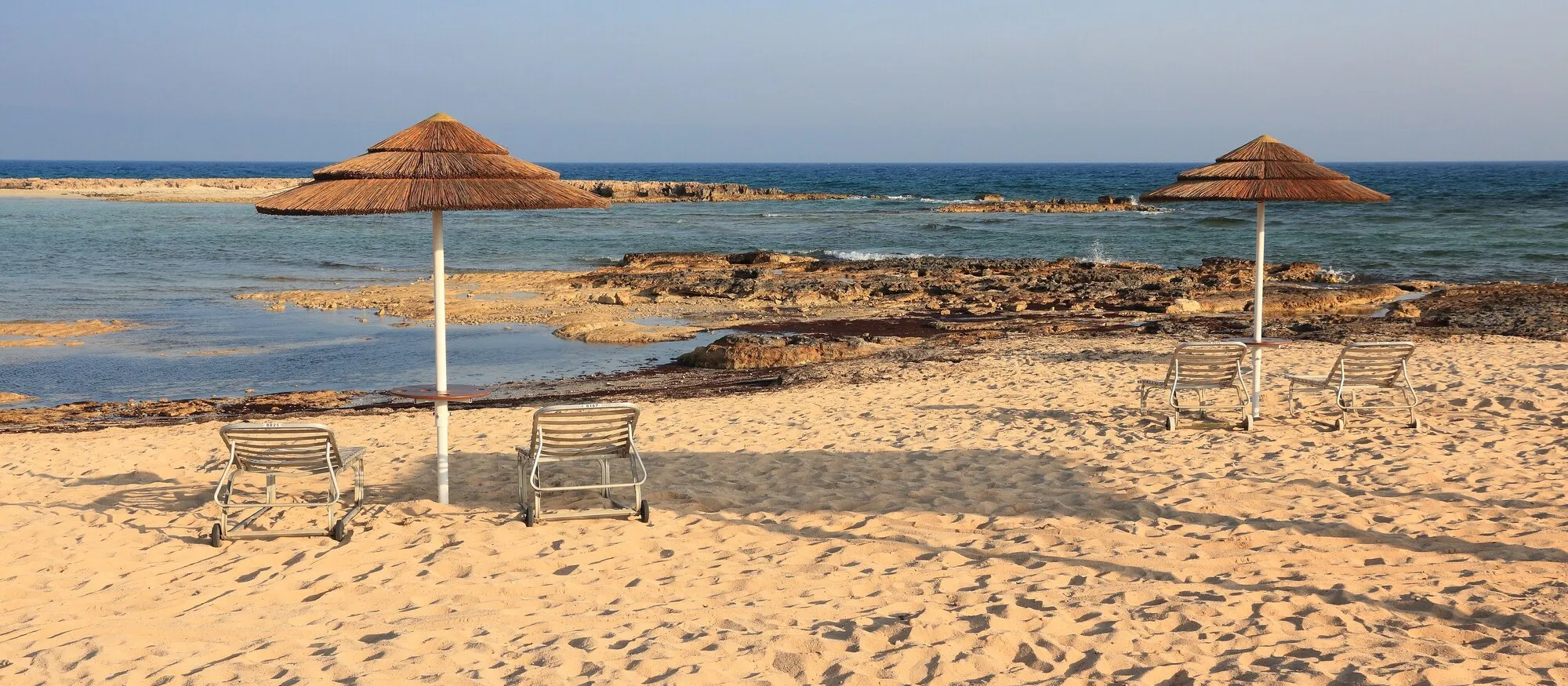
Ayia Thekla Beach is a 300-metre natural beach of fine golden sand, 6.5 km west of the centre of Ayia Napa, named after the small white and blue chapel of Saint Thekla on the shore beside it. It holds a Blue Flag for 2026, has lifeguards from April to October, sunbeds, umbrellas, toilets and a seaside taverna, and OSEA buses 501 and 502 stop at the entrance. Choose it when you want the Ayia Napa coast without the Ayia Napa crowds.
It is the last of the resort’s sandy beaches before the coast turns rocky towards Potamos tou Liopetriou, and it feels like it. There is no strip of bars behind the sand, the hotels are a few kilometres east, and the view is of a rock shelf, a turquoise lagoon and the open sea.
Ayia Thekla Beach at a glance
| Where | Sotira, Ayia Napa municipality, Famagusta district |
| Distance | 6.5 km west of Ayia Napa centre (Visit Cyprus) |
| Length | About 300 m |
| Sand | Fine golden sand over a rocky bottom, rock shelves in the shallows |
| Water | Clear and relatively calm |
| Blue Flag | Yes, 2026 |
| Lifeguards | April to October, with a special wheelchair at the tower |
| Facilities | Toilets, changing rooms, sunbeds, umbrellas, watersports, parking |
| Food | Nissaki Ayias Theklas taverna behind the beach |
| Bus | OSEA 501/502, stops Agia Thekla Beach 1 and 2 |
| Best for | A quiet swim, couples, sunset, families who will watch the rocks |
What the beach is like
Visit Cyprus, the official tourism site, describes Ayia Thekla as a natural beach with a rocky bottom covered in fine golden sand and crystal-clear, relatively calm water. That combination is what makes it different from its neighbours. Nissi and Makronissos are soft sand all the way in; at Ayia Thekla, flat slabs of brown rock break the surface in the shallows, and a low islet sits just offshore. Nissaki, the name of the taverna behind the beach, means “little island”.
The rock shelf does two jobs. It takes the edge off the swell, so the water between the sand and the rocks is often a still, shallow lagoon that suits paddling. It also means you should bring water shoes, watch where you put your feet and keep toddlers on the sandy patches rather than the slippery rock. Outside the shelf you are in open sea, so check the lifeguard flag before a longer swim.
The whole beach sits inside a Special Protection Area of the EU’s Natura 2000 network, which is one reason the shore behind it has stayed low-rise. Visit Cyprus lists toilets, changing rooms, sunbeds, umbrellas and watersports on the beach, a convenience store close by and restaurants and kiosks in the area. Lifeguards with first aid are on duty from April to October, and the lifeguard tower keeps a special wheelchair so that visitors with reduced mobility can be helped into the sea.
Agia Thekla is on CYMEPA’s official 2026 Blue Flag list, the 13th of 13 beaches under Ayia Napa. That is worth explaining, because the knowledge panel and the Tripadvisor pages disagree about where it is. The beach is in the Sotira community, and Sotira is now part of the enlarged Ayia Napa municipality, so “Sotira”, “Ayia Napa” and “Ayia Thekla” in different listings all describe the same place.
The chapel of Saint Thekla
The beach is named after Saint Thekla, and Visit Cyprus says the name belongs to two buildings beside it: a temple carved into the rock and a new white church. The new chapel is the one in every photograph, a whitewashed building with blue trim, a low dome, a bell tower and an arcade of arches facing the sea on a gravel headland just above the sand. The older rock-cut chapel is nearby on the same stretch of coast.
Thekla is one of the early saints most honoured in the Orthodox Church, which keeps her feast on 24 September. The chapel is a working place of worship rather than a monument, so there are no published opening hours: if the door is open, go in with shoulders and knees covered and leave the beach towel outside. Weddings are held here and at the venues along this shore, so be ready to wait a few minutes if a ceremony is under way.
Food, drink and the neighbouring beaches
Nissaki Ayias Theklas is the restaurant directly behind the beach. It is listed in the Cyprus Deputy Ministry of Tourism’s official gastronomy directory at Agia Thekla, 5390 Sotira (telephone 23 821 568), and the district tourism board, Visit Famagusta, describes it as a seaside taverna with direct beach access that also hosts wedding receptions. That last detail is useful: on a wedding day the terrace may be closed to walk-in diners, so ring ahead if lunch there is the plan.
Visit Famagusta groups Ayia Thekla with two smaller neighbours, Poseidon Beach in Sotira, a quieter cove backed by rocks with the Pagida Seaside bar and restaurant, and Sirens Beach just outside Sotira, a small sandy bay with its own wedding venue. Both are worth knowing about if Ayia Thekla’s loungers are full, but check facilities before you go, because the district board does not list lifeguards for Sirens.
Visit Cyprus also points to a pedestrian path along the shore, west to the fishing shelter of Potamos tou Liopetriou, a narrow river inlet lined with boats and fish tavernas, and east towards the Ayia Napa beaches. Potamos is 5.6 km by road but only about 3.5 km along the coast, and walking there for a fish lunch is the best half-day at this end of the resort.
How to get there
By car. From Ayia Napa, take Nissi Avenue west past Nissi, Landa and Makronissos, continue past WaterWorld along Agias Theklas Avenue, and the beach is on the left at the end of the resort strip. From Larnaca or the airport, leave the A3 motorway at the Ayia Napa exit and head for WaterWorld. There is a car park at the beach. Drive times from OSRM routing on OpenStreetMap data, retrieved 31 October 2026:
| From | Distance | Drive time |
|---|---|---|
| WaterWorld | 1.0 km | 2 min |
| Makronissos Beach | 2.6 km | 5 min |
| Nissi Beach | 3.7 km | 7 min |
| Potamos tou Liopetriou | 5.6 km | 7 min |
| Ayia Napa harbour | 7.0 km | 14 min |
| Fig Tree Bay, Protaras | 19.3 km | 22 min |
| Larnaca Finikoudes | 37.3 km | 37 min |
| Larnaca Airport | 49.4 km | 40 min |
Ayia Thekla is the closest Ayia Napa beach to Larnaca, so it is a good first or last swim if you are flying in or out. Our Larnaca Airport to Ayia Napa guide covers the shuttle, bus and taxi options, and our driving in Cyprus guide has the rules of the road.
By bus. This is the detail most guides miss. The busy OSEA coast routes 101 and 102 do not reach the beach: they terminate at WaterWorld, at the stop called Agias Theklas - Waterpark, about 1 km short by road. The routes that do stop at the beach are 501 and 502, a 90-minute loop between Deryneia, Frenaros, Liopetri, Agia Thekla Beach, Ayia Napa Marina, WaterWorld, Ayia Napa, Paralimni and Famagusta Hospital. The stops are named Agia Thekla Beach 1 and 2, with a string of Agia Thekla Tourist Area stops along the coast road either side.
The summer timetable, valid every day from 25 May to 31 October 2026, showed 17 departures a day on the 501 from Deryneia (05:55 to 03:30) and 17 on the 502 in the other direction (07:00 to 00:30). There is also a 510 that runs from Famagusta Hospital via Paralimni and Ayia Napa to Agia Thekla Beach at 05:45 and 07:05, returning at 15:25. A winter timetable replaces these from 1 November and had not been published on OSEA’s routes page on 31 October, so check osea.com.cy or the OSEA Live Arrivals app before you travel.
Fares, printed on the timetable: a single is 2 euros between 04:00 and 21:00 and 3 euros at night, a day ticket 6 euros, five days 20 euros and seven days 25 euros. Pay the driver in cash. Our public transport in Cyprus guide explains how the regional bus companies fit together.
When to go
The Meteorological Service’s Paralimni station, the nearest with published normals, averages a daily maximum of 33.3°C in August, 31.2°C in September and 27.7°C in October, and the official climate table gives an average sea temperature of 27°C in September and 25°C in October. That makes September and October the best months at Ayia Thekla: the water is at its warmest, the lifeguards are still on duty and the beach is quieter than in high summer. June is also good, with the sea at 24°C and the longest evenings.
In July and August arrive before 11:00 for a lounger, or after 16:00 and stay for the evening; Visit Famagusta singles out the sunset views from the taverna terrace. Sunset at Ayia Thekla is about 20:01 on 21 June and 18:28 on 1 October, then, after the clocks went back on 25 October, 16:49 on 1 November and 16:38 by mid-November.
From November to March the beach is empty, the lifeguards and sunbeds are gone and the sea falls to 22°C in November and 19°C in December. It is still a lovely walk, and the chapel and Potamos tavernas make it a good winter outing. Our Cyprus in November guide and Cyprus sea temperature guide have the month-by-month detail.
Is Ayia Thekla Beach worth it?
Yes, if you want a quiet swim and do not mind sharing the shallows with rock. It has the Blue Flag, lifeguards and loungers of the big Ayia Napa beaches, a better setting than any of them, a taverna on the sand and a good sunset, with none of the music. The trade-offs are real: it is small, the rock shelf needs care with children, the bus service is thinner than on Nissi Avenue, and on a summer Saturday you may share it with a wedding party.
Families who want soft sand all the way in should look at Makronissos Beach, 2.6 km east, or the Nissi Beach guide. For the whole resort coast compared, read our Ayia Napa beaches guide; for the island picture, our best beaches in Cyprus; and for everything beyond the sand, things to do in Ayia Napa and our WaterWorld Ayia Napa guide, a two-minute drive away.
Sources for changing details: Beach description, length, distance, facilities, lifeguard season, Natura 2000 status, the chapels and the coastal path from Visit Cyprus. Nissaki Ayias Theklas listing from the Visit Cyprus gastronomy directory; Poseidon and Sirens beaches from Visit Famagusta. Blue Flag 2026 list from CYMEPA. Bus routes, stop names, the 25 May to 31 October 2026 timetables and fares from OSEA. Drive times from OSRM routing on OpenStreetMap data. Climate normals for Paralimni from the Meteorological Service (Cyprus) table reproduced on Wikipedia’s Climate of Cyprus page; sea temperatures from the Deputy Ministry of Tourism’s 2011 to 2020 climate table. Sunset times calculated for 34.98N 33.93E. All checked 31 October 2026; confirm hours, timetables and prices before you travel.
Hero photo: sandy beach of Ayia Thekla, Sotira, by Marek Ślusarczyk (Tupungato), via Wikimedia Commons, licensed CC BY 3.0. Cropped for the header.

Quick answers
Frequently asked questions
Where is Ayia Thekla Beach?
On the south coast of Cyprus at the western end of the Ayia Napa resort coast, in the Famagusta district. Visit Cyprus puts it 6.5 km west of the Ayia Napa centre. It lies in the Sotira community, which is part of the enlarged Ayia Napa municipality. By road it is about 1 km from WaterWorld, 2.6 km from Makronissos, 7 km from Ayia Napa harbour and 49 km, around 40 minutes, from Larnaca Airport.
Is Ayia Thekla Beach sandy?
Yes. Visit Cyprus describes it as a natural beach with a rocky bottom covered in fine golden sand and relatively calm, clear water. Flat shelves of rock run through the shallows in places, so water shoes help, and the rocks break the swell to leave calm pools that suit paddling.
Does Ayia Thekla Beach have a Blue Flag in 2026?
Yes. Agia Thekla is on CYMEPA's official 2026 Blue Flag list as one of 13 beaches under Ayia Napa, alongside Nissi, Makronissos, Landa, Konnos and the others. Lifeguards are on duty from April to October, so from November swimming is unsupervised.
Can you get to Ayia Thekla Beach by bus?
Yes. OSEA routes 501 and 502 stop at Agia Thekla Beach 1 and 2 on a loop between Deryneia, Liopetri, Ayia Napa and Paralimni. The summer timetable ran 17 departures a day each way until 31 October 2026. The busier 101 and 102 coast routes end at WaterWorld, about 1 km away by road. A daytime single is 2 euros and a day ticket 6 euros.
Is there somewhere to eat at Ayia Thekla Beach?
Yes. Nissaki Ayias Theklas, a restaurant listed by the Cyprus Deputy Ministry of Tourism, sits directly behind the beach and also hosts wedding receptions. Visit Cyprus notes a convenience store close by and other restaurants and kiosks in the area.