Larnaca · A winter wetland beside the airport
Larnaca Salt Lake: when to see flamingos, where to walk and what to expect
Larnaca Salt Lake is a protected wetland with a 4 km nature trail and winter flamingos. When to go, where the trail starts, what summer looks like and how to visit without disturbing wildlife.
- Filed under
- Places
- Updated
- 5 September 2026
- By
- The editors
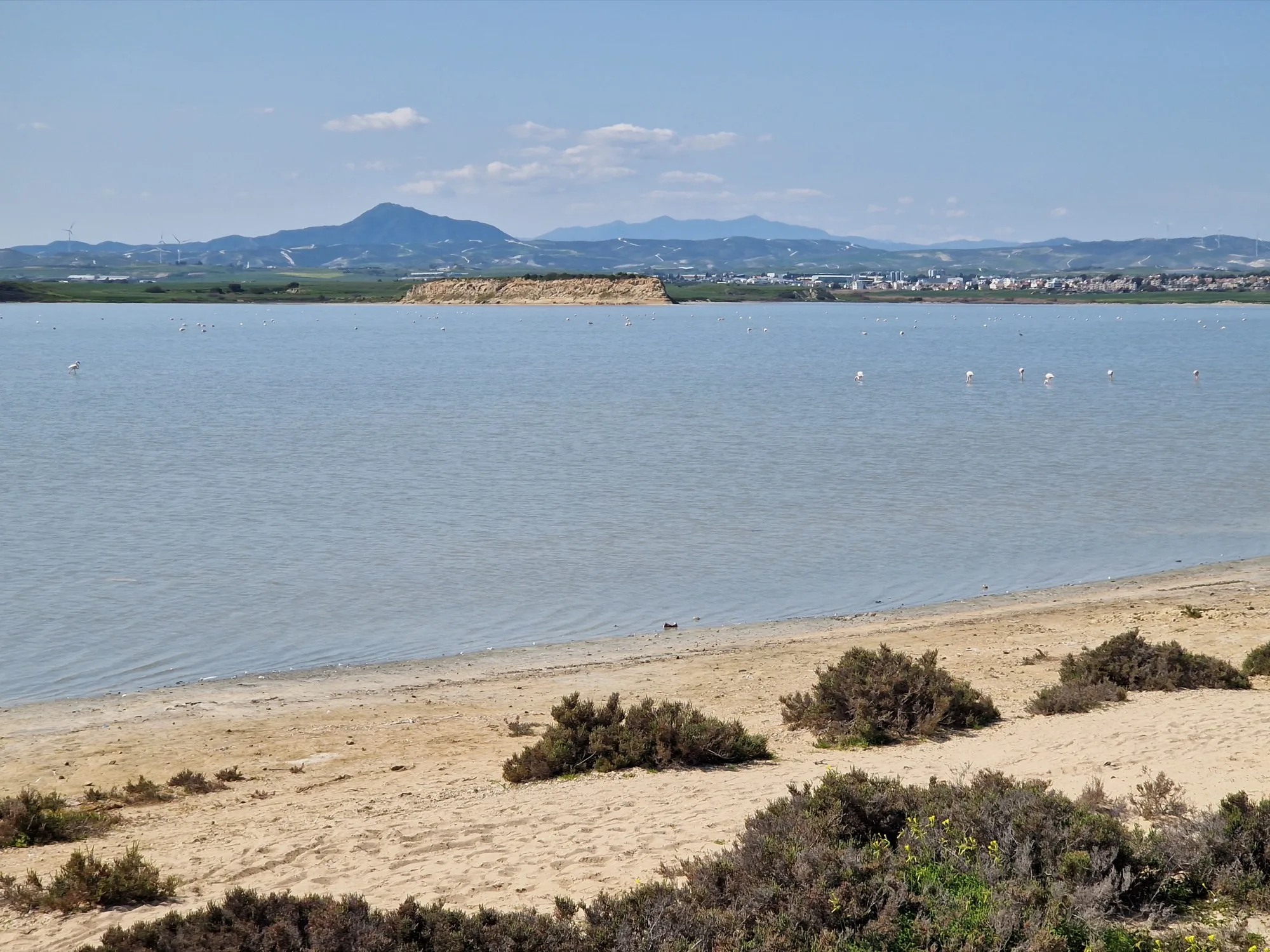
Larnaca Salt Lake is worth a detour in every season, but it is only the flamingo spectacle you expect between roughly November and March. In winter, rain refills this protected wetland southwest of the city and migratory birds gather on it; in summer, the salt flat, path and nearby monuments are still there, but the water and birds may not be. Plan it as a short nature-and-walk outing, not as a guaranteed close-up wildlife encounter.
That distinction is the useful one. The lake is beside the airport and frequently gets sold as a quick pink-photo stop. It is actually a complex of four lakes, a Ramsar and Natura 2000 wetland, and a place where the conditions decide the show. If birds are your priority, give it a winter morning and leave the flock room. If your trip is in summer, go for the landscape and combine it with the trail rather than chasing flamingos that have moved on.
For the broader city plan, start with our guide to things to do in Larnaca. This page is for deciding whether the salt lake itself belongs in that plan.
Larnaca Salt Lake at a glance
| What to know | The practical answer |
|---|---|
| Where it is | Southwest of Larnaca, near the old airport area and Hala Sultan Tekke |
| What it is | A complex of four lakes; the main lake is known locally as Aliki |
| Best time for flamingos | Winter, typically November to March, subject to rainfall and water levels |
| What happens in summer | The lake can be dry; go for the landscape and trail, not a bird guarantee |
| The pink water | A brief June–July phenomenon caused by salt-loving algae, not the flamingos |
| Nearby mosque | Hala Sultan Tekke on the west bank, free entry, hours change on 16 September |
| Walking route | A designated 4 km linear nature trail towards Kamares Aqueduct |
| Wildlife rule | Watch from the path or viewing areas; do not enter the lake or fly a drone over birds |
| Best fit | A 60–90 minute stop, longer if you add the trail or nearby sites |
The official tourism portal gives the main lake complex an area of 2.2 square kilometres and calls it Cyprus’s second-largest salt lake. It also explains the name you will see locally: Alyki. The surrounding system includes Orphani, Soros and Airport Lake. That is why a map label can make it look like one large visitor attraction when it is really a working wetland landscape with roads, paths and different viewing distances.
Go in winter for birds, not a promise
Visit Cyprus says the lake fills in winter and hosts migrating birds, including flamingos, between November and March. BirdLife Cyprus gives a slightly tighter rule of thumb (arrival in November and departure by the end of February) and adds the important caveat: water levels matter. In a wet year, some birds can stay longer; in a dry one, the number and position of birds can be very different.
So use the calendar like this:
| Your timing | What to plan for |
|---|---|
| November–February | The strongest chance of water and flamingos; keep the itinerary flexible |
| March | Still a reasonable birdwatching month, but do not assume peak numbers |
| April–October | A dry, salt-flat landscape is normal; walk and history may be the point instead |
The lake’s food web helps explain the uncertainty. The brine shrimp Artemia salina is the base of the food chain here, and Visit Cyprus is explicit that when the birds cannot find it they abandon the lake and move on to Akrotiri near Limassol or continue south towards Africa. It is much better to say “winter is the right window” than to claim that a visitor will see thousands of flamingos on a particular date.
It is also worth knowing the real scale, because a lot of pages quote a single headline count from a good year. Nikos Kassinis, senior officer at the Game and Fauna Service, told the Cyprus Mail in December 2025 that on average 5,000 to 10,000 birds winter in these wetlands, and that numbers have fallen by somewhere between 14% and 31% since 2013. He attributed the decline to repeated droughts, poorer-quality water inflows reducing the available food, and development pressure around the wetlands. That is a more honest expectation to travel with than the 15,000-bird figure still circulating from a decade ago.
Bring binoculars if birds matter to you. A phone zoom can record a view but it should not dictate how close you get. Larnaka Region Tourism specifically says wading into the lake is prohibited because the birds are sensitive to disturbance. Stay on the marked route, give the flock a wide berth, and leave the drone at home. BirdLife Cyprus makes the same point: entering the lake for a closer photograph disrupts feeding and rest.
The 4 km walk: choose a direction before you arrive
The official listing describes a 4 km designated linear nature trail through the lake area towards the old Kamares Aqueduct, with plant information and benches along the way. “Linear” matters: this is not a neat loop that deposits you back beside your car. Decide whether you want to walk a section and turn back, arrange a second vehicle, or use it as a link between two sights.
Larnaka Region Tourism identifies two starting points: one by Kamares Aqueduct, and one at the salt-collection plateau on Artemis Avenue towards the old airport, 150 metres after the District Judicial Court. That makes the route flexible, but it also means you should save the precise start you intend to use in your map app before leaving the city.
This is a low-key walk rather than a hike. Water, sun protection and comfortable shoes are more useful than special gear, particularly when there is no shade. In winter, add a layer for an exposed, breezy path; in summer, do not treat the open salt landscape as a casual midday stroll. For island-wide trail grades and weather planning, see our hiking in Cyprus guide.
The aqueduct is a worthwhile reason to use the northern end of the path, but do not turn the day into an endurance test just to complete a line on a map. A shorter out-and-back from the point that gives you the clearest, least disruptive view of the lake is often the better visit.
What else to pair it with
Hala Sultan Tekke. The mosque stands on the western bank of the lake and makes the most natural cultural pairing. It was built in stages between 1760 and 1817 over the grave of Umm Haram, who died on Cyprus during the Arab raids of the 640s, and it is one of the most revered sites in the Muslim world as well as a working place of worship. Entry is free, and the Deputy Ministry of Tourism lists it as open all year except Christmas Day, New Year’s Day and Greek Orthodox Easter Sunday.
Its hours change on a fixed date rather than gradually, which is the one detail most guides leave out:
| Period | Daily opening hours |
|---|---|
| 16 April – 15 September | 08:30 – 19:30 |
| 16 September – 15 April | 08:30 – 17:00 |
If you are visiting in the second half of September, that matters: the site loses two hours of afternoon opening overnight on 16 September, while the light for photographing the lake is still good until well after 17:00. Plan the mosque first and the lake afterwards. Treat it as a religious site rather than a tourist attraction: dress respectfully, and expect access to be shaped by worship.
Kamares Aqueduct. The northern trail connection gives a simple way to join the wetland landscape to one of Larnaca’s Ottoman-era landmarks. It makes most sense if you enjoy walking or have a car waiting at the other end; it is not necessary for a first-time flamingo visit.
Mackenzie or Finikoudes. If you are building a half-day around the airport side of Larnaca, continue to the coast for lunch or a swim. Our Larnaca beaches comparison explains the difference between Mackenzie’s long, restaurant-backed strip and the central Finikoudes beach.
A stopover itinerary. The lake is close enough to the airport to be tempting on arrival or departure day, but luggage and an early flight make it less relaxing than it sounds. If you need to cross the island after landing, use our Larnaca Airport transfer guides to plan the onward trip first; add the lake only when the timings genuinely leave room.
Is it worth it in summer?
It can be, but reset the reason. In summer, the lake is often a pale, dry expanse rather than a sheet of water. That is part of a seasonal salt lake’s character, not evidence that you have gone to the wrong place. The 4 km route, views towards the Tekke and the aqueduct connection still give the outing a point, and the open setting is particularly good for people who prefer a quiet walk to another organised beach.
There is also a summer spectacle that has nothing to do with flamingos, and it is the reason the lake keeps appearing in social feeds in June and July. As the water evaporates and salinity climbs, salt-loving microbes and algae multiply and the remaining water turns pink. The Cyprus Mail reported the lake turning pink again on 28 June 2026, describing rising temperatures and salinity creating ideal conditions for the algae and brine shrimp that give the water its colour. It is the same pigment story as the birds, running in reverse: flamingos are pink because they eat these organisms.
The catch is that it is brief and unpredictable. The phenomenon lasts only a few weeks, and it depends on how hot and how dry the season has been, so it is not something you can book a flight around. Treat it as a reason to check recent local photographs before a June or July visit rather than a fixture of the calendar.
It is not worth a special cross-island drive solely for flamingos at that time of year. If your holiday is based in Paphos, Limassol or the southeast resorts, choose it only as part of a wider Larnaca day. Visitors staying in town have a much easier decision: it is a compact contrast to the promenade, beaches and the historic centre covered in our Larnaca Old Town guide.
A respectful, realistic visit
The best version of Larnaca Salt Lake is unhurried. Go early enough that you can decide on the spot whether the birds, water level and weather make you want to linger. Keep the route short if the sun is strong. Do not wade across the lake, pursue birds for a photograph or fly a drone. And do not treat the word “flamingo season” as a booking guarantee.
That approach respects the reason the site is protected and makes the trip more satisfying: a genuine wetland walk beside a city, with an extraordinary winter bonus when the conditions line up.
Sources for current visitor and wildlife information: Visit Cyprus: Larnaca Salt Lake, Visit Cyprus: Hala Sultan Tekke, Larnaka Region Tourism: Flamingos & Salt Lake, BirdLife Cyprus: Greater Flamingo, Cyprus Mail: First flamingos reach Cyprus, fewer expected this year and Cyprus Mail: Larnaca Salt Lake turns pink. Bird numbers, water levels, trail access, opening hours and religious-site visitor arrangements can change; confirm locally before you travel.
Hero photograph: “Larnaca Salt Lake, Cyprus, view towards mountains, flamingos” by Gerda Arendt, Wikimedia Commons, CC0 1.0.

Quick answers
Frequently asked questions
When can you see flamingos at Larnaca Salt Lake?
Winter is the sensible target. Visit Cyprus says flamingos stay between November and March, while BirdLife Cyprus says they usually arrive in November and leave by the end of February. Rainfall and water levels affect both timing and numbers, so treat the season as a window, not a promise of a particular flock on a particular day.
Is Larnaca Salt Lake worth visiting in summer?
Yes if you want the landscape, the 4 km path, Hala Sultan Tekke or the Kamares Aqueduct; no if flamingos are the only reason for the trip. The lake is seasonal and the migratory spectacle is a winter one, so a dry salt flat in summer is the expected version rather than a disappointing surprise.
Can you walk around Larnaca Salt Lake?
There is an official 4 km linear nature trail through the lake area linking towards the Kamares Aqueduct. Larnaka Region Tourism identifies starting points at Kamares and at the salt-collection plateau on Artemis Avenue. It is a route through a protected wetland, not a permission to walk out across the lake bed.
Where is Larnaca Salt Lake?
It is southwest of Larnaca town, beside the old airport area and close to Hala Sultan Tekke. The wetland lies between the city and the villages of Meneou and Dromolaxia, so it is easy to pair with a Larnaca stopover but is not on the Finikoudes seafront.
Can you go close to the flamingos at Larnaca Salt Lake?
No. Larnaka Region Tourism says wading into the lake is prohibited because it damages and disturbs sensitive birds. Watch from the path or viewing areas, use a zoom or binoculars, and never send a drone over wildlife.