Larnaca · Agios Lazaros, Skala and the streets behind the promenade
Larnaca Old Town: where it actually is and how to walk it
A practical guide to Larnaca Old Town: where the historic centre really begins, what Agios Lazaros, Skala, the castle and Kition are worth, current hours and fees, and a route that fits a half-day.
- Filed under
- Places
- Updated
- 7 September 2026
- By
- The editors
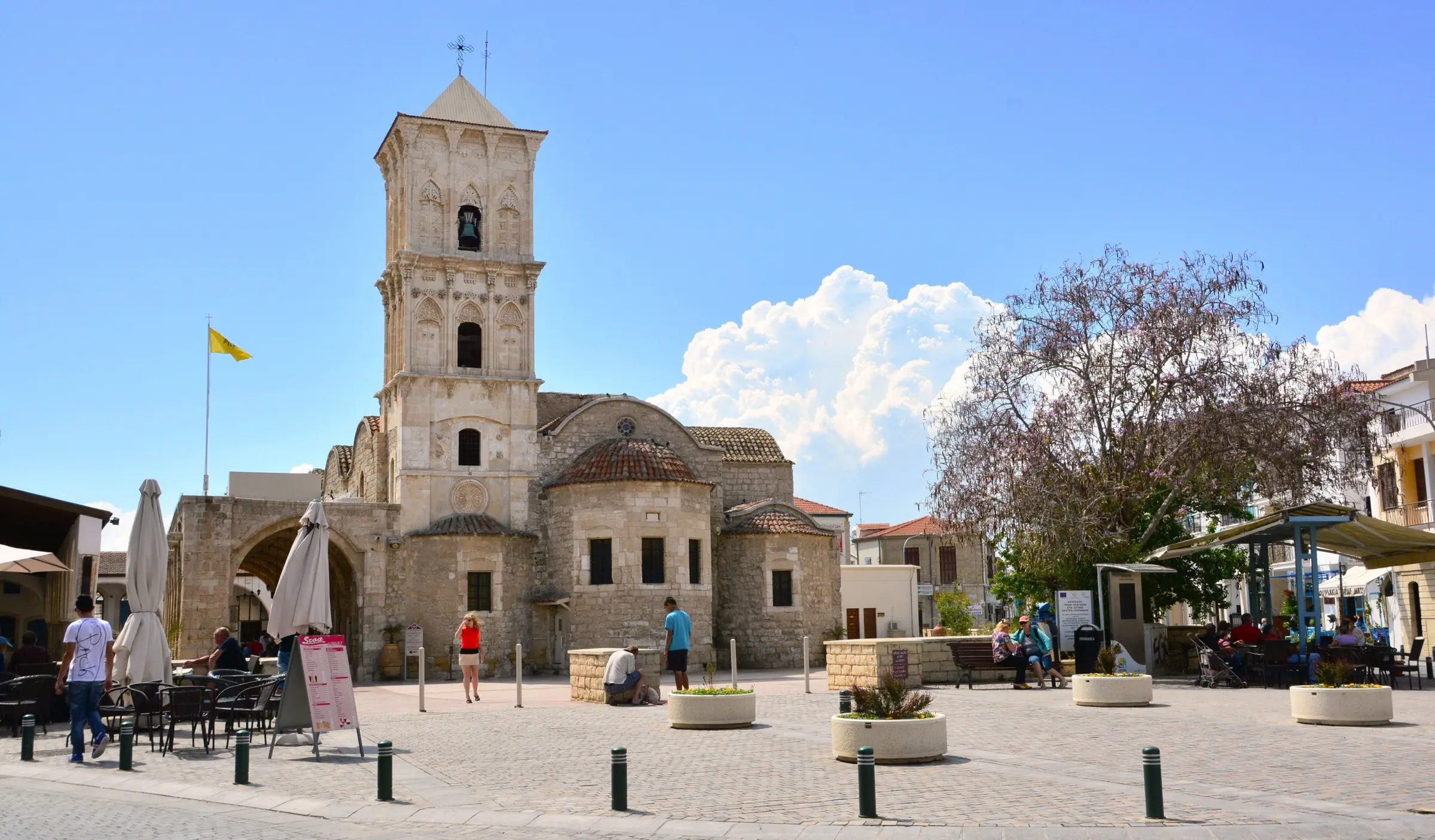
Larnaca Old Town is a two- to three-hour walk, not a day out, and it starts at the Church of Saint Lazarus rather than anywhere on the seafront. The historic centre is the wedge of streets inland from the southern end of the Foinikoudes promenade: the church and its square, the old warehouse lanes behind it, the shops of Zinonos Kitieos and Ermou Square, and the Skala quarter running back towards the castle. Walk that, choose one paid stop, and you have seen the old town properly.
Larnaca does not have an old town in the walled, gated sense, and there is no perimeter to cross. That is why it pays to plan the walk rather than hope to stumble into it, and why so many visitors report that Larnaca’s centre “took twenty minutes”. It takes twenty minutes if you only walk the promenade. This page covers the part behind it. For choosing Larnaca as a base, its food and the wider district, read our guide to things to do in Larnaca.
Larnaca Old Town at a glance
| What to know | The practical answer |
|---|---|
| Where it begins | The square around Agios Lazaros, roughly 300 metres inland from the southern Foinikoudes |
| Sensible time to allow | 2–3 hours for the walk; 4–5 with a museum, the art workshops and lunch |
| The one unmissable stop | The Church of Saint Lazarus, and the Byzantine Museum in the cells beside it |
| The most distinctive quarter | Skala, the historic port district behind Piale Pasha, now home to artists’ workshops |
| Paid stops nearby | Larnaka Medieval Castle (€2.50), Kition archaeological site (€2.50), Pierides Museum (€3) |
| Free guided option | The Larnaka Tourism Board’s Wednesday morning walk, no booking needed |
| The live-detail rule | Every hour and fee below is subject to change without notice, so check the venue before you build a day around it |
Start at Agios Lazaros and give it real time
The Church of Saint Lazarus is the anchor. The Larnaka Tourism Board records it as one of the most remarkable examples of Byzantine architecture in Cyprus, built by the Byzantine Emperor Leo VI in the 9th century and restored in the 17th. The bell tower and arcaded porch are what most people photograph; the interior carving and iconography are the reason to go in.
Official opening hours are seasonal. From 1 March to 31 October the church is generally open daily 08:00 to 18:30, with Sunday hours of 06:30 to 12:30 and 15:30 to 18:30. From 1 November to 28 February the daily pattern narrows to 08:00 to 12:30 and 14:30 to 17:30. That winter afternoon closure catches people out, so a mid-morning start is the safer plan in the cooler months.
The small Byzantine Museum occupies cells in the hypostyle porch to the south of the church and holds icons, gospels, crosses and ecclesiastical pieces from across the Larnaka district. Its listed hours are 08:30 to 12:30 and 15:00 to 17:30, closed on Wednesday and Saturday afternoons and on Sundays. It is a twenty-minute stop, not an hour, and it works best immediately after the church rather than as a separate errand.
Walk the warehouse streets, then the shopping streets
From the church square, the official city route runs back through Pavlou Valsaki and Kleanthi Kalogera Streets, past old warehouse buildings, several converted into venues and galleries. This is the part of Larnaca that rewards looking upwards: doorways, lintels and shutters from the trading town, rather than anything ticketed.
Continue inland and the character changes again. Zinonos Kitieos is the main old shopping street and also where you will find the Pierides Museum, the Bank of Cyprus Cultural Foundation collection, open Monday to Thursday 09:00 to 16:00 and Friday to Saturday 09:00 to 13:00, at €3 for adults and €1 for students. It is one of the oldest private archaeological collections on the island and it is a sensible choice if you want context for Cypriot material culture without a long museum visit.
Ermou Square is the cobbled, fountain-lined café and shopping space nearby, and the Municipal Market, reopened in 2023 on the site of the old agora, sets the traditional and modern versions of Larnaca side by side. Check market days and trading hours before making it the point of the morning.
Skala is the part most visitors miss
The quarter that gives Larnaca its oldest identity is Skala, the district around the historic port. The name comes from the Greek word for ladder or landing stage, rendered in Turkish as İskele. It was the city’s Turkish Cypriot quarter before 1974; many of its residents later moved to Trikomo in the north, which was renamed Yeni İskele, meaning New Skala, in reference to where they came from. Some of the street names in the area still reflect that history.
Today the Larnaka Tourism Board promotes part of it as the Larnaka Art Workshops Neighbourhood: two streets running parallel to the Piale Pasha coastal road, including Bozkurt and Akteniz Streets, where sculptors, ceramists and painters work in a cluster of studios. It is set up for a self-guided visit with maps and signage, and artists welcome visitors to watch them work. Some studios open by appointment only, so treat an open door as a bonus rather than the plan.
For anyone who finds churches and museums hard going, this is the most rewarding twenty minutes in the old town.
The castle, Kition and choosing one paid stop
Three ticketed sites sit at the edges of the walk. Do not attempt all three in one morning.
| Stop | Why go | Hours and fee |
|---|---|---|
| Larnaka Medieval Castle | Ends the promenade, gives the old town a physical anchor, rooftop views over the bay | €2.50. Summer (16 Apr–15 Sep) Mon–Fri 08:00–19:30, Sat–Sun 09:30–19:30. Winter (16 Sep–15 Apr) Mon–Fri 08:00–17:00, Sat–Sun 09:30–17:00 |
| Kition archaeological site | The Mycenaean and Phoenician city beneath the modern one, including the Temple of Aphrodite-Astarte | €2.50. 16 Apr–15 Sep Mon–Fri 09:30–17:00; 16 Sep–15 Apr Mon–Fri 08:30–16:00. Closed weekends |
| Pierides Museum | A compact private archaeological collection in the old shopping street | €3 adult, €1 student. Mon–Thu 09:00–16:00, Fri–Sat 09:00–13:00 |
Two planning notes matter more than the prices. Kition closes at weekends, which quietly ruins a lot of Saturday itineraries, and the site is excavated foundations rather than standing ruins. The castle’s Medieval Museum has been listed as closed for renovation, so confirm it first if the museum rather than the building is your reason for going. The castle square itself is free to walk through and holds the Winged Lion of Venice and the pier where visitors leave love locks.
The free Wednesday walk
The Larnaka Tourism Board lists a free guided tour called Larnaka: Past and Present, sponsored by Larnaka Municipality and led by licensed guides. It runs every Wednesday at 10:00 from the Tourist Information Office, lasts around two and a half to three hours and covers town landmarks, religious monuments, the Foinikoudes promenade, Saint Lazarus and museums, finishing at the Municipal Market. No booking is required, but the board asks people to arrive fifteen minutes early. Entrance fees and drinks are not included.
If your dates allow it, this is the best-value way to do the old town, because a guide solves the problem the streets create: knowing which unremarkable building matters. Confirm it is running for your week before rearranging a day around it.
What to pair it with
The obvious pairing is the seafront: the historic centre sits directly behind the southern end of the promenade, so a morning walk and an afternoon swim need no transport at all. Our Larnaca beaches guide compares central Finikoudes with Mackenzie, Kastella and the quieter sand south of the city. For a complete contrast, the Larnaca Salt Lake is a short drive southwest and is a winter attraction rather than a summer one, so check the season before committing to it.
With a car, the district villages are the better second half, and Lefkara needs its own half-day rather than a squeezed hour. Inland, Stavrovouni Monastery is about 40 minutes away on its mountain top, but only men may go inside and it closes in the middle of the day, so check the hours before you set off. If you are comparing historic centres across the island, the Limassol, Nicosia and Paphos old towns each work differently: Limassol is a working historic quarter around a castle, Nicosia is a walled city split by the buffer zone, and Paphos Old Town is the upper town above the harbour.
A Larnaca Old Town route that stays realistic
Treat this as an order of ideas rather than turn-by-turn directions.
- Start at Agios Lazaros mid-morning. Church first, Byzantine Museum second, and check the winter afternoon closure if you are visiting between November and February.
- Walk out through Pavlou Valsaki and Kleanthi Kalogera. Old warehouse buildings and converted venues, at a slow pace.
- Cross to Zinonos Kitieos and Ermou Square. Shops, cafés and the Pierides Museum if you want one indoor stop.
- Head down into Skala. The art workshops neighbourhood behind Piale Pasha is the most distinctive stretch of the walk.
- Finish at the castle. Rooftop views, the Winged Lion, and the point where the old town meets the Foinikoudes.
- Decide about Kition separately. Weekday mornings only, and better as its own short visit than as a sixth stop on a tiring walk.
The short answer
Larnaca Old Town rewards a planned two- to three-hour walk between Agios Lazaros and the castle, taking in the warehouse lanes, Zinonos Kitieos, Ermou Square and the Skala artists’ quarter. Add one paid stop rather than three, remember that Kition closes at weekends and the church shuts for winter afternoons, and use the free Wednesday tour if your dates line up. Done that way it is a genuinely good half-day. Done as a lap of the promenade, it is the twenty minutes that gives Larnaca its undeserved reputation for having nothing behind the seafront.
Sources for practical and historical detail: the Larnaka Tourism Board on Agios Lazaros, the Byzantine Museum, Larnaka Medieval Castle, the Kition archaeological site, the Pierides Museum, the Larnaka Art Workshops Neighbourhood, the free guided walking tours and the official Larnaka city centre route. The board’s standard caveat applies to everything above: opening times and entrance fees are subject to alteration without notice, so check before visiting.
Hero photograph: “St Lazarus Church, Larnaca, Cyprus” by Mike McBey, licensed CC BY 2.0.
.jpg)
Quick answers
Frequently asked questions
Is Larnaca Old Town worth visiting?
Yes, as a half-day walk rather than a headline attraction. The Church of Saint Lazarus, the lanes and warehouse streets around it, the Skala quarter with its artists' workshops and the seafront castle make a compact and genuinely historic route. It is not a large preserved quarter like Rhodes or Dubrovnik, so arrive expecting a working city centre with old bones.
Where exactly is Larnaca Old Town?
There is no gate or wall marking it. In practice it is the area inland from the southern end of the Foinikoudes promenade: the square around Agios Lazaros, the warehouse streets of Pavlou Valsaki and Kleanthi Kalogera, Zinonos Kitieos and Ermou Square, and the Skala quarter running back from Piale Pasha towards the castle.
How long do you need in Larnaca Old Town?
Two to three hours covers the church, the main lanes and the castle at a relaxed pace. Allow four or five if you add a museum, the Skala art workshops and a proper lunch. It is small enough that a full day only makes sense when you pair it with the Finikoudes seafront, Mackenzie or the salt lake.
Is there a free walking tour of Larnaca Old Town?
The Larnaka Tourism Board lists a free guided walk called Larnaka: Past and Present, running every Wednesday at 10:00 from the Tourist Information Office and lasting roughly two and a half to three hours, with no booking required. Entrance fees and drinks are not included. Confirm it is running before you plan a Wednesday around it.
Can you park in Larnaca Old Town?
The historic streets are narrow and often one-way, so treat them as somewhere to walk rather than somewhere to drive. Park once on the seafront side or in a signed municipal car park and cover the whole centre on foot, because the walkable core is only a few hundred metres across.