Larnaca district · Lace, silver and a quieter inland day
Lefkara, Cyprus: a practical guide to the lace village
Planning a visit to Lefkara, Cyprus? Learn the difference between Pano and Kato Lefkara, what the lace village is really like, what to see and how it fits a Larnaca or Limassol trip.
- Filed under
- Places
- Updated
- 19 August 2026
- By
- The editors
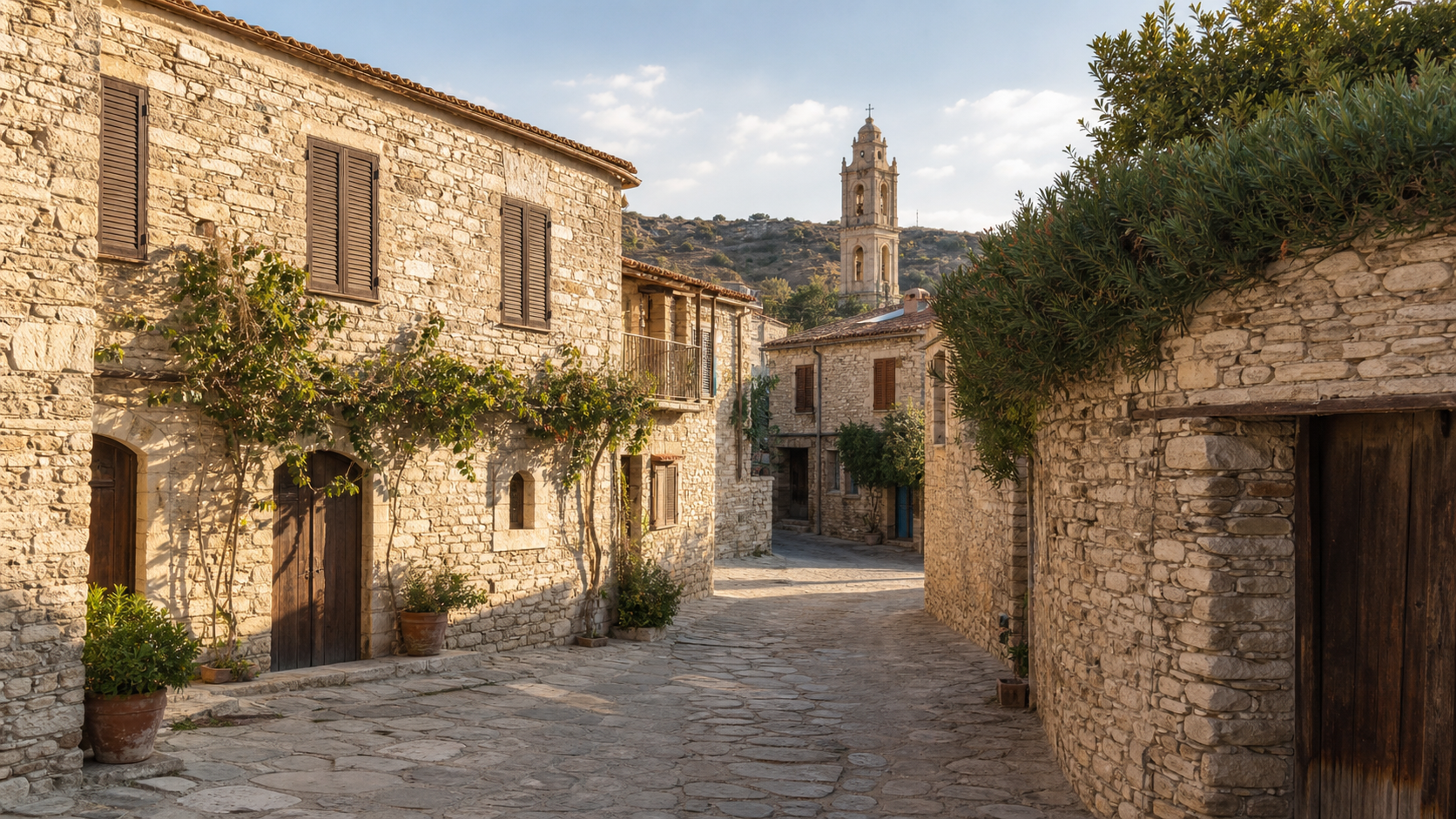
Lefkara is worth visiting when you want a proper inland contrast to Cyprus’s coast: stone lanes, traditional craft and a village day that does not need to become a checklist. Go for Pano Lefkara’s lanes, lace and silver work, allow time to wander and have lunch, then decide whether Kato Lefkara or another nearby stop genuinely improves the day. It is a gentler proposition than a beach resort or an archaeological site with one headline monument.
If you are still choosing an inland day, our comparison of the best villages in Cyprus explains how Lefkara differs from Omodos, Kakopetria and Kalopanayiotis — and why the craft-led pace is the reason to choose it.
The practical distinction matters. Lefkara refers to two settlements: Pano Lefkara (upper Lefkara) and Kato Lefkara (lower Lefkara). Cyprus Tourism places them in the Larnaca region, at the foot of the Troodos Mountains, and describes Pano Lefkara as 650 metres above sea level and 43 km from Larnaca. The craft tradition is the reason to come, but the village works because the setting asks you to slow down rather than rush from entrance to entrance.
Lefkara at a glance
| Choose Lefkara for… | Think twice if you need… |
|---|---|
| A slower village walk and traditional Cypriot architecture | A beach, major museum complex or a packed programme of paid sights |
| Lefkaritika lace, silver work and small-scale craft | A guaranteed workshop demonstration at a particular time |
| A change of pace from a Larnaca or Limassol stay | A trip that works without checking the return transport |
| A long lunch and one deliberately unplanned afternoon | A multi-stop road trip where every hour is allocated |
For a Larnaca stay, Lefkara is one of the most useful ways to add a village day without changing hotels. Start with our Larnaca guide if you are still choosing a base. From Limassol, it is also a different kind of inland trip from the western wine villages: less about a tasting itinerary, more about lanes and craft. The Limassol guide helps put that choice in the context of a wider holiday.
What makes Lefkara different
The name most visitors encounter is lefkaritika, the village’s traditional lace embroidery. UNESCO added Lefkara laces or lefkaritika to its Representative List of the Intangible Cultural Heritage of Humanity in 2009. That recognition is worth understanding as a living craft tradition, not a reason to buy the first souvenir presented to you.
Cyprus Tourism says lace embroidery and filigree silver are the village’s traditional handicrafts, and identifies the Lefkara Handicraft Centre, the Museum of Traditional Embroidery and Silversmithing and various workshops as places where visitors can learn about the work. Availability, demonstrations and opening arrangements can change, so use the official listing or contact a venue before making one particular workshop the whole purpose of the journey.
The streets are the other half of the experience. The tourism authority describes narrow, winding lanes and old terracotta-roofed houses; this is why Lefkara rewards a loose plan. Choose a few landmarks, walk the routes that appeal, and leave space to look rather than treating every shopfront as an obligation. The main pleasure is the relationship between the craft, the stone-built setting and the pace of the place.
You will often hear the story that Leonardo da Vinci bought a Lefkara lace cloth for Milan Cathedral. Cyprus Tourism records it as a legend. That is the right way to hold it: an interesting part of the village’s story, not a fact on which to base a visit.
Pano Lefkara or Kato Lefkara?
Most first-time visitors should make Pano Lefkara the focus. It is the upper village and the more obvious place to begin when you want the craft context and the pedestrian-friendly lanes. Give it enough time to orient yourself, see the church area and decide whether a museum or workshop is open and genuinely interesting to you.
Kato Lefkara is the lower village. It is not a compulsory second act just because it shares the name. Cyprus Tourism notes the Chapel of Archangelos Michail there, with frescoes dating from the 12th and 15th centuries. That can be a good reason to include it if the chapel’s access arrangements work for the day. Otherwise, it is perfectly sensible to let Pano Lefkara, lunch and the drive back be the whole outing.
This is a useful antidote to the familiar Cyprus road-trip mistake: seeing two nearby pins on a map and assuming they produce a better day together. If you are looking at a rental car for village stops, read our Cyprus car-hire guide first, then our driving in Cyprus guide for the left-side-driving, road and agreement checks that matter beyond the airport.
A simple way to structure the visit
Lefkara needs a framework, not an itinerary timed to the minute.
- Arrive with one purpose. Make that a lace-and-silver visit, a village walk or a long lunch—not all three at maximum speed.
- Start in Pano Lefkara. Walk the centre and lanes first, before committing to a shop, museum or detour.
- Choose one craft stop thoughtfully. If a demonstration or museum is open, take the time to understand it. If it is not, do not replace it with hurried souvenir shopping.
- Add Kato Lefkara only if it earns its place. A chapel visit or a slower drive can be a good reason; an urge to complete the map is not.
- Leave a realistic return margin. Village roads, a late lunch and a stop that runs longer than expected are all better when they do not threaten the journey back.
That approach works for couples, families with older children and visitors who have already had several beach days. For a family holiday where the week needs a sensible rhythm, our Cyprus family holiday guide can help balance a village outing against simpler swim-and-pool days.
How to get to Lefkara—and whether you need a car
Cyprus Tourism gives the official road approach from Larnaca as the A5, A1 and E105 and puts Lefkara 43 km from the city. That makes a car, taxi or organised trip the easiest way to control the day. A car is useful if you want the freedom to stop elsewhere, but it is not automatically the best answer if one person would rather not drive inland or everyone plans to taste wine.
Public transport deserves a more cautious answer. A search result may show a bus connection without telling you whether it works with your accommodation, the day of the week, the final walk or the last service back. Check the live timetable, the correct stop and your return before you set off. If that feels fragile, a taxi or organised day is usually more relaxing than trying to solve a missed connection in a village. Our public transport in Cyprus guide explains why airport shuttles, intercity buses and local networks are not interchangeable.
Lefkara is also listed by Cyprus Tourism as a stop on the island’s seventh wine route, covering mountainous Larnaca and Nicosia. Treat that as an option, not a promise that every visit should include a tasting. If wine is the main point, use our Cyprus wine tours guide to decide whether a planned tasting route or driver-led day would be better.
When to visit
The village can work in any season, but the shape of the day changes. In hot weather, start early or let the middle of the day be a long indoor lunch and keep the lane-walking modest. In the cooler months, stone streets and higher elevation can feel noticeably different from the coast; take a layer and let the forecast decide the pace.
Cyprus Tourism says the annual Lefkara Festival takes place in August, with music, dance, theatre and handicraft exhibitions. It may be a good reason to go if the dates line up, but check the municipality or event organiser for the current programme, locations and traffic arrangements. Festival weeks are not the time to assume the usual parking, street access or quiet-village rhythm.
For the bigger question of season—not only this outing—see our Cyprus holiday guide. It is better to give Lefkara a slot that suits the heat and the rest of your trip than to force it between two full beach days.
What to buy without making it awkward
The useful rule is simple: look for work that you genuinely like and can understand, ask politely about how it was made, and do not treat a craft tradition as a bargaining game. Lace and filigree are the central context of the visit, so a thoughtful purchase can be more meaningful than a generic Cyprus souvenir. Equally, leaving with no purchase is fine; the village is worth a visit for the walking and cultural context alone.
The verdict
Lefkara is a strong Cyprus day trip precisely because it does not need overplanning. Begin in Pano Lefkara, allow the lanes and craft to set the pace, and let a museum, workshop, Kato Lefkara or wine stop be an addition only when it fits. For travellers based in Larnaca or moving between the south coast and the hills, that is often the inland day that makes the rest of the holiday feel less like one long resort strip.
Sources for current practical details: Visit Cyprus’s Lefkara village listing and UNESCO’s Lefkara laces record. Check live venue, transport and festival information before travel.
Quick answers
Frequently asked questions
Is Lefkara worth visiting?
Yes, if you want a slow village walk, traditional craft and a change from the coast. Lefkara is a better half-day or long-lunch outing than a tightly scheduled attraction; it is less suitable for people who want a beach, nightlife or a large collection of ticketed sights.
What is Lefkara famous for?
Lefkara is known for lefkaritika lace embroidery and filigree silver. UNESCO inscribed Lefkara laces on its Representative List of the Intangible Cultural Heritage of Humanity in 2009.
Is Lefkara the same as Pano Lefkara?
Lefkara is made up of Pano Lefkara (upper Lefkara) and Kato Lefkara (lower Lefkara). Pano Lefkara is the part most visitors mean when they talk about the stone lanes, craft workshops and main village sights.
Can you visit Lefkara from Larnaca?
Yes. Cyprus Tourism places Lefkara 43 km from Larnaca and identifies the A5, A1 and E105 as the road approach. A hire car, taxi, organised trip or a checked local-bus plan can work; confirm the exact return journey before relying on public transport.