Larnaca district · A UNESCO site 30 minutes from Larnaca and Limassol
Choirokoitia: visiting Cyprus's 9,000-year-old Neolithic village
Choirokoitia costs €2.50 and needs about an hour. Official opening times, why winter sunsets beat the 17:00 closing, drive times, the free audio guide and what to pair it with.
- Filed under
- Places
- Updated
- 19 October 2026
- By
- The editors
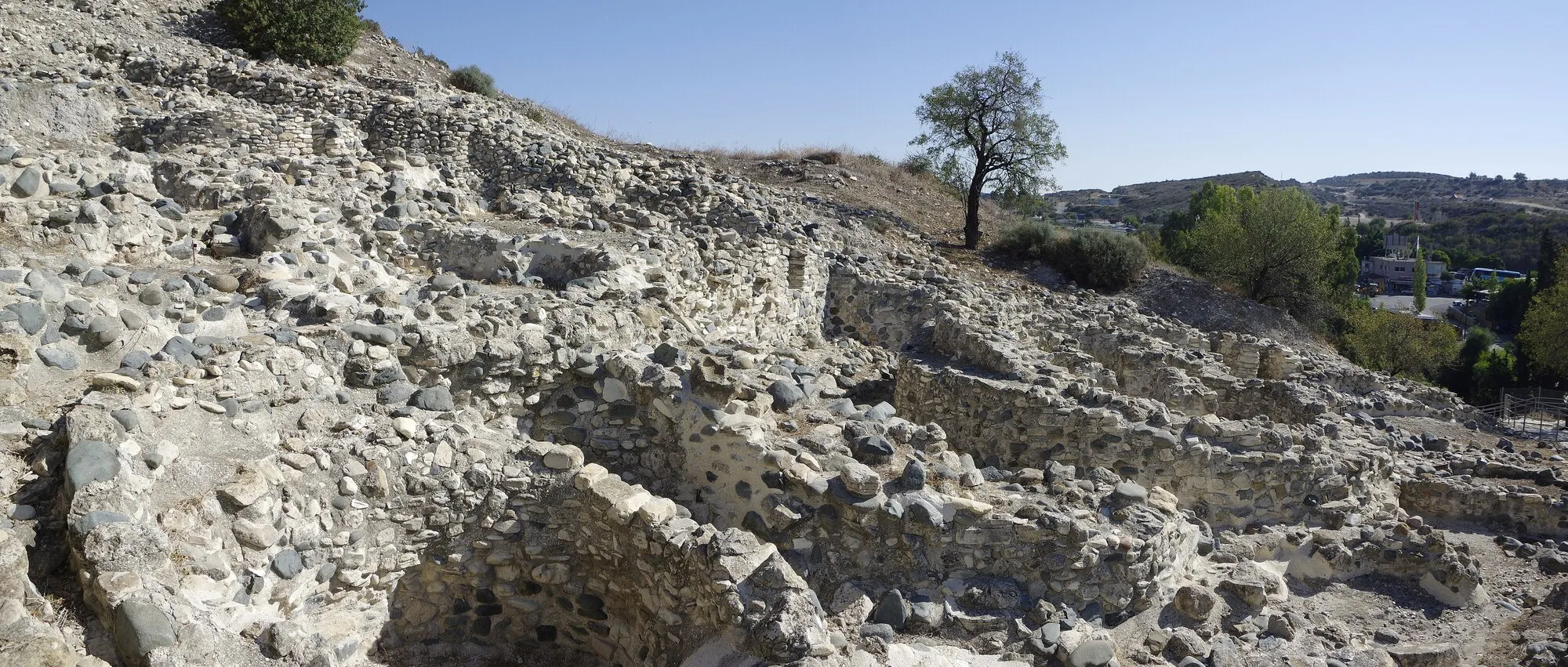
Choirokoitia costs €2.50, opens daily from 08:30, and needs about an hour: fifteen minutes at the reconstructed round houses by the entrance, then a steady climb up the hillside through the excavated village. It sits just off the A1 motorway, about 30 minutes from Larnaca and 33 minutes from Limassol, which makes it one of the easiest UNESCO World Heritage Sites in the Mediterranean to fit into a normal holiday day.
The one timing point most guides miss: until 15 April the site closes at 17:00, but once the clocks go back on 25 October the sun sets before closing time. In mid-December it is gone by about 16:36. Arrive by 15:00 in winter if you want to see the top of the hill in daylight.
Choirokoitia at a glance
These figures come from the Department of Antiquities page for Choirokoitia and the matching Visit Cyprus listing, checked on 19 October 2026. Both say hours and fees can change without notice.
| Detail | Official listing |
|---|---|
| Admission | €2.50; 20% off for organised groups of more than 10 |
| Winter hours | 16 September to 15 April, daily 08:30 to 17:00 |
| Summer hours | 16 April to 15 September, daily 08:30 to 19:30 |
| Closed | Christmas Day, New Year’s Day, Greek Orthodox Easter Sunday |
| Multi-site cards | 1 day €8.50, 3 days €17.00, 7 days €25.00 |
| Accessibility | Not wheelchair accessible on the hill; the reconstructed huts are reachable |
| Phone | +357 24 322 710 |
| Time to allow | About an hour, 90 minutes with the audio guide |
What you are actually looking at
Choirokoitia is a village of the Cypriot Aceramic Neolithic: farmers who arrived from the neighbouring mainland, brought plants and animals unknown on the island until then, and lived here before pottery, metal or writing. Radiocarbon dating puts the first settlement around 7000 BC, which is where the “9,000 years old” figure comes from. The Department of Antiquities describes it as the most impressive example of the first permanent communities on Cyprus, and UNESCO inscribed it on the World Heritage List in December 1998.
The visit has two parts.
The reconstructed houses. Near the entrance, five round dwellings and a section of the defensive wall with its entrance have been rebuilt using the same methods and materials as the originals. Visit Cyprus notes they are fitted with replicas of household objects found during excavation, and planted around with native species that grew in Cyprus in Neolithic times. Seeing them first makes the foundations further up the hill much easier to read.
The excavated settlement. A path then climbs the slope of the hill above the Maroni river, through the foundations of the real village. According to the Department of Antiquities, each household was a cluster of circular buildings around a small unroofed courtyard where grain was ground. Walls were stone, pisé and sun-dried mudbrick, and the roofs were flat frames of branches, reeds and earth. The dead were buried in pits inside the houses. The river bend protected three sides, and the west was closed off by successive walls with an access system the department calls unique in Cyprus and the Near East. Archaeologist Bernard Knapp gives the main wall as about 2.5 metres thick and up to 3 metres high where it survives.
Then, without an agreed explanation, the culture vanished. The department’s own summary says Choirokoitia was abandoned and the island appears to have been empty of people for a long time afterwards. That long silence after nearly two thousand years of village life is the strangest part of the story.
The villagers carved vessels from hard diabase and made jewellery from green picrolite. Finds from the site, including figurines and obsidian blades, are displayed at the Cyprus Museum in Nicosia rather than on the hillside.
Download the free audio guide before you go
Visit Cyprus publishes a free Choirokoitia audio guide as ten short MP3 tracks in English, covering the dwellings, daily life, beliefs, the climate and environment, the origin of the name and the archaeological research. Download it at your accommodation rather than relying on mobile data on a hillside, and bring headphones.
The winter daylight problem
The 17:00 winter closing time looks generous. The sunset does not cooperate. Cyprus moves from UTC+3 to UTC+2 on Sunday 25 October 2026 (our Cyprus time zone guide explains the change), and from then until mid-January the light fails before the gates shut.
| Date | Approximate sunset at Choirokoitia | Closing time |
|---|---|---|
| 19 October 2026 | 18:06 | 17:00 |
| 25 October 2026 | 16:59 | 17:00 |
| 15 November 2026 | 16:41 | 17:00 |
| 15 December 2026 | 16:36 | 17:00 |
| 15 January 2027 | 16:58 | 17:00 |
| 15 March 2027 | 17:53 | 17:00 |
Sunset times are calculated for the site’s coordinates. The practical rule: in November, December and January, start the climb by about 15:00. In summer the problem is the opposite one. There is little shade on the hillside, so go at opening time or after 17:00, when the summer timetable still gives you more than two hours before closing.
How to get there
The site is signposted from the A1 Nicosia to Limassol motorway, near Choirokoitia village. Drive times below are calculated road routes to the site’s official coordinates, without traffic.
| From | Distance | Drive time |
|---|---|---|
| Larnaca Airport | 32 km | about 27 min |
| Larnaca centre | 32 km | about 30 min |
| Limassol centre | 37 km | about 33 min |
| Nicosia centre | 48 km | about 41 min |
| Ayia Napa | 77 km | about 1 hr |
| Protaras | 85 km | about 1 hr 10 min |
| Paphos | 101 km | about 1 hr 20 min |
That position makes it an easy stop on the way from Larnaca Airport to a Limassol or Paphos hotel, though only if you are not arriving tired after an early flight. Our Larnaca Airport to Limassol guide covers whether hiring a car makes sense on that route, and driving in Cyprus covers the motorway basics for UK drivers.
Neither official listing mentions a bus that stops at the site, and we could not find a scheduled service that does. Plan on a car or a taxi, and see our public transport guide if you want to check the regional timetables yourself. Our car hire guide covers the excess and insurance points worth checking before you collect one.
What to pair it with
An hour at Choirokoitia rarely justifies a dedicated round trip from Ayia Napa or Paphos on its own. It works best as half of an inland day.
- Lefkara, 12.5 km and about 16 minutes away. The lace village is the natural partner: Neolithic site in the cooler morning, stone lanes and a long lunch afterwards. Our Lefkara guide explains Pano versus Kato Lefkara and how to pace the day.
- Kalavasos-Tenta, 9 km and about 9 minutes away. The island’s other major Neolithic site sits under a distinctive cone-shaped modern roof. Check the hours carefully: Visit Cyprus lists it as weekdays only, 08:30 to 16:00, from 16 September to 15 April, and closed on public holidays. On a winter weekend you will find it shut.
- Kourion, about 46 minutes west. For a full archaeology day, carry on to Kourion above the Limassol coast.
The Department of Antiquities day card only pays off at three sites. Choirokoitia plus Tenta is €5.00 at the gate, cheaper than the €8.50 card. Add Kourion (€4.50) and the gate total becomes €9.50, so the card saves you a euro. Our Kolossi Castle guide runs the same calculation for the Limassol sites.
Choirokoitia is one of three UNESCO World Heritage Sites in the south, alongside the Paphos archaeological park and the painted churches of the Troodos mountains. Seeing all three is a reasonable goal for a week-long trip with a car.
Who should skip it
Skip it if nobody in your group is interested in prehistory. These are low stone foundations on a dry hill, not mosaics or a castle, and the reconstructed huts are the only part that looks like buildings. Skip the climb if anyone has mobility problems; the huts alone are not worth a long detour. And skip midday in July and August.
Everyone else gets a 9,000-year-old village for €2.50, a short and well-explained visit, and an easy add-on to a day inland from Larnaca. For the rest of the district, start with our Larnaca guide.
Sources: Department of Antiquities: Choirokoitia; Visit Cyprus: Choirokoitia Archaeological Site; Visit Cyprus: Kalavasos-Tenta Archaeological Site; UNESCO World Heritage List: Choirokoitia. Drive times from OSRM routing on OpenStreetMap data; sunset times calculated for 34.796°N, 33.345°E. All checked 19 October 2026.
Hero photograph of the Choirokoitia settlement by Berthold Werner, Wikimedia Commons, licensed CC BY-SA 4.0.

Quick answers
Frequently asked questions
How much does it cost to visit Choirokoitia?
The Department of Antiquities lists admission at €2.50, with a 20% reduction for organised groups of more than 10 people. Its multi-site cards cost €8.50 for one day, €17.00 for three days and €25.00 for seven days. Fees can change without notice.
What are the opening hours of Choirokoitia?
The official hours are daily 08:30 to 17:00 from 16 September to 15 April, and daily 08:30 to 19:30 from 16 April to 15 September. Visit Cyprus lists the site as closed on Christmas Day, New Year's Day and Greek Orthodox Easter Sunday. Public holiday arrangements can vary, so phone the site on +357 24 322 710 if you are going on a holiday.
How long do you need at Choirokoitia?
Allow about an hour, or 90 minutes if you want to listen to the free audio guide and walk to the top of the hill. The reconstructed houses at the entrance take 15 minutes; the climb through the excavated settlement is the rest of the visit.
Where is Choirokoitia and how do you get there?
It is in the Larnaca district, just off the A1 Nicosia to Limassol motorway, about 32 km from Larnaca. By car it is roughly 30 minutes from Larnaca or Larnaca Airport, 33 minutes from Limassol and 41 minutes from Nicosia. A car or taxi is the practical way to reach it.
Is Choirokoitia suitable for wheelchair users?
Only partly. The Department of Antiquities says the site is not wheelchair accessible because of the natural slope of the hill, but wheelchair users can visit the area of the reconstructed huts near the entrance.