Famagusta district · beside Ayia Napa harbour
Limanaki Beach, Ayia Napa: the harbour beach and the name nobody agrees on
Limanaki Beach is the sandy bay that starts at Ayia Napa's fishing harbour, about ten minutes' walk from the square. Official sources call the same sand Pantachou, which is why you will not find Limanaki on the Blue Flag list. Where it is, how shallow it is, 2026 sunbed prices, buses and what is within walking distance.
- Filed under
- Places
- Updated
- 25 November 2026
- By
- The editors
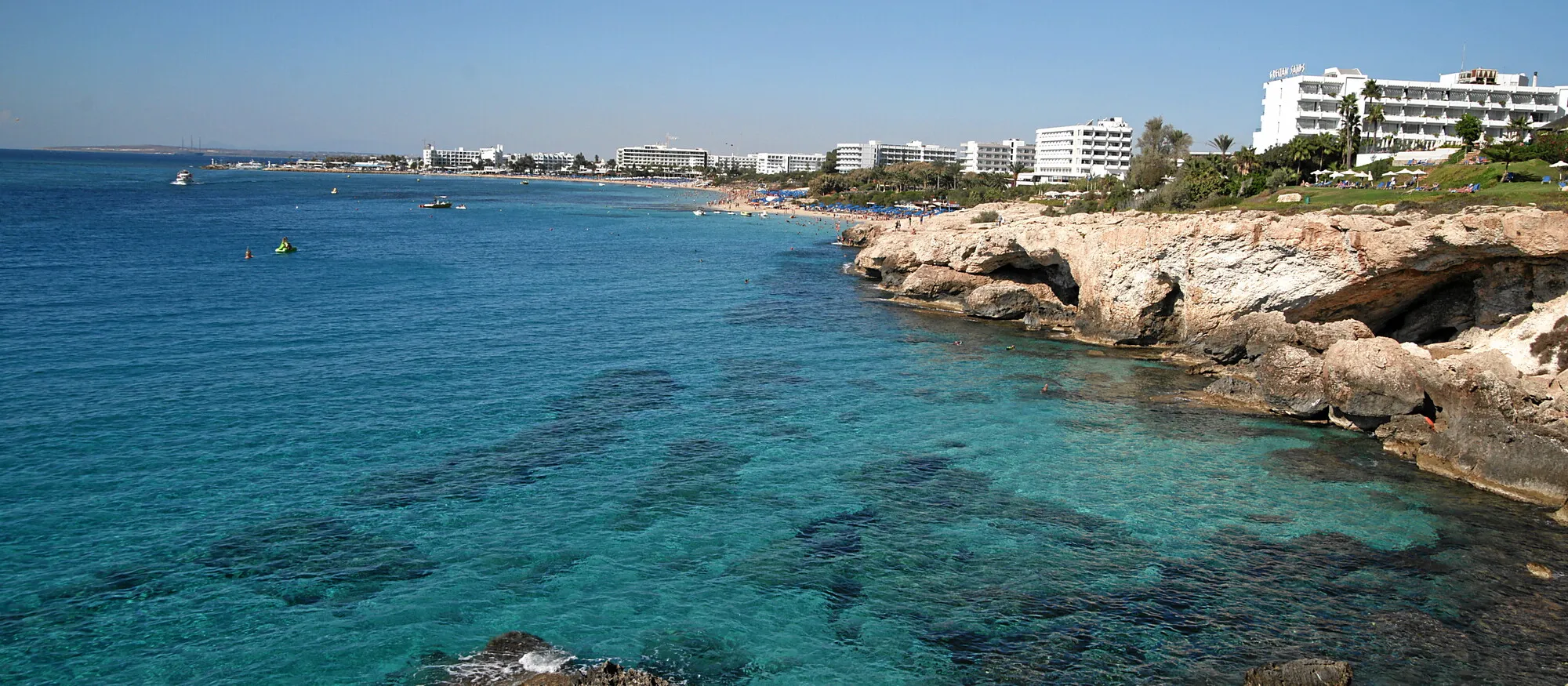
Limanaki Beach is the sandy bay that begins at the wall of Ayia Napa’s fishing harbour, about ten minutes’ walk downhill from the monastery and the square. The name means “little harbour”. Official sources call the same bay Pantachou, which is why Limanaki appears on hotel signs and map pins but not on the Blue Flag list. The sand is golden, the water stays shallow a long way out, lifeguards work from April to October, and it is the easiest beach in the resort to reach without a car.
Most of what ranks for this beach is a hotel page, a map pin or a directory entry, and several of them describe a different Limanaki altogether. This guide sorts out the name first, then covers what the beach is like, what it costs in 2026 and how to get there.
Limanaki Beach at a glance
| Detail | Limanaki Beach |
|---|---|
| Location | East side of Ayia Napa harbour, Famagusta district |
| Official name | Pantachou Beach, a 1.2 km bay from the harbour to Glyki Nero |
| Sand and water | Fine golden sand; very gradual, shallow entry |
| Blue Flag | Listed for 2026 as Pantachou, not as Limanaki |
| Lifeguards | April to October |
| Facilities | Toilets, changing rooms, sunbeds, umbrellas, watersports, parking |
| Access | Partially accessible: ramps or paths onto the beach, not into the sea |
| Bus | OSEA 101 and 102, harbour stops |
| Best for | Families with small children, anyone staying centrally, a swim before dinner at the harbour |
| Less good for | Quiet, snorkelling over rock, a postcard view like Nissi’s |
Limanaki, Pantachou or Harbour Beach?
Limanaki (Λιμανάκι) is the Greek diminutive of harbour. In Ayia Napa it is first of all the name of the harbour itself: the bus stops beside the quay are signed “Agia Napa Port” in English and “Λιμανάκι Αγίας Νάπας” in Greek. The beach took the name of the thing it sits next to, and so did the Limanaki Beach Hotel on the harbour front, which accounts for a good share of the searches.
The tourism authorities use a different name for the sand. Visit Cyprus, the official tourism site, has no Limanaki page. It describes Pantachou as a 1.2 km beach “starting from the harbour and stretching all the way to the beach of Glyki Nero”, the longest coastal strip in the area. Visit Famagusta, the regional tourism board, lists Limanaki Beach and Pantachou Beach as two separate entries on the same page, but gives no boundary, and describes Glyki Nero (also sold as Grecian Bay) as “the final part of the main beach in Ayia Napa called Pantachou Beach”.
| Name you will see | Who uses it | What it refers to |
|---|---|---|
| Limanaki Beach | Google Maps, hotels, Visit Famagusta, locals | The harbour end of the bay |
| Harbour Beach | Tour operators and older guidebooks | The same harbour end |
| Pantachou Beach | Visit Cyprus, the Blue Flag list, the accessibility list | The whole bay from the harbour eastwards |
| Glyki Nero or Grecian Bay | Visit Cyprus, the Blue Flag list, hotels | The eastern end, about 250 m, below the rocks |
So it is one continuous strip of sand with a name at each end and an official name over the top. If you are standing on the beach with the harbour wall on your right as you face the sea, you are on Limanaki, and you are also on Pantachou.
Two other mix-ups are worth knowing about. One beach directory that ranks near the top of the results files Limanaki under “Northern Cyprus”; Ayia Napa is in the Republic of Cyprus, well south of the Green Line. And Limanaki is a common beach name wherever Greek is spoken. There is a Zygi Limanaki in the Larnaca district, covered in our Larnaca beaches guide, and others at Lassi on Kefalonia, Kolymbia on Rhodes, and on Andros, Skyros and Thassos. Check the island before you trust a photo or a review.
What the beach is like
Visit Famagusta’s description is the useful one: “The golden sand of Limanaki beach gently slopes in to the sea”, and “you have to wade in a fair bit just to get knee deep”. That is the whole character of the place. It is a paddling and floating beach, good for small children and nervous swimmers, and less interesting for anyone who wants depth close to shore. Visit Cyprus adds that the long natural bay has fine golden sand and “relatively calm” water.
The photo at the top was taken in October 2021 from the low rocks at the eastern, Glyki Nero end, looking west along the bay towards the harbour in the distance. It shows what to expect: clear water over sand and dark patches of seagrass, blue umbrellas packed on to the sand beyond the rocks, and hotels along the whole frontage. Do not count on natural shade; hire an umbrella or bring one.
This is the town beach, so it is the busiest stretch after Nissi in July and August, and the harbour end fills first because it is closest to the centre. Walk east for a few minutes and the rows thin out. Excursion boats come and go from the harbour through the day, which adds some noise at that end and is part of the reason people like it.
Facilities, lifeguards and access
Visit Cyprus lists toilets, changing rooms, sunbeds, umbrellas and watersports on the beach, with accommodation, restaurants and kiosks around it, and says access is easy on foot, by bike or by car, with parking. OpenStreetMap shows a public car park directly behind the harbour end.
Lifeguards with lifesaving equipment and first aid are stationed along the bay from April to October. In late November the towers are unstaffed, most sunbeds have been taken in, and sunset in Ayia Napa is at about 16:35. The sea is still around 22°C in November and 19°C in December according to the Deputy Ministry of Tourism’s climate table; our Cyprus sea temperature guide has every month.
On the Blue Flag: the official 2026 list from CYMEPA, the scheme’s national operator, includes Pantachou and Glyki Nero in Ayia Napa and has no entry called Limanaki. Guides that say Limanaki holds its own Blue Flag, including an earlier version of our own Ayia Napa beaches page, are counting the same flag twice.
The Deputy Ministry of Tourism’s accessible beaches list puts Pantachou among the partially accessible beaches, which it defines as having ramps or pathways to a point on the beach but not into the sea, plus accessible toilets and disabled parking bays. It is not listed with a floating wheelchair. If you need assisted entry to the water, Landa and Makronissos are listed as fully accessible, each with a floating wheelchair.
Sunbed prices in 2026
For nearly two decades a sunbed or an umbrella on a Cyprus municipal beach cost 2.50 euros. In 2026 Ayia Napa adopted higher rates:
| Item | Before 2026 | 2026 |
|---|---|---|
| Sunbed | 2.50 euros | 3.50 euros |
| Umbrella | 2.50 euros | 3 euros |
| Two sunbeds and an umbrella | 7.50 euros | 10 euros |
The mayor, Christos Zannettou, told the Cyprus News Agency in June that visitors are “not required to rent complete sets” and that the designated free areas remain open to anyone with their own umbrella. Businesses with loungers beside their own premises may set their own prices where the law allows, and on a beach lined with hotels that matters: ask which row you are in before you sit down.
How to get there
On foot. This is the point of Limanaki. The harbour is about 800 m and 11 minutes’ walk from the Ayia Napa monastery and the square, downhill on the way there. Most central hotels and apartments are within a quarter of an hour.
By bus. OSEA routes 101 and 102, the coastal services between WaterWorld, Ayia Napa, Cape Greco, Protaras and Paralimni, both stop at the harbour: eastbound 101 at Agia Napa Port 2 and westbound 102 at Agia Napa Port 1, each roughly 400 m from the sand. The winter timetable valid from 16 November 2026 to 31 March 2027 has 53 departures a day in each direction, from early morning to about midnight. A single costs 2 euros between 04:00 and 21:00 and 3 euros at night, a day ticket 6 euros, paid in cash on board in notes up to 20 euros. Check osea.com.cy for the current timetable; our public transport in Cyprus guide explains how the district operators fit together.
By car. Follow signs for the harbour (Limanaki). Drive times from OSRM routing, retrieved on 25 November 2026:
| From | Distance | Drive time |
|---|---|---|
| Monastery and square | 1.0 km | 3 min |
| Sculpture park | 1.6 km | 4 min |
| Nissi Beach | 4.0 km | 11 min |
| Paralimni centre | 7.6 km | 12 min |
| WaterWorld | 8.2 km | 11 min |
| Ayia Napa Marina | 8.6 km | 12 min |
| Konnos Bay | 9.1 km | 15 min |
| Fig Tree Bay, Protaras | 10.6 km | 16 min |
| Larnaca Airport | 59.7 km | 51 min |
These are free-flowing times. In August the harbour car park fills by late morning, and walking from your hotel is usually quicker than looking for a space. Arriving by air, our Larnaca Airport to Ayia Napa guide covers the shuttle, bus and taxi options.
What is within walking distance
Limanaki’s advantage over the prettier beaches is everything around it.
- The harbour. Fishing boats, fish tavernas and the departure point for the boat trips along the Cape Greco coast. It is at its best in the early evening.
- Thalassa Municipal Museum. A sea-themed museum a few minutes inland. Visit Cyprus lists it as open all year: Monday 09:00 to 13:00 and Tuesday to Saturday 09:00 to 17:00, closed on Sundays from October to May and open 15:00 to 19:00 on Sundays from June to September, closed on public holidays. Entry is 4 euros for adults and 1.50 euros for children.
- The monastery and square. Free to enter; note the winter hours in our monastery guide.
- The coastal path. A paved walkway runs both ways from the harbour: west past Loukkos tou Manti towards the Katsarka rocks, and east along the bay to Glyki Nero.
For a day out from here, Konnos Bay and Cape Greco are a quarter of an hour by car or a ride on the 101, and WaterWorld is at the other end of the same bus route.
When to go
The eastern end of Cyprus is the hot end. The Meteorological Service’s Paralimni station, the nearest with published normals, averages a daily maximum of 33.3°C in August, 31.2°C in September, 27.7°C in October and 21.7°C in November. Late May, June, September and October give you lifeguards, warm water and room on the sand.
In high summer go before 10:00 or after 16:00. The shallow water warms quickly and the late afternoon is the pleasant time to be in it, with dinner at the harbour afterwards. From November to March it is a beach for a walk and a quick swim on a still day; our Cyprus in winter guide sets expectations for the off season.
Is Limanaki Beach worth it?
Yes, for what it is. Limanaki is a convenient, safe, sandy town beach with shallow water and every facility close by, and you can reach it on foot from almost any central hotel. It is not the most beautiful beach in Ayia Napa and it does not try to be. Choose it for an easy day with small children, for a swim without a bus ride, or when you want the harbour for lunch. Choose Nissi for the view, Landa or Makronissos for more space, and Konnos for scenery.
For the whole resort, see our Ayia Napa beaches comparison and things to do in Ayia Napa; for evenings, the Ayia Napa nightlife guide explains how the harbour differs from the square.
Sources for changing details: Pantachou description, length, facilities, lifeguard season and parking from Visit Cyprus. Limanaki and Glyki Nero descriptions from Visit Famagusta’s Ayia Napa beaches page. Blue Flag 2026 list from CYMEPA. Accessibility categories from the Deputy Ministry of Tourism’s accessible beaches list. Sunbed prices from SigmaLive (26 February 2026) and the Cyprus Mail (19 June 2026). Museum hours and prices from Visit Cyprus. Bus routes, the 16 November 2026 to 31 March 2027 timetable and fares from OSEA and its tickets page; stop names, the car park and the harbour-front hotel from OpenStreetMap. Drive distances from OSRM routing on OpenStreetMap data. Climate normals for Paralimni from the Meteorological Service (Cyprus) table reproduced on Wikipedia’s Climate of Cyprus page; sea temperatures from the Deputy Ministry of Tourism’s 2011 to 2020 climate table. All checked 25 November 2026; confirm prices, timetables, museum hours and lifeguard cover before you travel.
Hero photo: the bay from Glyki Nero towards Ayia Napa harbour, 23 October 2021, by Mboesch, via Wikimedia Commons, licensed under CC BY-SA 4.0. Cropped for the header.

Quick answers
Frequently asked questions
Where is Limanaki Beach?
In Ayia Napa on the south-east coast of Cyprus, in the Famagusta district of the Republic of Cyprus. It is the sandy bay immediately east of the fishing harbour, about 800 metres or ten minutes' walk downhill from the monastery and main square. By road it is roughly 4 km from Nissi Beach and 60 km, or about 50 minutes, from Larnaca Airport.
Is Limanaki Beach the same as Pantachou Beach?
In practice, yes. Limanaki means little harbour, and the name is used for the end of the bay beside the harbour. Visit Cyprus describes the whole 1.2 km bay from the harbour to Glyki Nero as Pantachou Beach, and that is the name on the official Blue Flag and accessibility lists. The regional tourism board lists Limanaki and Pantachou as two entries without drawing a line between them. There is no separate beach to find.
Does Limanaki Beach have a Blue Flag?
Not under that name. The 2026 Blue Flag list published by CYMEPA has no entry called Limanaki in Ayia Napa. It lists Pantachou, the official name for the bay that Limanaki is part of, and Glyki Nero at its eastern end. A flag is awarded for one season and can be withdrawn, so check for the flag flying at the lifeguard tower when you arrive.
Is Limanaki Beach good for children?
Yes. The regional tourism board says the golden sand slopes so gently that you have to wade out a fair way to get knee deep, and calls it safe and perfect for children. Visit Cyprus lists toilets, changing rooms, sunbeds and umbrellas, and lifeguards from April to October. It is busy in July and August because it is the closest sand to the town centre.
How much are sunbeds at Limanaki Beach?
On the municipal rows, Ayia Napa's 2026 rates are 3.50 euros for a sunbed and 3 euros for an umbrella, so 10 euros for two beds and an umbrella, up from 7.50 euros. The mayor has said visitors do not have to rent a complete set, and the free areas are open to anyone with their own umbrella. Hotels and beach bars with their own loungers set their own prices.