Planning · Two official languages, one you will barely need
What language do they speak in Cyprus? Greek, Turkish, and the English you will actually hear
Cyprus has two official languages, Greek and Turkish, and English is spoken almost everywhere a visitor goes. Here is where each one is used, why the Greek you hear is not the Greek in your phrasebook, and why the road signs spell your resort differently from your booking.
- Filed under
- Plan your trip
- Updated
- 24 August 2026
- By
- The editors
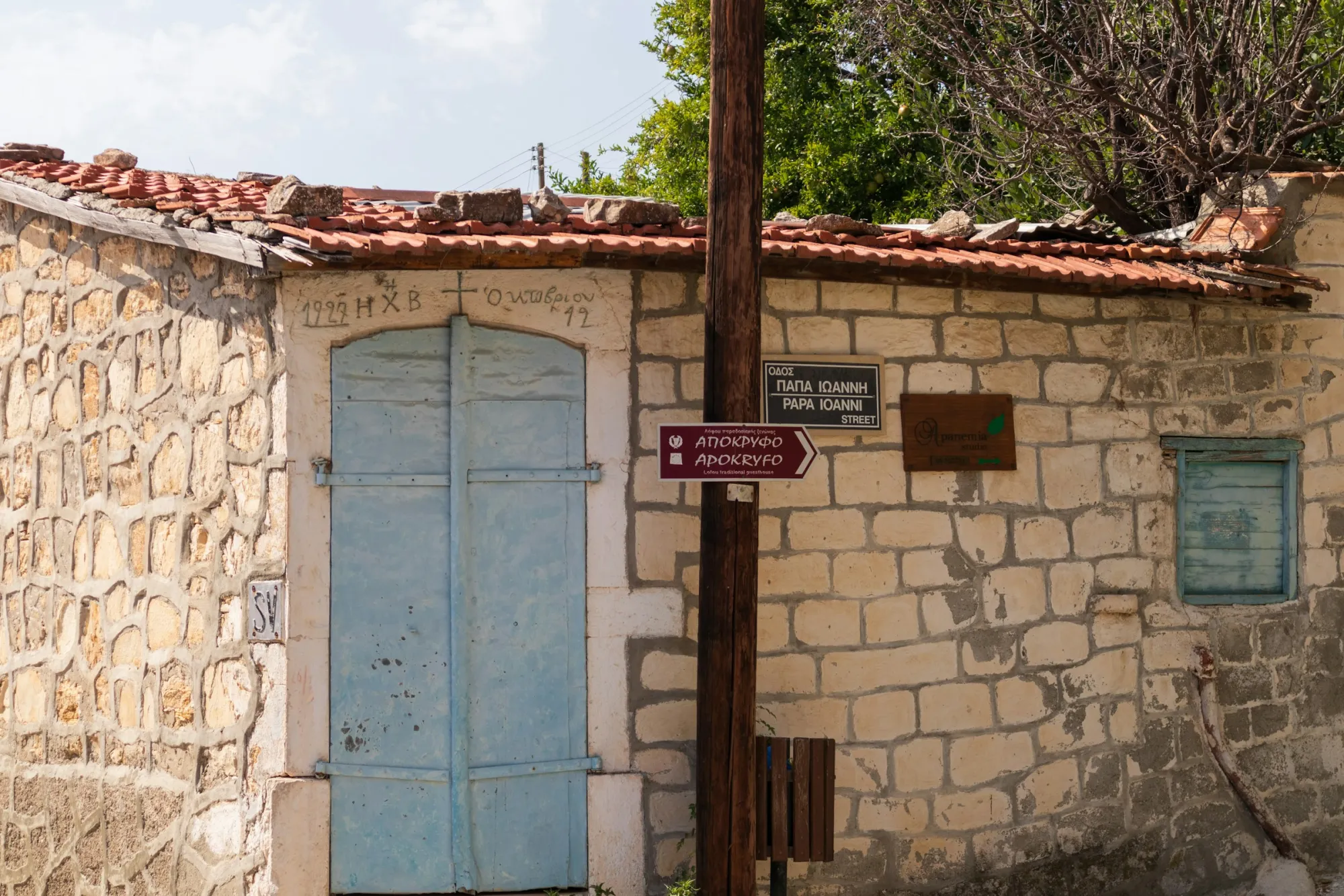
Cyprus has two official languages, Greek and Turkish. Greek is what you will hear in the south, where almost every holiday takes place. Turkish is spoken in the north. English has no official standing at all, and you will still be able to use it everywhere you are likely to go.
That is the answer, and it is where most pages stop. Two things they leave out will affect your week more than the constitutional position: the Greek spoken around you is not quite the Greek in your phrasebook, and the place names on the road signs are not the ones on your booking confirmation.
The official position, and where it comes from
Article 3 of the 1960 Constitution of the Republic of Cyprus made Greek and Turkish the official languages of the new state, reflecting the two communities living side by side across the island. That article still stands. What changed was the geography: after 1974 the island divided into two near-homogeneous linguistic areas, Greek-speaking in the south and Turkish-speaking in the north, and the two official languages stopped overlapping in daily life.
Two smaller languages are formally protected. Cyprus ratified the Council of Europe’s European Charter for Regional or Minority Languages, which entered into force on 1 December 2002 and applies to Armenian, recognised as a non-territorial language, and to Cypriot Maronite Arabic. Both are spoken by small, long-established communities, and Cypriot Maronite Arabic is now classed as endangered.
| Language | Status | Where you will hear it |
|---|---|---|
| Greek | Official | The south, and all government-controlled areas |
| Turkish | Official | The north, and among Turkish Cypriots |
| English | None | Resorts, hotels, car hire, road signs, business |
| Armenian | Protected minority | The Armenian Cypriot community |
| Cypriot Maronite Arabic | Protected minority | A small and ageing group of speakers |
| Russian | None | Parts of Limassol |
Will English actually get you by?
Yes, and the data is unusually clear on this. Eurostat’s 2022 Adult Education Survey found that 91.9% of Cypriots aged 25 to 64 know at least one foreign language, which put Cyprus in the EU’s top ten alongside Slovenia, Sweden and the Netherlands, and well ahead of the EU average of roughly 75%. English is the foreign language in question for the overwhelming majority, and it is taught from the first year of state primary school.
There is a long history behind that. Cyprus was under British administration from 1878 until independence in 1960, and English did not simply leave with the administrators. It remained the working language of the Cypriot courts until 1989 and of legislation until 1996, when Law 67/1988 finally brought the Greek-language provisions of the Constitution into effect. The pendulum has even swung back a little: in 2022 Cyprus set up a Commercial Court and an Admiralty Court, and amended Article 3 of the Constitution so that proceedings before them can be conducted in English where the interest of justice requires it.
The practical upshot is that in Paphos, Limassol, Larnaca, Ayia Napa and Protaras you will not need a word of Greek. Menus are bilingual, hotel and restaurant staff switch to English without being asked, and car hire desks and taxi drivers operate in English as a matter of course.
Where it thins out is inland and among older people. In the Troodos villages, at a rural petrol station, or in a government office dealing with something unusual, you may find yourself in a slower conversation. It is rarely a problem, but it is worth knowing that “everyone speaks English” is a resort-coast truth rather than an island-wide one.
Cypriot Greek is not the Greek in your phrasebook
If you have learned a few words of Greek before a holiday in Crete or Corfu, you may be briefly thrown. The Greek spoken between Cypriots is Cypriot Greek, a distinct variety with features Standard Modern Greek does not have: doubled consonants that are genuinely held longer, the “sh” and “ch” sounds absent from standard Greek, and a distinction between a tapped and a rolled r. Linguists describe it as divergent enough that Greek speakers from Greece need some exposure before they follow it comfortably.
It was also, until recently, a largely unwritten language. Cypriot Greek only began appearing in written form in the 2000s through texting and online forums, usually typed out in Latin characters, and it still has no standard spelling.
None of this should put you off learning a few words. Cyprus operates what linguists call a diglossia: Cypriot Greek is the low-effort, everyday spoken variety, while Standard Modern Greek is the high variety used for education, broadcasting, official documents and anything written down. Everyone understands standard Greek, so a normal phrasebook works exactly as intended. You are simply learning the formal register, which if anything reads as polite rather than odd.
Why the road sign says Lemesos and your booking says Limassol
This is the language issue most likely to cost you twenty minutes on your first day, and almost nothing written for visitors mentions it.
Cyprus romanises Greek place names using ELOT 743, the transliteration system the United Nations recommended in 1987 for rendering Greek in the Latin alphabet. The Cyprus Permanent Committee for the Standardization of Geographical Names, the national authority for the job, has applied it across official geographical names, mapping, street names and road signs. Government departments follow the same convention, which is why the Department of Lands and Surveys lists its district offices as Lefkosia, Lemesos, Larnaka, Pafos, Ammochostos and Keryneia.
Airlines, tour operators and English-language habit, meanwhile, have kept the older anglicised forms. So the two systems run in parallel and disagree with each other on almost every major town.
| On your booking | On the road sign | In Greek |
|---|---|---|
| Nicosia | Lefkosia | Λευκωσία |
| Limassol | Lemesos | Λεμεσός |
| Paphos | Pafos | Πάφος |
| Larnaca | Larnaka | Λάρνακα |
| Ayia Napa | Agia Napa | Αγία Νάπα |
| Famagusta | Ammochostos | Αμμόχωστος |
| Kyrenia | Keryneia | Κερύνεια |
Neither spelling is wrong. If you are following motorway signs to Limassol and every gantry says Lemesos, you are on the right road. When you type a destination into a satnav or a maps app, try the official form as well as the familiar one, because the two do not always resolve to the same place. Our guide to driving in Cyprus covers the rest of what the road throws at you, including the fact that Cyprus drives on the left.
What changes if you cross to the north
North of the buffer zone the working language is Turkish, and the place names change a third time: Lefkoşa for Nicosia, Girne for Kyrenia, Gazimağusa for Famagusta. English is still widely spoken in the tourist areas, so a day trip is not a linguistic challenge, but Greek will not help you and signage is Turkish first.
Crossing has its own rules that are worth reading before you go rather than at the checkpoint. Our guides to crossing the Green Line and Cyprus entry requirements cover what you need to carry and what to avoid.
The words worth learning
You do not need these. Using them anyway tends to change the temperature of an interaction, particularly away from the resorts.
| Greek | Sounds like | Means |
|---|---|---|
| Γεια σου / Γεια σας | ya soo / ya sass | Hello (informal / polite) |
| Καλημέρα | kali-MER-a | Good morning |
| Καλησπέρα | kali-SPER-a | Good evening |
| Ευχαριστώ | ef-hari-STO | Thank you |
| Παρακαλώ | para-ka-LO | Please, and also you’re welcome |
| Ναι | neh | Yes |
| Όχι | O-hi | No |
| Συγγνώμη | sig-NO-mi | Sorry, excuse me |
| Τον λογαριασμό | ton logaria-SMO | The bill |
| Γεια μας | ya mas | Cheers |
One trap is worth flagging because English speakers fall into it constantly. Ναι means yes and sounds like “neh”, which the English ear reads as a reluctant no. Όχι means no and sounds like “ohi”. If a waiter appears to be refusing everything cheerfully, they are agreeing with you.
The distinctly Cypriot word you will hear most is Έλα (eh-la). It literally means “come”, and it does the work of hello, go on, seriously? and answering the phone. Beyond that, most of the Cypriot vocabulary worth having is food, which our guide to Cypriot food covers properly, and it is the fastest way to order well in Limassol or Paphos.
The short version
Greek and Turkish are official. Greek is what you will hear in the south, Turkish in the north, and English is spoken well enough across the whole tourist economy that you will never be stuck. Learn five words of standard Greek rather than hunting for a Cypriot phrasebook, and check both spellings of your destination before you set off, because the road signs and your booking are working from different rulebooks.
If you are still putting the trip together, our Cyprus holiday guide is the place to start. If you are thinking about something longer than a holiday, life as an expat in Cyprus covers how far English really takes you once the paperwork begins.
Language statistics are from Eurostat’s 2022 Adult Education Survey. Constitutional and minority-language details are drawn from the Constitution of the Republic of Cyprus and the Council of Europe’s records for the European Charter for Regional or Minority Languages, and are correct at the time of writing in August 2026.
Quick answers
Frequently asked questions
What is the official language of Cyprus?
Cyprus has two. Article 3 of the 1960 Constitution of the Republic of Cyprus makes Greek and Turkish the official languages of the state, and that has never been repealed. In practice the island has been split along linguistic lines since 1974: Greek is the working language of the Republic in the south, where almost every visitor stays, and Turkish is used in the north. English has no official status, but it is used far more widely than that suggests.
Do they speak English in Cyprus?
Widely, yes. Eurostat's 2022 Adult Education Survey found that 91.9% of Cypriots aged 25 to 64 know at least one foreign language, placing Cyprus in the EU's top ten and well above the EU average of about 75%. English is taught from the first year of state primary school, and Cyprus was under British administration until 1960, which left English embedded in law and business for decades afterwards. In Paphos, Limassol, Larnaca, Ayia Napa and Protaras you can get through an entire holiday in English without difficulty.
Is Cypriot Greek the same as the Greek spoken in Greece?
No. Cypriot Greek is a distinct variety with sounds Standard Modern Greek does not have, including doubled consonants and the 'sh' and 'ch' sounds, and linguists describe it as divergent enough that Greek speakers from Greece need some exposure before they follow it comfortably. It matters less than it sounds. Cyprus operates a diglossia: Cypriot Greek is the everyday spoken language, while Standard Modern Greek is what is taught, written and used in every formal setting, so a standard Greek phrasebook works perfectly well.
How do you say hello in Cypriot?
The same way you would in Greek. 'Γεια σου' (ya soo) to one person you know, 'Γεια σας' (ya sass) to a group or anyone you are being polite with. The distinctly Cypriot thing you will notice is 'Έλα' (eh-la), literally 'come', used as an all-purpose opener for answering the phone, greeting a friend or expressing mild disbelief. There is no separate Cypriot greeting to learn.
What language do they speak in Paphos, Larnaca and Ayia Napa?
Greek, with English spoken by essentially everyone working in tourism. These are the three main resort areas of the Republic, so the everyday language is Cypriot Greek among locals and English with visitors. Menus, signage and hotel staff are all English-capable. The same is true of Limassol, Protaras and Nicosia, though Nicosia is a working capital rather than a resort and you will hear proportionally less English away from the old town.