Larnaca Bay · A 172-metre ferry on its side, 16 to 42 metres down
Zenobia wreck, Cyprus: the ferry off Larnaca, how deep it lies and who can actually dive it
The Zenobia is a Swedish ro-ro ferry that sank off Larnaca on 7 June 1980 and now lies on its port side in 16 to 42 metres of water. What happened, what qualification the official pages ask for, the 500-metre no-fishing zone, the 2026 safety record and how to see it without diving.
- Filed under
- Places
- Updated
- 20 November 2026
- By
- The editors
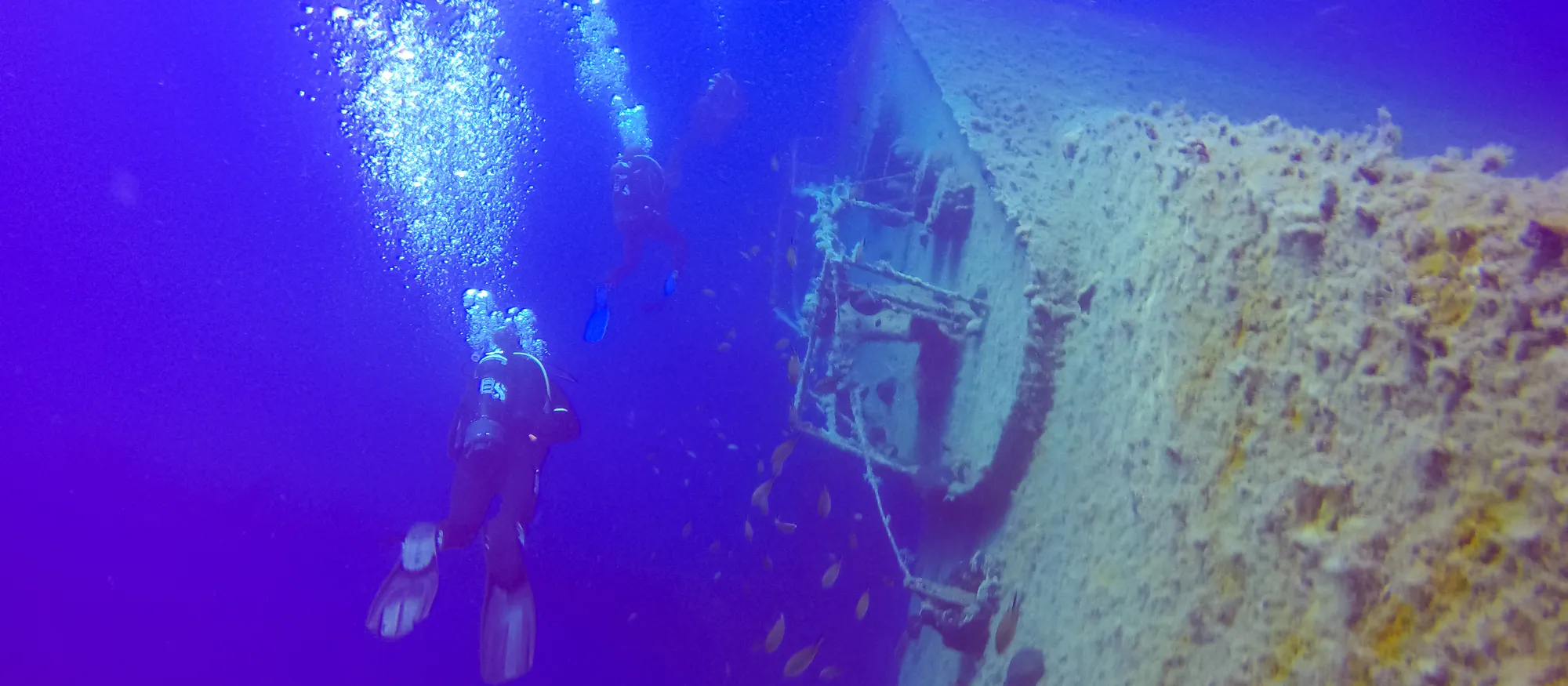
The Zenobia is a 172-metre Swedish roll-on/roll-off ferry that capsized and sank off Larnaca in the early hours of 7 June 1980 with more than 100 lorries on board. She lies on her port side in Larnaca Bay, with her upper side 16 to 18 metres below the surface and the seabed at 42 metres, and is regularly listed among the ten best wreck dives in the world. Nobody died in the sinking. Divers have died on the wreck since, two of them in 2026, and that belongs in any honest guide to it.
This page is for certified divers working out whether the Zenobia is within their training, and for everyone else who has seen the name on a Larnaca excursion board. It does not replace a dive briefing.
The Zenobia at a glance
| What | Swedish Challenger-class ro-ro ferry, built by Kockums in Malmö, launched 1979 |
| Sank | About 02:30 on 7 June 1980, after five days listing off Larnaca; no casualties |
| Where | Larnaca Bay; Visit Cyprus position 34° 53’ 31.80” N, 33° 39’ 16.20” E |
| Size | 172 m long, 28 m wide (Visit Cyprus) |
| Depth | 16 to 42 m; the ship lies on her port side |
| Visibility | ”25+ metres” (Visit Cyprus); up to 30 m in good conditions (Larnaka Tourism Board) |
| Water temperature | 15 to 28 °C over the year (Larnaka Tourism Board) |
| Access | By boat only, from Larnaca |
| Qualification listed | Advanced Open Water / Boat Diver (Visit Cyprus) |
| Protection | No fishing of any kind within 500 m, by ministerial decree since September 2021 |
What happened in June 1980
The Zenobia was the first of three sister ships built at the Kockums yard in Malmö and was delivered to her owners, Rederi AB Nordö, in late 1979. In the usual telling she left Malmö on 4 May 1980 bound for Tartous in Syria, calling at Heraklion and Piraeus on the way, and developed a list to port that was traced to excess water in the ballast tanks.
She reached Larnaca on 2 June 1980 with the problem back. The fault lay in the computer-controlled ballast system, which kept pumping water into the side tanks. On 4 June she was towed out of the harbour so that she could not block it, and anchored offshore. Over the following days the list grew, the cargo shifted, and at about 02:30 on 7 June she rolled over and went down. Nobody was hurt. Visit Cyprus puts the value of the cargo at £200 million at the time.
Two details you will see repeated are less settled than they look:
- How many lorries. Visit Cyprus and the Larnaka Tourism Board both say 108 articulated lorries. The Visit Cyprus page then describes “100 trucks” in the cargo bay a paragraph later, and the widely quoted ship history used by Wikipedia says 104. “More than 100” is the safe version.
- Whether it was her maiden voyage. Almost every source, including both tourism bodies, says she sank on her maiden voyage, hence the nickname “the Titanic of the Mediterranean”. The ferry historians at HHV Ferry tell it differently: they have her in service on a Greece to Syria freight line, switched to run from Koper in January 1980, and in trouble near the end of a Koper to Tartous trip. We have not seen a primary document that settles it.
Where she lies and how deep
The ship rests on her port side on a flat bed of sand and rock. Because she is 28 metres wide, lying on her side puts the uppermost (starboard) side far above the seabed. Visit Cyprus gives the range as 16 to 42 metres; the Larnaka Tourism Board gives 17 metres on one page and 18 on another. The seabed is at about 42 metres either way.
The official pages disagree on distance. Visit Cyprus says the wreck is 1.5 km from the shore; the tourism board’s wreck page says 3.7 km. Measured from the Visit Cyprus coordinates it is about 3 km in a straight line from Larnaca Marina, where dive boats are based, so the two figures probably start from different places. Either way it is a short boat ride, not a shore dive.
The Egyptian fishing boat Alexandria, which sank in 2006, lies about 200 metres away at around 30 metres and is sometimes offered as a second dive.
Who can dive it
This is where sales pages and official pages part company, so it is worth being exact.
| Part of the wreck | Depth | What the sources say |
|---|---|---|
| Upper (starboard) side and outside of the hull | From 16 to 18 m | The simplest dive on the wreck. Open Water certification is limited to 18 m, so this is the only part within it, and only just |
| Outside of the superstructure, lifeboats, propellers | Roughly 20 to 40 m | Advanced Open Water territory (trained to 30 m); the deepest parts need deep-diver training |
| Upper car deck and accommodation | Inside the ship | Described in dive literature as a more advanced dive; overhead environment |
| Lower car deck and engine room | Inside the ship, deep | For very experienced, wreck-trained and technical divers only |
| Seabed | About 42 m | Below the 40 m limit of recreational diving |
Visit Cyprus lists the qualification required as “Advanced Open Water / Boat Diver”. The Larnaka Tourism Board lists the same, while saying that low currents make the site “suitable for almost all qualified divers”. Both are true of different parts of the ship.
Three things follow:
- It is not a try-dive. If you have never dived, the Zenobia is not where you start. Our Cyprus scuba diving guide covers where a first dive makes more sense.
- If you hold Open Water only, ask before you book. Ask exactly which part of the wreck the dive covers, the planned maximum depth and the size of the group. The top of the wreck sits at the edge of your certified depth, with a 42-metre drop beside it.
- Allow two dives. Visit Cyprus says it is “highly recommended to take two dives” to see the ship properly, which in practice means most of a day.
For choosing an operator, Visit Cyprus publishes a list of diving enterprises certified to ISO 24803, which includes Larnaca centres, and the tourism board points divers to the Cyprus Dive Centre Association. We have not quoted prices because we could not verify a current official tariff; get a written quote that states boat, guide, equipment, gas and the number of dives.
Is the Zenobia safe?
For a dive inside your training, with a guide who knows the wreck, the conditions are forgiving: warm water, low current and long visibility. That is what makes it deceptive. The ship lies on her side, so decks are walls, and there is always something interesting a little deeper.
The record this year, from Cyprus Mail and dive-press reports:
- 10 November 2026. A 61-year-old British diver died after being found unconscious in the sea near the wreck. The Joint Rescue Coordination Centre in Larnaca received the alert at 10:10.
- 7 March 2026. A 67-year-old instructor died after getting into difficulty during a training dive with two students. Police opened an investigation.
- October 2023. An instructor was found dead inside a rarely visited compartment after a two-day search. The rescue centre’s commander said at the time that conditions inside “are not easy, there is lack of visibility and it can be hard to find the exit”, and suggested that parts of the wreck might need to be closed off.
No cause has been published for the two 2026 deaths, and we are not drawing one. The sensible conclusions are modest: dive within your certification, tell the centre the truth about your experience and health, do not enter the ship without the training for it, and check that your travel insurance covers scuba diving to the depth you plan, because standard policies often limit or exclude it.
A protected site: the 500-metre rule
The wreck has become the richest artificial reef on the island. Visit Cyprus lists grouper, barracuda, jacks, kingfish, moray eels, stingrays, lionfish, octopus and visiting turtles.
It is also protected in law. The Department of Fisheries and Marine Research lists “MPA Zenobia wreck” among its 16 national marine protected areas, under a decree made on 1 September 2021 (K.D.P. 379/2021). The decree is one paragraph long: fishing by any means is prohibited within 500 metres of the wreck. The tourism board’s page says fishing is banned “within the vicinity of 3 miles”; the decree itself says 500 metres. It followed years of lobbying: in 2015 Larnaca’s tourism bodies were still complaining of illegal fishing on a site they estimated drew 45,000 divers and €14 million a year.
One oddity: the wreck has a claimed private owner. In October 2015 the Cyprus Mail reported that the port authority recognised a Larnaca cruise company as owner through a 1998 purchase for £15,000, and that dive centres were contesting its plan to charge every diver €5. We found no official notice of such a fee today.
Seeing it without diving
The honest answer is that you cannot see much. The shallowest metal is 16 to 18 metres down, so a snorkeller or a passenger on a glass-bottomed boat is looking at the hull from a long way above, even in 25 metres of visibility. Larnaca boat operators do advertise bay cruises with a swim stop over the wreck; treat that as a swim in deep clear water with a famous shape below you, and check the route and price with the operator on the day.
Better options if you do not dive:
- The virtual dive. The Larnaka Tourism Board’s Virtual Diving Routes map the Zenobia in 3D with underwater footage and suggested routes, and Visit Cyprus links 3D models of the hull, the propeller and the lorries. They are free and made for non-divers as much as divers.
- A wreck you can snorkel. The LEF1, sunk in December 2019 in the Larnaka Marine Protected Area off Voroklini, sits at 13 metres and is described by the tourism board as the island’s only artificial reef suitable for snorkellers.
- Shallow reefs in town. The same board lists the Alia snorkelling reef between Kastella and Mackenzie beach at 0.5 to 2.5 metres, and the Dorida reef at 5 to 12 metres, 500 metres offshore.
Planning a Zenobia day
Dive boats are based around Larnaca Marina, at the north end of the Finikoudes promenade and a short walk from Larnaca old town. Staying in Larnaca makes the early start easy, and our Larnaca guide covers what to do with the rest of the trip. Dive centres elsewhere on the island, Protaras and Pissouri among them, also sell the Zenobia as a day trip.
The tourism board quotes water of 15 to 28 °C across the year, and the sea is warmest from July to October; our Cyprus sea temperature guide has the month-by-month figures. Winter diving goes on, in thicker suits and with more days lost to weather.
Leave the usual gap before flying. Dive-training agencies advise at least 18 hours on the ground after repeated dives, so do not book the Zenobia for the morning of an evening flight home.
Sources for changing details: site data from the Visit Cyprus MS Zenobia page and its certified diving enterprises list, and from the Larnaka Tourism Board’s Zenobia wreck, diving and virtual diving routes pages, all read 20 November 2026; protection from the Department of Fisheries and Marine Research Marine Protected Areas Network page (16 March 2026) and decree K.D.P. 379/2021 linked from it; ship history from HHV Ferry and the Wikipedia article on MS Zenobia; incidents from the Cyprus Mail (10 November 2026, 7 March 2026, 27 October 2023) and DIVE Magazine; ownership dispute from the Cyprus Mail archive, 14 October 2015; 2015 visitor estimates from Scubaverse. Dive plans, depth limits and prices are set by the operator on the day.
Hero image: Schiffswrack Zenobia in Zypern by dronepicr, Wikimedia Commons, CC BY 2.0, cropped.

Quick answers
Frequently asked questions
Where is the Zenobia wreck?
In Larnaca Bay on the south-east coast of Cyprus. Visit Cyprus gives its position as 34° 53' 31.80" N, 33° 39' 16.20" E and describes it as 1.5 km from the shore, reached by boat. That position is about 3 km in a straight line from Larnaca Marina, where the dive boats are based.
How deep is the Zenobia wreck?
The ship lies on its port side on a flat seabed at about 42 metres. Because it is 28 metres wide, the uppermost side is far shallower: Visit Cyprus gives the depth range as 16 to 42 metres and the Larnaka Tourism Board as 17 or 18 to 42 metres.
Can beginners dive the Zenobia?
Not as a first dive. Visit Cyprus and the Larnaka Tourism Board both list Advanced Open Water as the qualification required. Some dive centres take Open Water divers along the shallow upper side at around 16 to 18 metres, which is the limit of that certification, but the decision rests with the centre. Anything inside the ship is for trained and experienced wreck divers.
Why did the Zenobia sink?
The accepted explanation is a fault in the computer-controlled ballast system, which kept pumping water into the side tanks and made the ship list to port. She was towed out of Larnaca harbour and anchored offshore, and capsized in the early hours of 7 June 1980 with more than 100 lorries on board. Nobody was killed in the sinking.
Can you see the Zenobia without diving?
Only from a distance. The shallowest part is 16 to 18 metres below the surface, so snorkellers and boat passengers look down on it from above. The Larnaka Tourism Board publishes a free virtual dive and 3D models of the wreck, and its LEF1 wreck off Voroklini, at 13 metres, is the one it describes as suitable for snorkellers.