Kili · The waterfall visit that goes wrong before you arrive
Adonis Baths, Paphos: tickets, opening hours and the road you should actually take
A clear-eyed guide to the Adonis Baths waterfalls near Paphos: current ticket prices, seasonal opening hours, why the operator tells you to ignore Google Maps, and whether it earns a day.
- Filed under
- Places
- Updated
- 9 September 2026
- By
- The editors
Most bad Adonis Baths trips are decided before anyone reaches the waterfall. The operator’s own website carries a warning that almost no other page repeats: Google Maps does not show the correct way in, and visitors are asked not to use GPS at all. Follow the signposts from Tala village or from Coral Bay instead. Get that right and it is a pleasant half-day at a landscaped river site with two waterfalls you can swim in, for €15 an adult. Get it wrong and you spend forty minutes on a rough track wondering whether the hire car will make it, which is exactly the story behind a good share of the site’s mixed reviews.
This page sets out what you will pay, when it is open, how to arrive without incident, and who should skip it. It is not a review of somewhere we have been, and it is not a rewrite of the operator’s marketing. Every practical figure below is attributed, because several of them are contested.
Adonis Baths at a glance
| Question | The practical answer |
|---|---|
| Where | Kili (Koili) village, Paphos district, about 267 m above sea level on the Mavrokolympos river |
| Ticket | €15 adults, €10 children, bought at the entrance; no time limit |
| Opening | Every day, all year; the operator lists 09:00–18:30 in September and October |
| Getting there | By car from Tala, Kamares or Coral Bay, following signs, not GPS |
| Time to allow | Two to four hours, longer if you swim and eat there |
| What not to expect | A free natural swimming hole, or a short stop you can bolt onto a harbour morning |
What the place actually is
This matters more than it sounds, because the gap between expectation and reality drives most of the complaints.
Adonis Baths is a privately operated attraction, run by Adonis Baths Waterfalls Ltd and marketed as a theme park rather than as a nature reserve. Alongside the two-level falls and their pool, the site has statues from Greek mythology including a ten-metre Aphrodite, an amphitheatre, a small traditional museum, a café terrace with a mountain view, a souvenir shop and rooms and bungalows to rent. There is also a watermill on site, which the operator says was built in the 16th century by the monastery of Agios Neophytos.
Wikipedia’s entry adds a piece of context the tourist listings leave out, and it is worth knowing before you form an opinion. The name “Adonis Baths” is a modern designation introduced by the owner of the surrounding land, and it does not appear in ancient or medieval sources. The river itself is public land; what you are paying for is access across the private ground around it. None of that makes the place a con, but it does explain why some visitors arrive expecting an ancient site and leave feeling they were sold a legend.
The legend, as the operator tells it, is a decent one: Adonis kept his horses here and hunted in the Akamas forest, Artemis grew jealous of his love for Aphrodite and twice tried to have him killed at the baths, and he was eventually fatally wounded while hunting and died in Aphrodite’s arms. Local tradition also connects the spot with Digenis Akritas, who is said to have stood with a foot on each bank of the Mavrokolympos to drink. Enjoy it as folklore rather than history.
One point of confusion worth clearing up: this is not the Baths of Aphrodite. That is a separate, free, and much smaller grotto at the edge of the Akamas near Latchi, an hour further north. If that is what you had in mind, read our Baths of Aphrodite guide instead, because the two sites offer completely different days.
Tickets and opening hours
The operator publishes both on its own site, and these are the figures to work from:
| Item | Published detail |
|---|---|
| Adult ticket | €15 |
| Child ticket | €10 |
| What it covers | The whole site, with no stated time limit |
| Where to buy | At the entrance on arrival; no reservation needed if you drive |
| Summer hours | 09:00–19:00 |
| Autumn hours (September and October) | 09:00–18:30 |
| Winter hours | 09:00–17:00 |
| Open | Monday to Sunday, all year |
Two caveats you should carry with you. First, some third-party pages still quote a €10 entrance fee, which contradicts the operator’s own listing. Second, the sources disagree on closing time: the operator’s seasonal table gives 18:30 for September and October, a sidebar on the same website says 09:00–20:00 year-round, and Google’s business listing showed a 18:00 close when we checked on 9 September 2026. The published page was last updated in August 2025. If you are planning a late-afternoon arrival, ring +357 96 321335 rather than trusting any of the three.
The practical answer is the same in every version: go in the morning. You get the coolest air for the walk, the quietest site, and no risk of arriving forty minutes before a closing time nobody agrees on.
Getting there without the horror story
The drive is the whole problem, and it is solvable.
The operator states plainly that Google Maps does not show the correct way to the site, and asks visitors not to use GPS. It directs drivers to follow the road signs from Tala village or from Coral Bay, and adds that anyone on a bicycle or motorbike should use the Tala road specifically. Kamares is the third approach. Take that at face value: routing apps have repeatedly sent people onto an unsurfaced track, and that track is the subject of the “what a rip-off” forum threads that still rank on page two of the search results.
Approximate driving times, using mapped public roads:
| From | Distance | Rough driving time |
|---|---|---|
| Tala village | about 7 km | 25 minutes |
| Coral Bay | about 8 km | 25 minutes |
| Paphos harbour | about 18 km | 40 minutes |
| Paphos airport | about 24 km | 50 minutes |
| Limassol | about 79 km | 1 hour 30 minutes |
Look at the first two rows again. Seven or eight kilometres taking twenty-five minutes tells you everything about the last stretch: it is narrow, it climbs, and it is slow even on the correct route. Budget for it.
If you are driving a rental, this is a good moment to re-read what you signed. Cyprus rental agreements commonly restrict unsurfaced and forest roads, and a car that can physically manage a track may still be outside its permitted-roads clause. Our car hire guide explains how to check that before collection, and driving in Cyprus covers the wider habit of treating every line on a map as a hire-car route. Following the signed approach from Tala or Coral Bay keeps you on sealed road and out of that argument entirely. If the entrance fee is what is giving you pause, our Cyprus waterfalls guide sets Adonis Baths against the six free falls in Troodos and the Paphos hills and says plainly which ones need a walk.
Without a car, the realistic option is a jeep safari. The operator works with a Paphos safari company that runs private and group trips and requires advance booking. Organised half-day tours from Paphos resorts also bundle the entrance fee. Do not plan on a public bus reaching the gate.
Is it worth it? An honest reading of the reviews
The ratings are worth setting side by side, because they measure different things:
| Source | Rating | Reviews |
|---|---|---|
| 3.9 / 5 | about 6,100 | |
| GetYourGuide | 4.7 / 5 | 985 |
| AllTrails | 3.1 / 5 | 29 |
The pattern is consistent and easy to read. People who booked a tour, and therefore never dealt with the road or the ticket desk, rate it highly. People who drove themselves rate it middling. People who approached it as a hike rate it lowest, because a paid, landscaped attraction is not what a trail app promises. AllTrails lists the associated walk as an easy 3.9 km route with about 111 m of ascent, taking an hour to an hour and a half.
So: worth it for whom?
- Yes, if you are based around Coral Bay, Peyia or Tala, want a half-day inland from the coast, and are happy paying to swim somewhere green and shaded with a café and changing rooms.
- Yes, if you are travelling with children who will enjoy the statues, the museum and the water, and you would rather pay for parking, toilets and sunbeds than improvise.
- Probably not, if you want a wild, free swim in unmanaged countryside. The fee will annoy you.
- Probably not, if it would be your only inland day. The Akamas peninsula and the Troodos villages are the stronger single choices, and our hiking in Cyprus guide covers routes that cost nothing.
- Not first, if this is a short first visit to Paphos. The archaeological park and the harbour come before a private waterfall park in almost any sensible itinerary. Our Paphos guide sets out that order.
Planning the visit itself
- Go early. Aim to arrive close to the 09:00 opening. Cooler, quieter, and no closing-time anxiety.
- Set the route by signs, not satnav. Programme Tala or Coral Bay as the destination, then follow the brown signs from there.
- Bring cash as a backup. Tickets are sold at the entrance; do not assume a card terminal is working at a rural gate.
- Pack for water and for walking. Towel, swimwear, and shoes with grip. The path down to the falls is a proper descent and you will come back up it.
- Take water and sun cover. There is a café, but the site is exposed in the middle of the day.
- Decide about children in advance. This is natural water with no lifeguard, and the pool is not a supervised swimming facility.
If you are building a wider family week around this part of the coast, Paphos Zoo is the other Peyia-side half-day, and our Cyprus family holiday guide helps balance the driving days against the beach days. For an easier day nearer the sea, Coral Bay is twenty-five minutes back down the hill.
The short answer
Adonis Baths is a fair half-day if you go in knowing what it is: a privately run riverside attraction at €15 an adult, not a secret free waterfall, and not an ancient site despite the name. Arrive in the morning, follow the signs from Tala or Coral Bay rather than your phone, check the closing time by telephone if you are going late, and treat the drive as the part that needs planning. Do that and the mixed reviews stop being a warning and start looking like a sorting mechanism for people who did not read this page.
Sources for live visitor details: the operator’s own home page (ticket prices, seasonal hours, access advice) and about page (history, amenities), the Wikipedia entry on the site’s geography and the provenance of its name, and the AllTrails route listing for walk distance. Prices, hours and facilities can change, and the operator’s published page was last updated in August 2025, so confirm on +357 96 321335 before travelling.
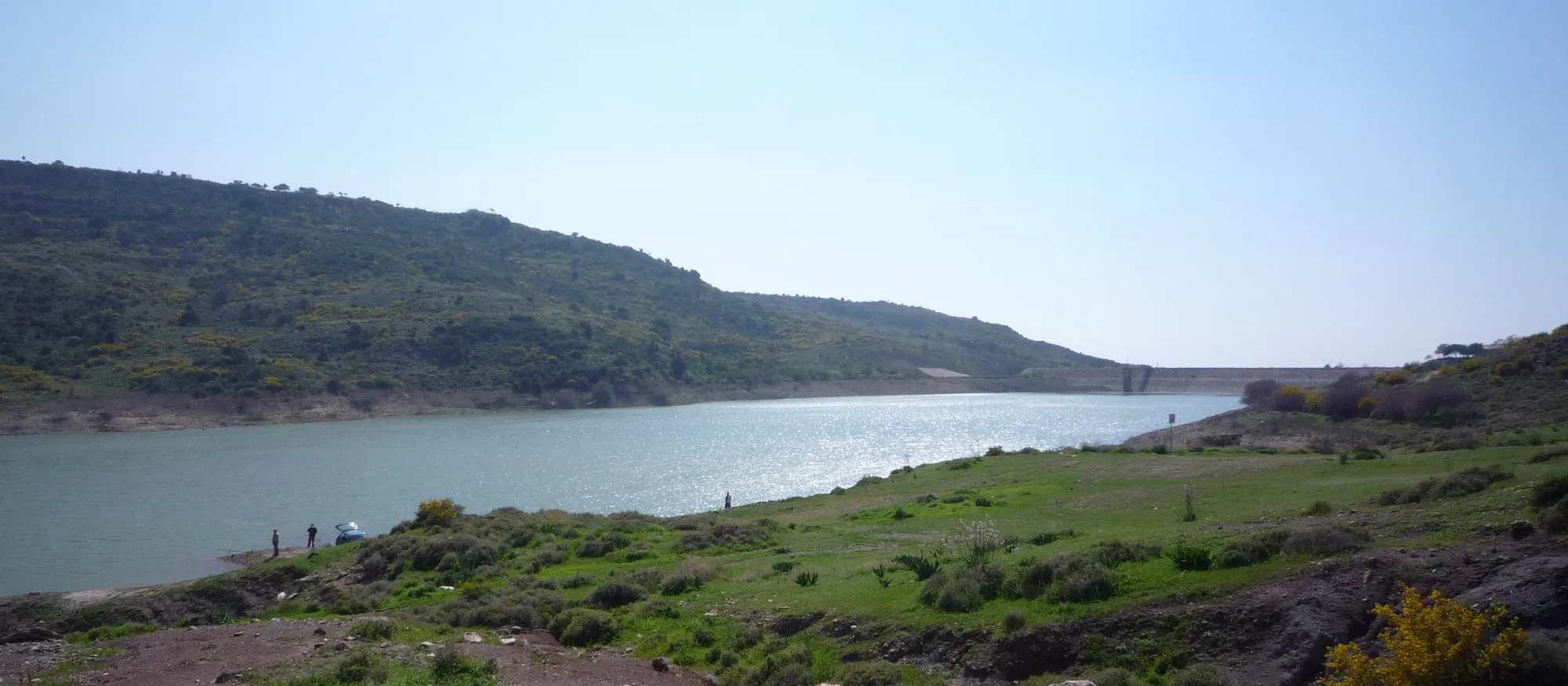
Hero photograph: “Mavrokolympos Reservoir” by RHaworth, licensed CC BY-SA 3.0. It shows the reservoir downstream on the same river, not the waterfalls themselves. Cropped for this page.

Quick answers
Frequently asked questions
How much does it cost to enter Adonis Baths?
The operator's own website lists €15 for adults and €10 for children, covering the whole site with no time limit, bought at the entrance on arrival. Some third-party listings still quote €10, which is out of date. That published price page was last updated in August 2025, so treat it as the best available figure rather than a guarantee and confirm on +357 96 321335 if the cost is decisive.
Can you drive to Adonis Baths?
Yes, and no reservation is needed to arrive by car. The operator is unusually blunt about one thing: it says Google Maps does not show the correct way and asks visitors not to use GPS. Follow the road signs from Tala village or from Coral Bay instead. Cyclists and motorcyclists are told to use the Tala road specifically.
Can you swim in Adonis Baths?
Yes. The operator describes the two-level waterfalls as somewhere visitors can swim, and lists changing rooms, restrooms, sunbeds and parking among the facilities. Bring a towel and footwear you can get wet, and treat it as unsupervised natural water rather than a pool with a lifeguard.
Is Adonis Baths worth visiting?
It depends what you are expecting. It is a privately run attraction that calls itself a theme park, with statues, a museum, a watermill and a café alongside the falls, and the reviews are genuinely mixed: 3.9 out of 5 across more than 6,000 Google reviews. Visitors who arrive expecting a free wild swimming hole tend to be disappointed by the fee; those who plan it as a half-day at a landscaped riverside site are usually happier.
What time of year is best for the Adonis Baths waterfalls?
Spring and the first half of autumn are the comfortable window. The site is open every day all year, but the walk down and back up is exposed, and midsummer afternoons in the Paphos hills are hot. Arriving near the 09:00 opening gives you the coolest air and the quietest site whatever the month.