Paphos district · A hill village and a hotel strip, 1.5 km apart
Chloraka, Cyprus: the village beside Paphos, its hotel coast and how to get around
Chloraka (Chlorakas) is the village on the northern edge of Paphos, about 7 km and 12 minutes from the harbour. What the square and the hotel coast each offer, the 1954 landing site and boat museum, where you can and cannot swim, bus 615 and 607 times, and who it suits as a base.
- Filed under
- Places
- Updated
- 11 November 2026
- By
- The editors
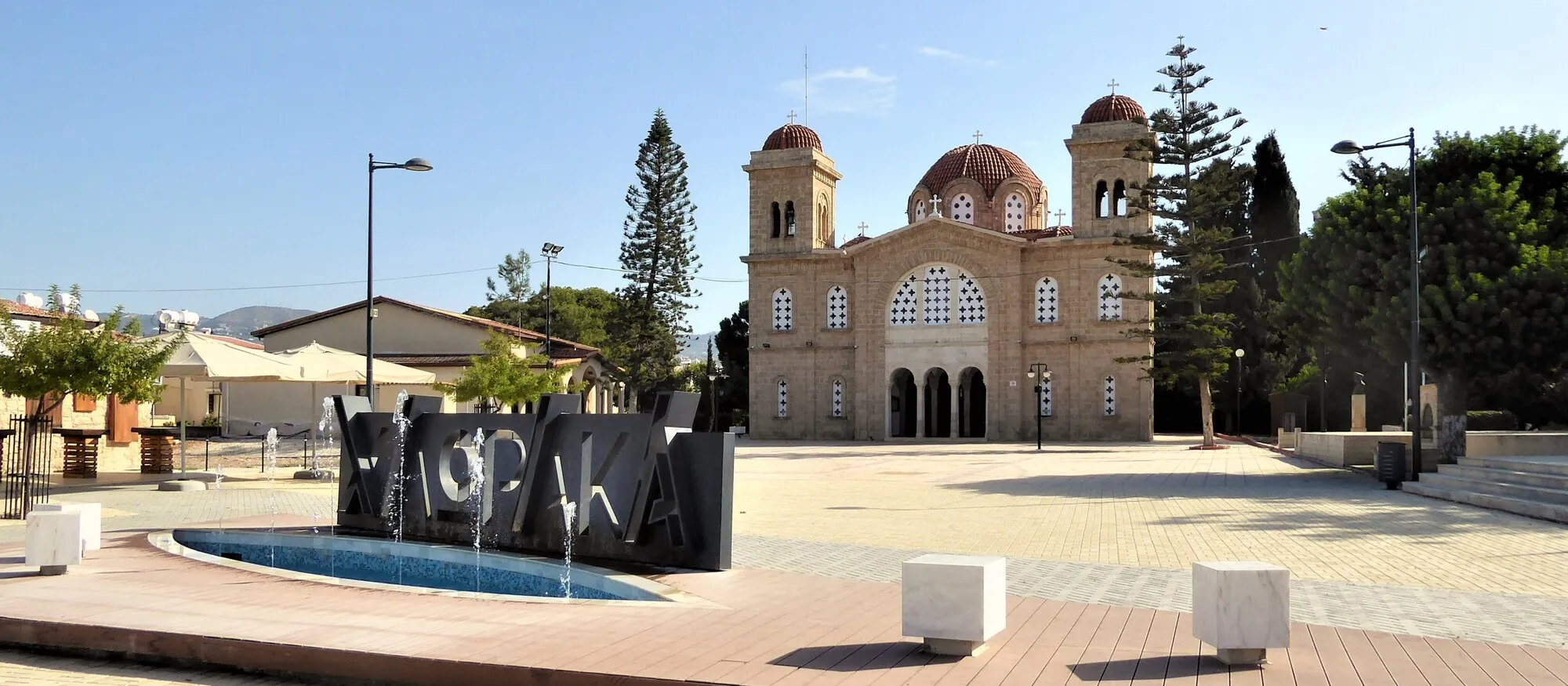
Chloraka, formally Chlorakas, is the village on the northern edge of Paphos, about 7 km and 12 minutes by car from the harbour. It comes in two parts: an old centre on a low hill, with a paved square and two churches, and a strip of large hotels on the coast road 1.5 km below. The coast is rocky, with no Blue Flag beach, so treat it as a quieter base next to Paphos with Coral Bay a short bus ride away, not as a beach resort.
Which half you are booking into matters more than anything else on this page, because the frequent bus serves one and barely touches the other.
Chloraka at a glance
| Where | West coast, joined to the north-west edge of Paphos |
| Spelling | Chlorakas officially, Chloraka in everyday use; same place |
| Altitude | About 75 m at the village centre |
| Population | 6,422 at the 2021 census |
| Local council | Its own community council; not part of Paphos or Akamas municipality |
| Postal code | 8220 for the village |
| Paphos harbour | 6.9 km, about 12 min by car |
| Coral Bay | 8.8 km, about 14 min |
| Buses | 615 along the coast road (frequent, daily); 607 through the square (not Sundays) |
Driving figures here and below are OSRM road-routing estimates in normal traffic.
Two Chlorakas: the square and the coast
| The village | The coast | |
|---|---|---|
| What it is | The old centre: square, churches, council offices, tavernas, bakeries, shops | Hotels and apartments along the Tombs of the Kings to Coral Bay road |
| Height | About 75 m | Sea level |
| Distance apart | 1.5 km by road, about 3 minutes by car, uphill from the sea | |
| Bus | 607, six a day on weekdays | 615, every 10 to 15 minutes |
| Best for | Longer stays, eating where residents eat | Pool holidays, sea views, easy buses to Paphos and Coral Bay |
The walk between the two is short on a map but it climbs all the way and has little shade, so in summer most people drive it or stay put.
A village that kept growing
Chloraka is a working suburb with an old core, and the numbers show how quickly that happened. The census counted 4,420 residents in 2001, 5,356 in 2011 and 6,422 in 2021. The community council’s own hotel list, last updated in 2024, adds ten hotels and apartment complexes with about 1,400 rooms and more than 2,800 beds, most of them on or near the coast. In high season there is almost one visitor bed for every two residents.
Unlike its neighbours, Chloraka was not merged into a larger municipality when local government was reorganised in July 2024. Peyia and Kissonerga to the north became part of Akamas Municipality, and Paphos is its own municipality to the south. Chloraka sits between them and still answers to its own community council, which was putting out tenders under that name in March 2026.
What to see in the village
The square. The centre is a broad paved square with a fountain and the village name in metal letters. Facing it is Panagia Chrysoaimatousa, the large stone parish church with twin bell towers. The council dates it to 1928 and says about half of it collapsed in the Paphos earthquake of 1953, after which it was rebuilt.
Panagia Eleousa. A few steps away is the church the big one replaced: a small domed, cross-shaped building that the council dates to the late 12th or early 13th century, with a Frankish coat of arms over the west door. Inside are layers of wall paintings, the oldest from the 13th century, including a Baptism in which Christ is shown unclothed, which the council describes as extremely rare. It served as the parish church until 1928. There are no published visiting hours, so the inside is a matter of luck or of asking at the council offices on Eleftherias Avenue.
The amphitheatre and the old fountain. Just off the square, next to the village fountain of 1916, is an open-air theatre for about 400 people, finished in 2011, looking west over a ravine to the sea. It is used for summer performances.
Agios Nikolaos. At the southern edge of the village, near the football ground, is a single-aisled domed chapel that was a small monastery until the first half of the 19th century. The council gives it a probable 16th-century date.
For food, the Deputy Ministry of Tourism’s directory lists Angelica on Griva Digeni Avenue, Paradise on Solonos Michaelide Street, and Costa Rica and Pepperoni Pizza on the main Chlorakas to Paphos avenue. We have not ranked them; take it as a list of where to start looking. Our Paphos restaurants guide covers the town next door.
The coast: Alyki and the boat museum
The one sight on the coast that people travel for is at Alyki, beside the St George hotel. In the 1950s this was an empty shore, which is why it was chosen for smuggling arms from Greece for EOKA, the armed campaign against British colonial rule that began on 1 April 1955.
Most short descriptions of the site blur two events and two boats. The government leaflet on the site, the council and the Cyprus Mail give the sequence clearly:
| Date | What happened | Boat |
|---|---|---|
| 5 March 1954 | First arms shipment landed at Vrexi cove | Siren |
| 10 November 1954 | Georgios Grivas, EOKA’s military leader, came ashore in secret at Alyki | Siren |
| 25 January 1955 | A second shipment was intercepted at Rodafinia, 1.5 km to the south-west; boat, crew and the men waiting on shore were arrested | Agios Georgios |
So the caique in the museum, the Agios Georgios, is the boat that was caught, not the one Grivas arrived on. It was built on Skopelos in 1947, bought at auction by the then mayor of Paphos on Archbishop Makarios’s instructions after the British sold it, and moved to Alyki in October 1961. A shelter was built over it in 1968 and extended in 1994 and 2000. The hull was fully restored in 2019.
Around it are a small white chapel of Saint George, whose foundation stone was laid in July 1961 and which is now a popular wedding chapel; a 14-metre bronze-clad Monument of Memory and Honour on the landing spot, unveiled in November 2000; a statue of Grivas; and a wall of white marble reliefs telling the story.
The monument, reliefs and chapel exterior are outdoors and can be seen at any time. We could not find official opening hours or an entry fee for the boat shelter on any government or council page, so if seeing the caique up close matters to you, ask your hotel to check before you walk down. This is a memorial site for many Cypriots and wreath-laying ceremonies are held here, so treat it as you would a war memorial.
The other shipwreck. Looking south from the coast road you will see a rusting cargo ship stuck on a reef. This is the Demetrios II, a 66-metre Honduran-flagged freighter built in Hamburg in 1964, which ran aground in a storm on 23 March 1998 with a cargo of timber. Its crew were lifted off by a British military helicopter. It is a different wreck from the Edro III, the one in most photographs, which is further up the coast at the Sea Caves.
Can you swim at Chloraka?
Yes, but manage your expectations. The shoreline is low rock with small inlets. Dimma, the cove where village children traditionally learned to swim, is named after the holes fishermen cut in the rock to tie up their boats. The council itself laments on its website that the coast has been built over, and the sea lilies that once covered it are mostly gone.
There is no Chloraka entry on the 2026 Blue Flag list published by CYMEPA, which means no beach here with the lifeguard cover and facilities that the award requires. Hotels on this stretch are built around pools and terraces. For sand, lifeguards and shallow water, go to:
- Coral Bay, 7.7 km and about 12 minutes north of the St George hotels, or a direct ride on bus 615. See our Coral Bay guide.
- The Paphos town beaches, including Faros by the lighthouse, about 6.4 km south. Our Paphos beaches guide compares them.
A paved footpath follows parts of the shore from the Saint George chapel. Local walk reports from 2023 and 2024 describe steps and closed sections, so treat it as a stroll, not a through route into Paphos.
Getting to Chloraka
By car
| From the village square to | Distance | Drive time |
|---|---|---|
| Chloraka coast (Saint George chapel) | 1.5 km | 3 min |
| Tombs of the Kings | 3.5 km | 6 min |
| Paphos, Karavela bus station | 3.7 km | 6 min |
| Paphos old town | 4.2 km | 7 min |
| Kings Avenue Mall | 5.3 km | 9 min |
| Paphos harbour | 6.9 km | 12 min |
| Coral Bay | 8.8 km | 14 min |
| Peyia village | 10.9 km | 16 min |
| Paphos Airport | 16.4 km | 24 min |
| Larnaca Airport | 137 km | about 1 h 55 min |
Arriving by air, our Paphos Airport to Paphos guide explains the taxi and bus options as far as the town; Chloraka is ten minutes beyond it. For hire terms, see the Cyprus car hire guide.
By bus
Two Pafos Buses routes serve Chloraka, and they serve different halves of it. These were the times on the operator’s route pages on 11 November 2026.
| Route | Where it stops | When it runs |
|---|---|---|
| 615 Tombs of the Kings station to Coral Bay | The coast road past the hotels | Daily. In school term on weekdays, every 10 to 15 minutes from 08:00 to 17:45; at weekends and in holidays, every 10 to 15 minutes from 08:20 to 17:50. Evening buses every 20 minutes from 18:00 to 23:40 between April and November, then 00:15 and 00:40; every 30 minutes from 18:00 to midnight from December to March |
| 607 Karavela station, Chloraka, Lemba, Kissonerga, Pegeia | Archiepiskopou Makariou and Eleftherias in the village, by the square | Weekdays from Karavela at 06:00, 08:10, 09:50, 11:30, 15:10 and 18:00; from Pegeia at 06:30, 09:00, 10:30, 12:10, 16:00 and 18:40. Saturdays from Karavela at 07:20, 11:20, 13:30 and 16:20. No Sunday service listed |
The practical point: a hotel on the coast road has a bus to Paphos or Coral Bay every few minutes until late, while a villa up in the village has six a day and none on Sundays. The 615 ends at the Tombs of the Kings station, where you change for the harbour; our Paphos to Coral Bay guide walks through that connection.
Fares are €2 for a single, €3 after 21:00 and €6.50 for a day ticket, bought on the bus. Children up to five travel free and under-12s pay half. Public holiday timetables differ, so check the route 615 and route 607 pages before relying on a particular departure.
Chloraka weather
There is no weather station in Chloraka, and none is needed: Paphos Airport, 16 km away on the same coast, is the long-term record. Its 1991 to 2020 normals give a mean daily maximum of 31.0°C in August and 19.3°C in December. The council puts average annual rainfall for the village at about 420 mm a year. For the month-by-month picture, see our best time to visit Cyprus guide.
Should you stay in Chloraka?
Stay on the coast if you want a pool hotel with sea views at a little distance from the Paphos bar strip, and you are happy to take the 615 to a proper beach. Stay in the village if you have a car, are here for weeks and want bakeries, tavernas and neighbours rather than a resort; it is one of the places people weigh up in our best places to live in Cyprus guide. If a sandy beach outside the door is the whole point, Coral Bay or Paphos itself will suit you better.
Either way the sights of Paphos are close. The Tombs of the Kings are six minutes away, the harbour twelve, and our Paphos guide covers the rest.
Sources for changing details: bus times and fares from Pafos Buses route and ticket pages, read 11 November 2026; village history, churches, coves and the hotel list from the Chloraka community council; the 1954 and 1955 events from the Press and Information Office leaflet The Liberation Struggle of EOKA 1955-1959 and the Chloraka Coast and the Cyprus Mail report on the 2019 restoration; the monument from the Open University of Cyprus public art record; Blue Flags from the CYMEPA 2026 list; restaurants from the Visit Cyprus gastronomy directory; population from Statistical Service census figures; climate normals for Paphos Airport from the World Meteorological Organization 1991 to 2020 series.
Hero image: Panagia Chrysoematousa Church, Chloraka by Chris06, Wikimedia Commons, CC BY-SA 4.0, cropped.

Quick answers
Frequently asked questions
Where is Chloraka in Cyprus?
Chloraka is a village on the west coast of Cyprus, directly north-west of Paphos and joined to it by continuous building. The village centre sits about 75 metres above sea level, roughly 7 km and 12 minutes by car from Paphos harbour and 3.5 km from the Tombs of the Kings. Its hotel coast is 1.5 km downhill from the square. The postal code for the village is 8220.
Is it Chloraka or Chlorakas?
Both are correct and both mean the same place. Chlorakas is the formal, masculine form used on official documents and by the community council; Chloraka is the everyday spoken form and the one on most maps and hotel listings. You will also see Hloraka on some government publications.
Does Chloraka have a beach?
It has a coastline rather than a beach resort. The shore is mostly low rock with small coves, and the hotels there rely on pools and sunbathing terraces. No Chloraka beach appears on the 2026 Blue Flag list. The nearest flagged sandy beaches are Coral Bay, about 8 km and 12 minutes north by car or on bus 615, and the Paphos town beaches to the south.
How do I get from Paphos to Chloraka by bus?
For the hotel coast, take Pafos Buses route 615 from the Tombs of the Kings bus station towards Coral Bay. It runs along the Chloraka coast road every 10 to 15 minutes for most of the day and into the late evening. For the village square, route 607 from Karavela station is the direct bus, with six departures on weekdays, four on Saturdays and none listed on Sundays. A single is 2 euros.
What is the boat on display at Chloraka?
It is the Agios Georgios, a wooden caique built on the Greek island of Skopelos in 1947. British forces seized it off Chloraka on 25 January 1955 while it was unloading arms for EOKA, the group that fought British rule. It has been kept at Alyki on the Chloraka coast since October 1961 and was restored in 2019. It is not the boat that brought the EOKA leader Georgios Grivas ashore in November 1954; that was a different vessel, the Siren.