Paphos district · 85 m up on the coastal plain, 18 minutes from Paphos
Kouklia, Cyprus: the Sanctuary of Aphrodite at Old Paphos and how to visit
Kouklia is the village 16 km east of Paphos built over Palaepaphos, the ancient city and Sanctuary of Aphrodite. Opening hours (closed Mondays), the 4.50 euro ticket, what to see in the site and museum, bus 631, drive times and how to pair it with Aphrodite's Rock.
- Filed under
- Places
- Updated
- 6 November 2026
- By
- The editors
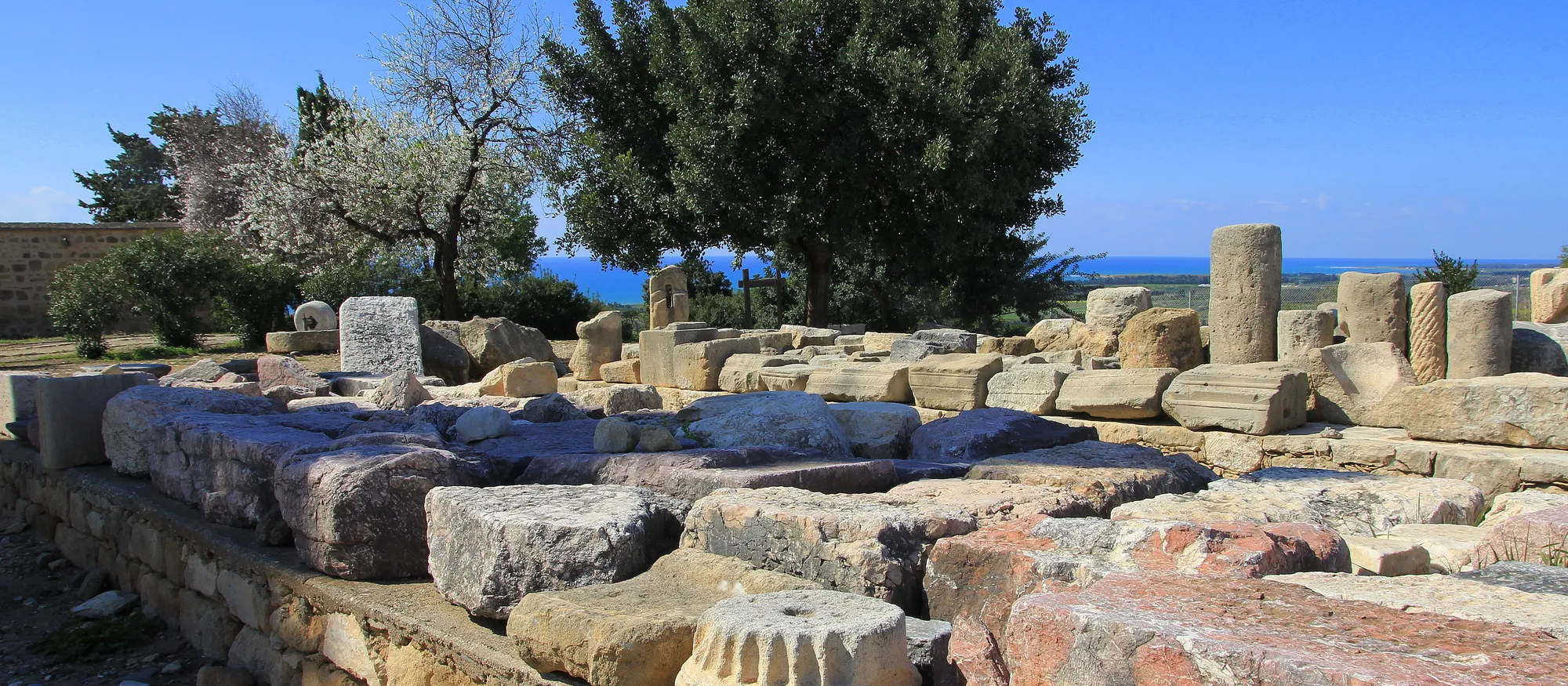
Kouklia is the village about 16 km east of Paphos that stands on top of Palaepaphos, Old Paphos, the ancient city-kingdom whose Sanctuary of Aphrodite was the most famous shrine of the goddess in the ancient world. You can visit the sanctuary ruins and a small museum in a 13th-century Lusignan manor house on one 4.50 euro ticket, Tuesday to Sunday from 08:30 to 17:00. It is closed on Mondays. Allow about an hour, and pair it with Aphrodite’s Rock, eight minutes down the road.
That Monday closure is the detail most guides miss. The Department of Antiquities changed the hours on 1 July 2024, and many websites still show the old daily timetable with a 19:30 summer close. If you are building a day around Kouklia, check the day of the week before anything else.
Kouklia at a glance
| Where | Paphos district, on the old Paphos to Limassol road (B6), 85 m above sea level |
| From Paphos | About 18 km and 18 minutes from the Karavella area; 22 km and 25 minutes from Kato Paphos harbour |
| From Paphos Airport | About 12 km and 18 minutes |
| From Limassol | About 50 km and 45 minutes via the A6 motorway |
| Main site | Palaepaphos archaeological site (Sanctuary of Aphrodite) and the Local Archaeological Museum |
| Hours | Tuesday to Sunday 08:30-17:00; closed Mondays, Christmas Day, New Year’s Day and Orthodox Easter Sunday |
| Ticket | 4.50 euros, site and museum together |
| Bus | Pafos Buses 631 from Paphos Harbour, 2 euros single |
| Accessibility | The Department of Antiquities lists the site as not wheelchair accessible |
| Time needed | About an hour for the site and museum |
What Palaepaphos was
Palaepaphos was the capital of the ancient kingdom of Paphos, which covered much of western Cyprus. Its kings also held the title of high priest of the goddess; inscriptions call them “King of Paphos and Priest of Anassa”, Anassa meaning the lady or queen. Visit Cyprus records two founding legends: one credits Agapenor, king of Tegea, blown to Cyprus on his way home from the Trojan War, and the other Kinyras, a legendary local king and first high priest.
The first monumental sanctuary went up around 1200 BC, and worship continued on the same spot until the 3rd or 4th century AD. In the Visit Cyprus audio-guide text, that makes it the longest-lasting cult site in the island’s religious tradition, with a fertility goddess older than the Greek Aphrodite merging into her over time. Greek writers placed the goddess’s birth from the sea foam a few kilometres away, which is where Aphrodite’s Rock gets its legend.
Around 320 BC the last king, Nikokles, moved the capital to a new port city, Nea Paphos, where the harbour and mosaics of modern Kato Paphos are now. The old city was renamed Palaepaphos and became a sacred town; Roman-era pilgrims walked here from Nea Paphos in procession. The whole area is part of the UNESCO World Heritage Site inscribed as “Paphos” in 1980, the first in Cyprus, which also covers the Paphos Archaeological Park and the Tombs of the Kings.
The village name has a later story. Visit Cyprus links it to kouvouklio, a Byzantine word for the emperor’s chamber. In the 13th century the Lusignan kings made the place the centre of a royal sugar-cane estate, and it was known as Kouvouklia.
What you see at the site
Set your expectations before you go: this is not Kourion or the Kato Paphos mosaics. The sanctuary was quarried for building stone in the Middle Ages, so what survives is mostly foundations, huge limestone blocks and scattered column pieces. What makes it worth the trip is knowing what you are standing in.
- Sanctuary I. The Late Bronze Age sanctuary of about 1200 BC, near the manor house. Look for the enormous limestone blocks of the temenos wall, the open-air court where worship happened, and a tall rectangular pillar. Until recent decades, village mothers lit candles at that pillar for Panagia Galatariotissa, the Virgin who gives milk, a faint echo of the old fertility cult.
- Sanctuary II. The Roman rebuild of the late 1st or early 2nd century AD, laid out as a Pi-shaped court about 79 by 67 metres with two long stoas used for ritual banquets. Fragments of their geometric mosaic floors survive.
- The House of Leda. Across the path, a Roman peristyle house with a Leda and the Swan mosaic in its courtyard. The mosaic in place is a copy.
- The Lusignan manor house. The big sandstone building with buttresses at the south of the site, built in the 13th century as the administrative seat of the royal sugar estate and later an Ottoman estate house. The vaulted Gothic hall in its east wing is, in the audio guide’s words, one of the finest surviving pieces of Frankish secular architecture on the island.
Visit Cyprus publishes a free English audio guide and a written tour on its Kouklia audio-guide page. Download it before you arrive; the on-site panels are brief.
The museum
The Local Archaeological Museum fills two halls of the manor’s east wing and is included in your ticket. The single object to look for is the dark conical stone that represented the goddess in worship. The Paphian Aphrodite was not shown as a woman in her own sanctuary but as this stone, which is also what you see on Roman coins of the shrine.
The Department of Antiquities lists the other highlights as a Late Bronze Age clay bathtub, finds from the area’s cemeteries from the 2nd millennium BC to Roman times, Ionic and Corinthian capitals, and, at the back, two bronze cannons from Venetian ships. There are also clay moulds and jars from the medieval sugar works, and a 6th-century BC limestone sarcophagus found in 2006 with painted battle scenes, including Hercules and Odysseus escaping the Cyclops.
Beyond the sanctuary
- Panagia Katholiki stands just east of the sanctuary enclosure. The 12th or 13th-century church was originally dedicated to Panagia Aphroditissa, a name that says a lot about the place.
- The sugar refinery at Stavros, on the coastal plain to the east, is one of the few medieval sugar works in the Mediterranean to keep all its main functional parts, according to Visit Cyprus. It ran from the late 13th to the 16th century, and Cypriot sugar fetched the highest prices in Europe. The Knights of St John built a similar works next to Kolossi Castle, where the ruins are easier to read.
- The village churches. Visit Cyprus singles out Panagia Hodegetria, a 13th-century cruciform church with 15th-century wall paintings, and the main church of Apostle Luke, which holds a large religious fair on 17 October.
- The Kouklia nature trail. The community council describes a trail of about 7 km through farmland and scrub around the village. There is no shade to speak of, so walk it early or in the cooler months.
Getting to Kouklia
By car. Leave the A6 motorway or the old B6 coast road and follow the F616 into the village; the site is signposted and has a car park. From Paphos it is a quick 18 to 25 minutes depending on where you start. Our driving in Cyprus guide covers the rules and roads.
By bus. Pafos Buses route 631 runs from Paphos Harbour station via Poseidonos Avenue, Geroskipou and the old Limassol road to a stop at Kouklia Archaeological Site, then on to Petra tou Romiou. A single is 2 euros on board, 3 euros after 21:00, and a day ticket is 6.50 euros.
| 631 timetable | From Paphos Harbour (Mon-Sat) | From Petra tou Romiou (daily) |
|---|---|---|
| April to November | 07:25, 09:15, 10:40, 14:20, 15:40, 16:00, 17:30, 18:40, 19:40, 22:35 | 08:20, 10:10, 11:35, 15:15, 16:35, 16:55, 18:20, 19:30, 20:30, 23:15 |
| December to March | 07:25, 09:15, 10:40, 14:10, 16:00, 18:40, 22:35 | 08:20, 10:10, 11:35, 15:05, 16:55, 19:30, 23:15 |
On Sundays and public holidays the first bus from the harbour leaves at 06:30 instead of 07:25. The return bus calls at Kouklia a few minutes after leaving Petra tou Romiou. The 09:15 from the harbour gives you the site plus Aphrodite’s Rock, with the 11:35 or a mid-afternoon bus back. Pafos Buses does not publish journey times, so allow some slack.
Kouklia, Aphrodite’s Rock or Kourion?
| Kouklia (Palaepaphos) | Aphrodite’s Rock | Kourion | |
|---|---|---|---|
| What it is | The goddess’s main sanctuary, a museum and a medieval manor | The sea stack of her birth legend and a pebble beach | A Greco-Roman city with a theatre on a clifftop |
| What you see | Low ruins, needs context | A famous view | Big, legible ruins and mosaics |
| Cost | 4.50 euros | Free | 4.50 euros |
| Closed Mondays | Yes | No | No |
| Time needed | About 1 hour | 30 to 60 minutes | 2 to 3 hours |
For a day on the Aphrodite theme, start at Kouklia when it opens, drive eight minutes to Aphrodite’s Rock for the viewpoint, and carry on to Kourion or lunch in Pissouri. That works heading east or west and fits neatly into a Paphos to Limassol transfer. Back in town, our things to do in Paphos page covers the rest of the UNESCO sites.
Tips for visiting
- Avoid Mondays, and check the Department of Antiquities’ public holiday hours; the Cyprus public holidays list will show if your date is affected.
- Go early in summer. The site is open ground with little shade, and the afternoon heat on the coastal plain is hard going.
- Read or listen first. Ten minutes with the Visit Cyprus audio guide makes the ruins far more rewarding.
- Combine tickets only if you will use them. The 8.50 euro one-day pass pays off only if you visit two other Department of Antiquities sites the same day, such as Kourion and the Paphos Archaeological Park.
Sources for changing details: Opening hours, ticket price, museum contents and accessibility from the Department of Antiquities. Site history, holiday closures, group discount, passes and village details from Visit Cyprus (archaeological site, village and the Kouklia audio guide written tour). Nature trail from the Kouklia community council. Bus times from Pafos Buses route 631 and fares from Pafos Buses tickets. Drive times from OSRM routing on OpenStreetMap data. All checked 6 November 2026; confirm hours before you travel.
Hero photo: Sanctuary of Aphrodite at Palaepafos by Wojciech Biegun, via Wikimedia Commons, licensed CC BY-SA 3.0. Cropped for the header.

Quick answers
Frequently asked questions
Where is Kouklia in Cyprus?
Kouklia is a village in the Paphos district, about 16 km east of Paphos town on the old Paphos to Limassol road (B6), at 85 metres above sea level. It sits a short way inland from the coast and about 7 km by road from Aphrodite's Rock (Petra tou Romiou). The ancient city of Palaepaphos, or Old Paphos, lies under and around the village.
What are the opening hours of the Sanctuary of Aphrodite at Kouklia?
Since 1 July 2024 the Department of Antiquities has opened the Palaepaphos archaeological site and the Kouklia museum Tuesday to Sunday, 08:30 to 17:00, all year. It is closed on Mondays, and Visit Cyprus says it also closes on Christmas Day, New Year's Day and Orthodox Easter Sunday. Many older websites still show daily opening with 19:30 summer closing, which is out of date.
How much does it cost to visit Kouklia?
Entry is 4.50 euros and includes both the Palaepaphos archaeological site and the local museum in the Lusignan manor house. Groups of more than ten get 20% off. The Department of Antiquities also sells one, three and seven day passes for its sites at 8.50, 17 and 25 euros.
Can you get to Kouklia by bus from Paphos?
Yes. Pafos Buses route 631 runs from Paphos Harbour station along the old Limassol road and stops at Kouklia Archaeological Site before ending at Petra tou Romiou. A single is 2 euros on board (3 euros after 21:00). In the April to November timetable there are ten departures from the harbour Monday to Saturday, and seven in the December to March timetable.
Is Kouklia worth visiting?
Yes, if you have any interest in Aphrodite beyond the photo at her rock. It was the goddess's most famous sanctuary for some 1,600 years, the museum holds the conical stone that stood for her in worship, and the medieval manor house is one of the best Frankish buildings in Cyprus. The ruins themselves are low and fragmentary, so allow about an hour and read up first.