Places · The island's far north-east
The Karpas Peninsula, Cyprus: Golden Beach, Apostolos Andreas and how to get there
The Karpas (Karpaz) peninsula in northern Cyprus: Golden Beach, the Apostolos Andreas monastery, the free-roaming donkeys, Rizokarpaso, 2026 site hours and tickets, and realistic drive times from Ayia Napa, Protaras and Larnaca.
- Filed under
- Places
- Updated
- 14 October 2026
- By
- The editors
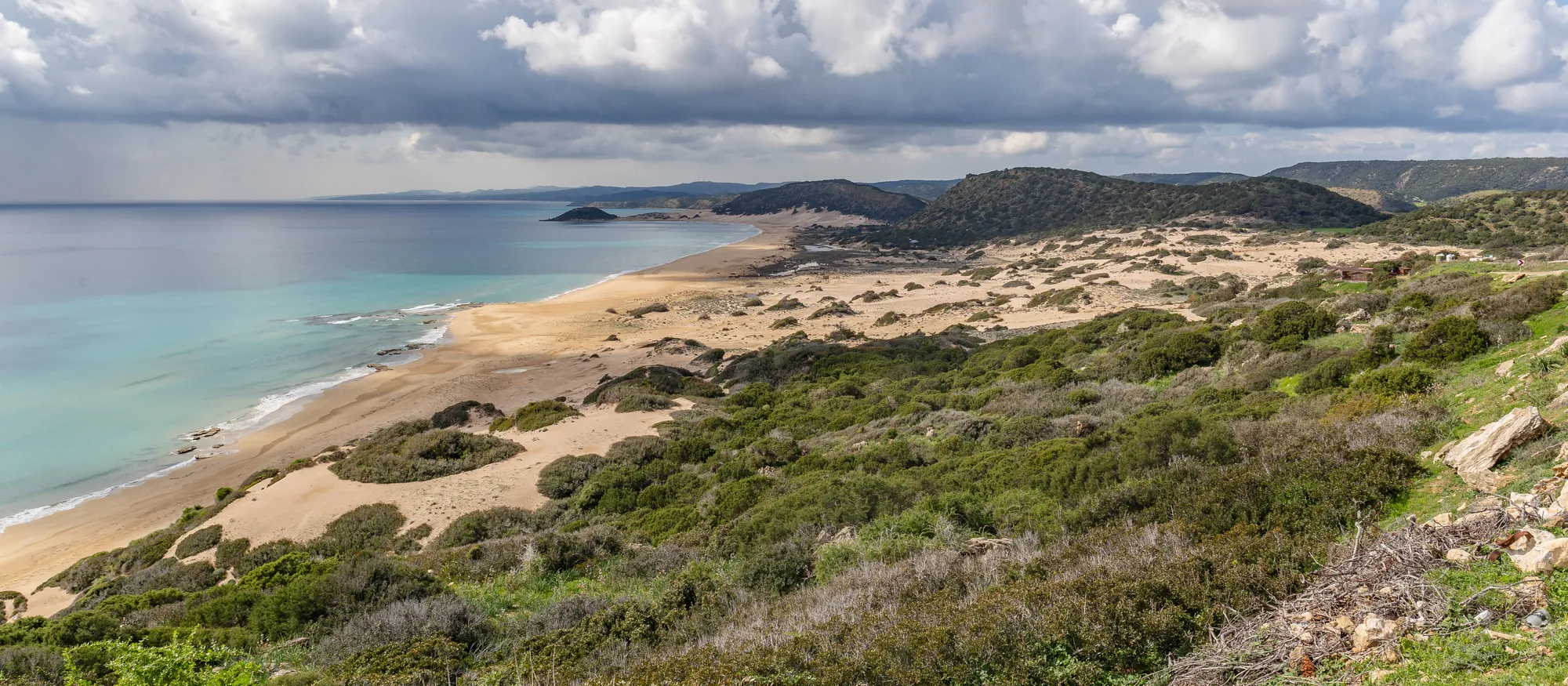
The Karpas peninsula, called Karpaz in Turkish, is the long, narrow finger of land at the north-eastern tip of Cyprus. It is the emptiest part of the island: sand beaches where turtles nest, free-roaming donkeys, a handful of villages and the Apostolos Andreas monastery near the very end. It is in the north, under Turkish Cypriot administration, and from Ayia Napa or Protaras Golden Beach is about 120 km and two hours 20 minutes by car through the Deryneia crossing.
That drive time is what shapes a visit. The Karpas is the furthest you can get from any southern resort, the road beyond the last town is slow, and in late October it is dark before 17:00. This guide covers what there is to see, the 2026 hours and prices for the sites that charge, realistic drive times from the south and how to fit it into a day, or better, two.
The Karpas at a glance
| Where | North-east tip of Cyprus, from the İskele area out to Cape Apostolos Andreas |
| Names | Karpas or Karpass in English, Karpaz in Turkish, Karpasia in Greek |
| Administration | Turkish Cypriot, in the north of the divided island |
| Main town | Rizokarpaso, called Dipkarpaz in Turkish |
| Highlights | Golden Beach, Apostolos Andreas monastery, the donkeys, Ayia Trias basilica |
| Golden Beach from Ayia Napa | About 120 km, 2 hr 20 min by car, plus the checkpoint |
| Currency | Turkish lira |
| Beach facilities | Few or none; no lifeguards |
The peninsula covers about 898 square kilometres, roughly a quarter of the north’s territory, but in 2010 it had only around 26 people per square kilometre. Visit North Cyprus, the Turkish Cypriot tourism body, puts its length at almost 80 km from end to end. Much of the far end is protected as the Karpaz National Park.
Golden Beach
Golden Beach, Altınkum in Turkish and Nangomi in Greek, is the reason most people make the trip. It is a wide sweep of pale sand about four kilometres long, backed by dunes that run up to 500 metres inland on the eastern side, with low scrub-covered hills behind. There are no hotels on it, and on a weekday outside the school holidays you may share a kilometre of it with a handful of people.
It is also a protected turtle nesting beach, and the way it is managed has changed. From 1990 the north’s forestry department allowed small restaurants and wooden bungalows around the beach. After a long court case over the state of the site, those leases were cancelled and the buildings were cleared around 2017. The result is a cleaner beach with almost nothing on it, so treat it as a wild beach rather than a beach club:
- No lifeguards. The sea is often calm, but there is nobody to help if it is not.
- Bring everything. Water, food, shade and sun cream. Older guides that mention beach huts and a café on the sand are out of date.
- Take your rubbish home. Visitors still report litter left behind, and there is no one clearing up after you.
- Camping is forbidden on the beach and the surrounding protected area.
- Respect the nests. Loggerhead and green turtles nest on the Karpas beaches in summer. Do not dig near marked nests, use lights on the sand at night or drive onto the beach.
The last hundred metres to the parking area are unsurfaced. A paved coast road continues past the beach to the monastery and the cape.
Apostolos Andreas monastery
The monastery of Apostolos Andreas, St Andrew, stands just south of the cape at the north-eastern point of Cyprus, about ten minutes’ drive beyond Golden Beach. Tradition says the ship carrying St Andrew to the Holy Land struck the rocks here and that a spring with healing powers rose where he struck the ground with his staff. The present church dates from the 18th century, and the larger buildings around it were added about a hundred years later.
Both Greek Cypriots and Turkish Cypriots treat it as a holy place, and it remains an active Orthodox pilgrimage site, so dress modestly. After years of decay, a restoration funded equally by the Church of Cyprus and the Turkish Cypriot EVKAF foundation, coordinated through the UN, restored the church, which reopened in November 2016. Work on the surrounding buildings went on after that. The monastery is not run by the north’s Department of Antiquities, so it does not appear on its ticket list, and we could not find official opening hours. Go in daylight and expect it to be busiest at weekends and on the saint’s feast in late November.
Beyond the monastery the road runs on to Cape Apostolos Andreas, Zafer Burnu in Turkish, the very tip of the island. The tip is a protected area, where marine life is recovering after years of dynamite fishing.
The Karpas donkeys
The free-roaming donkeys are the peninsula’s best-known residents. They live in the national park area around Golden Beach and the monastery and often gather at the roadside waiting for food from passing cars. The national park lies within Rizokarpaso’s municipal area, and conservation campaigns for the herd have been run jointly by Turkish Cypriots and Greek Cypriots.
They are wild enough to kick and bite and tame enough to put their heads through a car window. Drive slowly through the park, keep children back from their hind legs and do not feed them bread, crisps or anything salty.
Rizokarpaso and the sights on the way
Rizokarpaso (Dipkarpaz) is the last sizeable town, about 18 km and 25 minutes before Golden Beach, and the place to stop for fuel, cash and lunch. It is also unusual: in 1974 the peninsula was cut off before its Greek Cypriot population could leave, and Rizokarpaso still has the largest Greek Cypriot community in the north, mostly elderly. Its main church, Ayios Synesios, stands near the mosque. Since about 2000 a number of old village houses have been converted into guesthouses, which makes it the natural base for an overnight stay.
Ayia Trias basilica at Sipahi, about 20 minutes’ drive before Rizokarpaso, is the ruin of an early Christian basilica with a mosaic floor.
The ancient city of Karpasia and the church of Ayios Philon lie on the coast just north of Rizokarpaso, with the ruins of ancient Aphendrika further east.
Kantara Castle is near the start of the peninsula, high in the hills above the north coast, and makes a good stop on the way out or back.
The two Department of Antiquities sites charge entry. These are the summer 2026 hours from the department’s visiting-hours page:
| Site (1 Apr to 31 Oct 2026) | Hours | Last entry | Full ticket |
|---|---|---|---|
| Kantara Castle | 10:00 to 15:30 | 14:45 | 100 TL |
| Ayia Trias basilica, Sipahi | 08:00 to 15:30 | 15:00 | 100 TL |
Student tickets are 50 lira. At the European Central Bank reference rate on 12 October 2026, 100 lira is about £1.55 or €1.80. The summer schedule ends on 31 October, and winter hours had not been published when we checked on 14 October 2026. Both sites close mid-afternoon, so if you want to see them, do it on the way out rather than on the way back.
Getting to the Karpas from the south
From the east coast the usual route is the Deryneia crossing, then north through Famagusta and up the peninsula. These are driving estimates on the public road network, and they leave out the checkpoint queue.
| From | To Golden Beach | Drive time |
|---|---|---|
| Ayia Napa (via Deryneia) | 120 km | 2 hr 20 min |
| Protaras (via Deryneia) | 123 km | 2 hr 20 min |
| Larnaca Airport (via Deryneia) | 168 km | 2 hr 55 min |
| Limassol (via Deryneia) | 225 km | 3 hr 40 min |
| Nicosia (Agios Dometios crossing) | 149 km | 2 hr 35 min |
| Kyrenia | 129 km | 2 hr 15 min |
| Famagusta | 103 km | 1 hr 55 min |
| Rizokarpaso | 18 km | 25 min |
| Golden Beach to the monastery | 6 km | 10 min |
By car. This is the only practical way to see the peninsula independently. Many cars hired in the Republic are not covered in the north, and insurance sold at the crossings does not mean your hire company allows the trip, so check before you book. Our car hire guide covers what to ask. Fill up and get cash in Rizokarpaso, because there is very little beyond it.
By tour. Several operators in the north run full-day Karpas tours, mostly from Kyrenia and Famagusta. A tour removes the hire-car question and the long drive back in the dark, at the cost of a fixed timetable.
Crossing the line. Take a passport or EU identity card. Our Green Line crossing guide explains the checks and the customs limits on what you bring back.
A day trip or a night?
From Ayia Napa or Protaras a day trip works if you leave early: about four and a half hours of driving, plus the crossing both ways, leaves time for the beach, the monastery and lunch in Rizokarpaso. From Larnaca it is close to six hours in the car, and from Limassol or Paphos it is too far for a day.
Daylight is the real constraint. The clocks go back on 25 October, and from then until late January the sun sets before 17:00, so a winter day trip means turning round by early afternoon. The road beyond Rizokarpaso is narrow and unlit, and donkeys stand on it. Our Cyprus time zone guide has the clock-change dates.
A night in a Rizokarpaso guesthouse fixes all of this. You get Golden Beach in the early morning, the sights on the way back and no night driving.
What changes on the north side
The Karpas follows the same rules as the rest of the north, and our north or south Cyprus guide sets them out in full.
- Money. The north uses the Turkish lira. Cards are not taken everywhere in the villages, so carry some cash. See our Cyprus currency guide.
- Phones. The north is on Turkish networks and outside EU roaming rules. Our phone guide explains the costs.
- Health cover. EHIC and GHIC are not valid in the north, so check that your travel insurance covers it.
- Arriving by air. The UK Foreign Office says that entering Cyprus through the north, for example at Ercan airport, counts as illegal entry in the eyes of the Republic. Fly into Larnaca or Paphos and cross by land.
Pairing the Karpas with other trips
If you have a second day in the north, Famagusta is on the way back. The walled city, ancient Salamis and the fenced resort of Varosha are all within half an hour of the Deryneia crossing. For a different north-coast day, Kyrenia is closer to Nicosia than to the Karpas. If wild beaches are what you are after and you are staying in the south, compare the drive with Lara Beach in the Akamas, the south’s best-known turtle beach, or the closer coves on our Protaras beaches list.
Sources for changing details: Kantara Castle and Ayia Trias hours and prices from the Turkish Cypriot Department of Antiquities and Museums visiting-hours page, checked 14 October 2026; the same page notes that Apostolos Andreas is not managed by the department. Sterling and euro conversions at the European Central Bank reference rate of 12 October 2026. Peninsula area, population density and the turtle and donkey details from the Karpas Peninsula reference page; length from Visit North Cyprus. Golden Beach history, dunes and access from the Golden Beach reference page. Monastery history and restoration from the Apostolos Andreas Monastery reference page and Greek City Times, 8 November 2016. Rizokarpaso community details from the Rizokarpaso reference page. Entry and crossing points from the UK Foreign Office Cyprus travel advice. Driving distances and times are OpenStreetMap routing estimates and exclude checkpoint queues.
Hero photo: Golden Beach, Karpaz, by Michal Klajban, via Wikimedia Commons, licensed CC BY-SA 4.0. Cropped.

Quick answers
Frequently asked questions
Is the Karpas peninsula worth visiting?
Yes, if you want empty sand and quiet countryside more than resort facilities. Golden Beach is one of the finest natural beaches on the island and the Apostolos Andreas monastery is a genuine pilgrimage site. But it is a long day: about two and a quarter hours each way from Ayia Napa or Protaras, plus the checkpoint, so go early or stay a night in Rizokarpaso.
How long does it take to drive from Ayia Napa to Golden Beach?
About 120 km and two hours 20 minutes by car through the Deryneia crossing, before any queue at the checkpoint. From Protaras it is much the same, from Larnaca Airport about three hours, and from Limassol close to three and three-quarter hours. The last stretch beyond Rizokarpaso is slow.
Are there facilities at Golden Beach?
Very few. The bungalows, restaurants and toilets that once stood on the beach were demolished around 2017 after a court ruling, and there are no lifeguards. Bring water, food, shade and a bag for your rubbish, and fill up with fuel before you leave Rizokarpaso.
Can I see the Karpas donkeys?
Usually, yes. Free-roaming donkeys live in the national park area around the tip of the peninsula and often wait by the road between Rizokarpaso and the monastery. They are used to cars and can be pushy. Drive slowly, keep food out of reach and do not feed them bread or crisps.
Do I need my passport to visit the Karpas peninsula?
Yes. The Karpas is in the north of the island, under Turkish Cypriot administration, so you cross the Green Line with a passport or an EU identity card. Check before you set off that your hire car is allowed and insured in the north.