Places · The north coast's harbour town
Kyrenia, Cyprus: a visitor's guide to the harbour town in the north
Kyrenia (Girne) in northern Cyprus: the harbour, the castle and its 2,300-year-old shipwreck, 2026 ticket prices and hours, drive times from the south, nearby sights and what changes once you cross the Green Line.
- Filed under
- Places
- Updated
- 13 October 2026
- By
- The editors
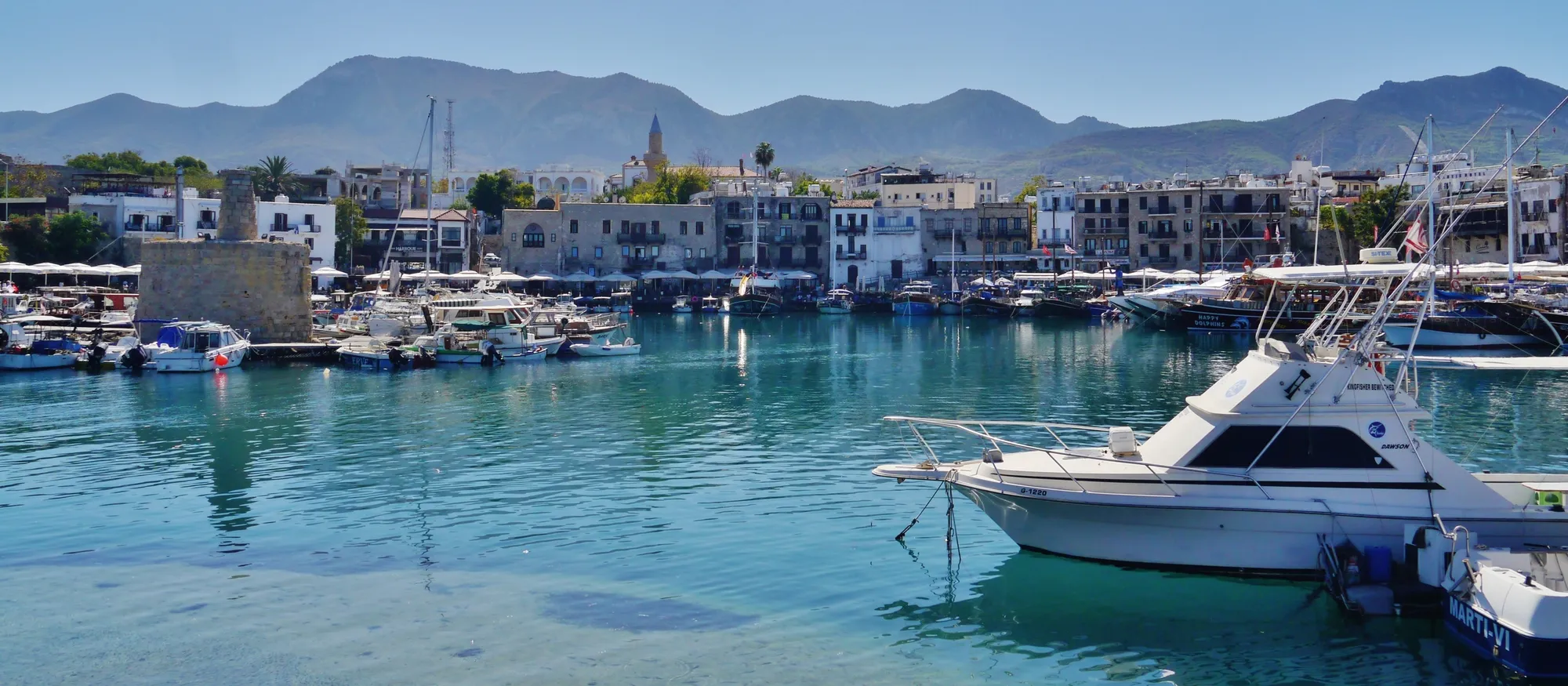
Kyrenia, called Girne in Turkish, is the main harbour town on the north coast of Cyprus, about 35 minutes’ drive from the Nicosia crossings and 80 minutes from Larnaca Airport. Its draws are the horseshoe-shaped old harbour and the Venetian castle beside it, which holds a Greek merchant ship from the 4th century BC. Until 31 October 2026 the castle opens daily from 08:00 to 19:00 (last entry 18:00) and a full ticket costs 150 Turkish lira, about £2.30.
Kyrenia is in the north of the island, under Turkish Cypriot administration, so a visit from Paphos, Limassol or Ayia Napa means crossing the Green Line, and a few practical things change on the other side. This guide covers what there is to see, the 2026 prices and hours, how long it takes to get there and the rules that catch visitors out.
Kyrenia at a glance
| Where | North coast of Cyprus, between the sea and the Kyrenia mountains |
| Name | Kyrenia in English, Girne in Turkish, Keryneia in Greek |
| Administration | Turkish Cypriot, in the north of the divided island |
| Currency | Turkish lira |
| Main sights | Old harbour, Kyrenia Castle and Shipwreck Museum |
| Castle, summer 2026 | 08:00 to 19:00 daily, last entry 18:00; 150 TL full, 50 TL student |
| From Nicosia crossings | About 27 km, 35 minutes by car |
| From Larnaca Airport | About 81 km, 80 minutes by car, plus the checkpoint |
| August average high | About 33°C |
The old harbour
The harbour is the reason most people come. It is a small, enclosed horseshoe of water lined with old stone warehouses that now hold restaurants and bars, with tour boats and gulets moored along the quay and the castle walls closing off its eastern side. A breakwater runs out from the far side towards a squat old lighthouse tower, and from the end of it you get the classic view back across the boats to the town and the mountains behind.
It is a place for a slow walk and a long lunch rather than a list of attractions. Go in the morning for clear light on the water and fewer people, or in the evening, when the quay restaurants fill up. The waterfront restaurants trade on the view and price accordingly; the backstreets a block or two inland are usually cheaper.
Just behind the western end of the harbour, the Ağa Cafer Paşa mosque dates from the late 16th century, and the lanes around it are the oldest part of town.
Kyrenia Castle and the Shipwreck Museum
The castle guards the eastern side of the harbour. The Byzantines probably built the first fortress here in the 7th century against Arab raids. It was enlarged in the early 13th century under the Lusignan kings, and the Venetians rebuilt it from 1540 into the thick-walled artillery fort you see now. Inside are a small Byzantine church of St George, older than the Venetian walls around it, and the walkways along the ramparts, which give the best view over the harbour.
The highlight is the Shipwreck Museum, in a room off the courtyard. It holds the Kyrenia ship, a Greek merchant vessel that sank just off the coast around 294 BC. A Cypriot diving instructor, Andreas Cariolou, came across the wreck in 1965, and a University of Pennsylvania team led by Michael Katzev excavated it between 1967 and 1969. More than half of its pine hull survived in good condition, a hull of about 14 metres, and it was found with its cargo of wine amphorae and millstones. Seeing the reassembled hull is the main reason to pay for the castle, and the museum is included in the ticket.
The castle is run by the Turkish Cypriot Department of Antiquities and Museums. Its visiting-hours page lists these summer 2026 times for the Kyrenia area:
| Site (1 Apr to 31 Oct 2026) | Hours | Last entry | Full ticket |
|---|---|---|---|
| Kyrenia Castle and Shipwreck Museum | 08:00 to 19:00, daily | 18:00 | 150 TL |
| Bellapais Abbey | 08:00 to 19:00, daily | 18:00 | 150 TL |
| St Hilarion Castle | 09:00 to 18:30, daily | 17:30 | 150 TL |
| Carob Warehouse and Cyprus House Museum | 08:00 to 15:30, weekdays | 15:00 | 100 TL |
Student tickets are 50 lira at all four. At the European Central Bank reference rate on 12 October 2026, 150 lira is about £2.30 or €2.70, and 100 lira about £1.55. The same page lists the Peace and Freedom Museum as closed for restoration and the Archangelos Icon Museum as closed, so do not plan around either.
Two dates matter if you are going this month. The summer schedule ends on 31 October and the winter hours had not been published when we checked on 13 October 2026. The clocks also go back on 25 October, after which sunset falls just before 17:00, so an afternoon at the castle needs to start earlier. Our Cyprus time zone guide has the details.
Some older guides still quote castle tickets of 25 lira or less. Prices in the north have risen sharply with Turkish inflation, so use the official page rather than any figure more than a season old.
Getting to Kyrenia from the south
Kyrenia is closest to the south through Nicosia. These are driving estimates on the public road network to Kyrenia harbour, and they leave out the queue at the checkpoint, which can add anything from a few minutes to much longer at busy times.
| From | Distance | Drive time |
|---|---|---|
| Nicosia (Agios Dometios crossing) | 27 km | 35 min |
| Larnaca Airport | 81 km | 1 hr 20 min |
| Ayia Napa | 98 km | 1 hr 40 min |
| Limassol | 114 km | 1 hr 50 min |
| Paphos Airport | 171 km | 2 hr 40 min |
| Bellapais Abbey | 6 km | 10 min |
| St Hilarion Castle | 10 km | 15 min |
By car. The UK Foreign Office warns that cars hired in the Republic often have no insurance cover in the north. Insurance can be bought at some vehicle crossings, but that does not mean your hire company allows the trip, so ask before you book. Our car hire guide covers what to check.
On foot and by bus. The simplest car-free route is to walk across at Ledra Street or Ledra Palace in Nicosia; both crossings are for pedestrians only. Wikivoyage reports buses to Kyrenia from the Kyrenia Gate area of north Nicosia about every 15 minutes, taking around half an hour, and arriving a short walk south of the castle. Our Green Line crossing guide explains the passport check and the customs limits on what you bring back, and the Nicosia old town guide covers the walk to the crossing.
By ferry from Turkey. Kyrenia’s newer port, east of the old harbour, handles ferries to the Turkish mainland. On 30 August 2026 a passenger ferry bound for Taşucu sank shortly after leaving it. By 7 October, Cyprus Mail reported that 25 bodies had been recovered and three people were still missing, and that the captain, seven crew and a company representative were in custody. If you are planning to travel by sea, check the current position with the operator before you book.
What changes on the north side
Most of these points apply to anywhere north of the Green Line, and our north or south Cyprus guide sets them out in full.
- Arriving by air. There are no direct UK flights to the north. Ercan airport only serves Turkey, and the Foreign Office says that if you enter through the north, the Republic of Cyprus will consider you to have entered illegally. Fly into Larnaca or Paphos if you want to see both sides.
- Money. Kyrenia uses the Turkish lira. Restaurants and shops often quote euros or sterling as well, but official sites charge in lira. Our Cyprus currency guide covers cards and conversion.
- Phones. The north is on the Turkish +90 network and outside EU roaming rules, so data can be expensive. See our guide to using your phone in Cyprus.
- Health cover. EHIC and GHIC are not valid in the north. Make sure your travel insurance names it.
- Language. Turkish is spoken, and English is widely used in the tourist trade. Place names change: Kyrenia is Girne and Bellapais is Beylerbeyi.
Beaches near Kyrenia
The harbour itself is not for swimming. Most swimming is done at hotel beaches and beach clubs along the coast either side of town, many of which charge for entry or sunbeds. Escape Beach at Alsancak, to the west, is one of the best known.
The finest natural beach within reach is Alagadi, about 30 km east of Kyrenia, where loggerhead and green turtles nest. It is protected, and access is restricted at night through the nesting and hatching season; Lonely Planet gives the closure as 20:00 to 08:00 from May to October. The Society for the Protection of Turtles runs a research centre there in summer. If you are after a beach-first trip, the far north-east Karpas peninsula is quieter still, but it is a long drive from Kyrenia and better as a separate trip.
When to go
The north coast is about as hot as the rest of the island in summer, with average August highs of around 33°C, and it is almost completely dry from June to September. It catches more winter rain than the south because it sits under the Kyrenia mountains, so for a winter trip, pick a clear day. Spring and autumn are the best seasons for combining the harbour with the climbs at St Hilarion and the walk round Bellapais. Our best time to visit Cyprus guide compares the months.
Is Kyrenia worth the trip?
- Staying in Nicosia, Larnaca or on the east coast: yes. It is under 90 minutes from Larnaca, and the harbour, the castle and Bellapais make a full and easy day.
- Staying in Limassol: worth it, but plan a long day and leave early to get ahead of the checkpoint queue.
- Staying in Paphos: five hours or more of driving in a day. A tour, or a night in Kyrenia, makes more sense.
- Short of time: allow about three hours for the castle and harbour, and add Bellapais, ten minutes away, if you have the afternoon.
If you have a second day in the north, the east is a different trip: Famagusta’s walled city, ancient Salamis and the abandoned resort of Varosha are about an hour and a quarter from Kyrenia by road.
Sources for changing details: Kyrenia-area hours and ticket prices from the Turkish Cypriot Department of Antiquities and Museums visiting-hours page, checked 13 October 2026. Sterling and euro conversions at the European Central Bank reference rate of 12 October 2026. Castle history and the Kyrenia ship from the Kyrenia Castle and Kyrenia ship reference pages. Bus details and the Alagadi summary from Wikivoyage; Alagadi closure hours from Lonely Planet. Ferry sinking from Cyprus Mail, 7 October 2026. Entry, hire-car and consular points from the UK Foreign Office Cyprus travel advice. Driving distances and times are OpenStreetMap routing estimates and exclude checkpoint queues.
Hero photo: Kyrenia harbour, by Zairon, via Wikimedia Commons, licensed CC BY-SA 4.0. Cropped.

Quick answers
Frequently asked questions
Is Kyrenia worth visiting?
Yes, especially if you are staying in Nicosia, Larnaca or the east coast. The old harbour is the most attractive waterfront on the island, the castle holds a remarkably well-preserved Greek merchant ship from around 300 BC, and Bellapais Abbey and St Hilarion Castle are both within 15 minutes. From Paphos it is a long day, so consider a night there or a tour.
How do I get to Kyrenia from the south of Cyprus?
Cross the Green Line in Nicosia. By car it is about 27 km and 35 minutes from the Agios Dometios crossing to Kyrenia harbour, and about 80 minutes from Larnaca Airport, plus the checkpoint queue. Without a car, walk across at Ledra Street or Ledra Palace and take a bus from the Kyrenia Gate area of north Nicosia, which takes about half an hour. Check that your hire car is allowed and insured in the north before you drive.
What currency is used in Kyrenia?
The Turkish lira. Many tourist businesses in Kyrenia also quote or accept euros and sterling, and cards are widely taken, but official sites such as Kyrenia Castle price their tickets in lira. Check which currency a price is in before you pay.
How much is Kyrenia Castle?
A full ticket costs 150 Turkish lira and a student ticket 50 lira in the 2026 summer season, according to the Turkish Cypriot Department of Antiquities and Museums. That is about 2.30 pounds or 2.70 euros at the 12 October 2026 exchange rate, and it includes the Shipwreck Museum inside the castle. Until 31 October 2026 it opens daily from 08:00 to 19:00, last entry 18:00.
Can British people go to Kyrenia?
Yes. The UK Foreign Office has no advice against travel to any part of Cyprus, and British visitors cross into the north with a passport every day. The catch is how you arrive: if you fly into the north's Ercan airport, the Republic of Cyprus treats that as illegal entry. Flying into Larnaca or Paphos and crossing the Green Line avoids the problem.