Places · Larnaca district
Pyla, Cyprus: the mixed village in the UN buffer zone, its tower, its beach strip and the half-hourly bus
What Pyla is and why it is unlike any other village in Cyprus, what there is to see in the square, how the hotel beach 4 km below fits in, what the UN said about the area in 2026 and how the X424 bus from Larnaca works.
- Filed under
- Places
- Updated
- 16 November 2026
- By
- The editors
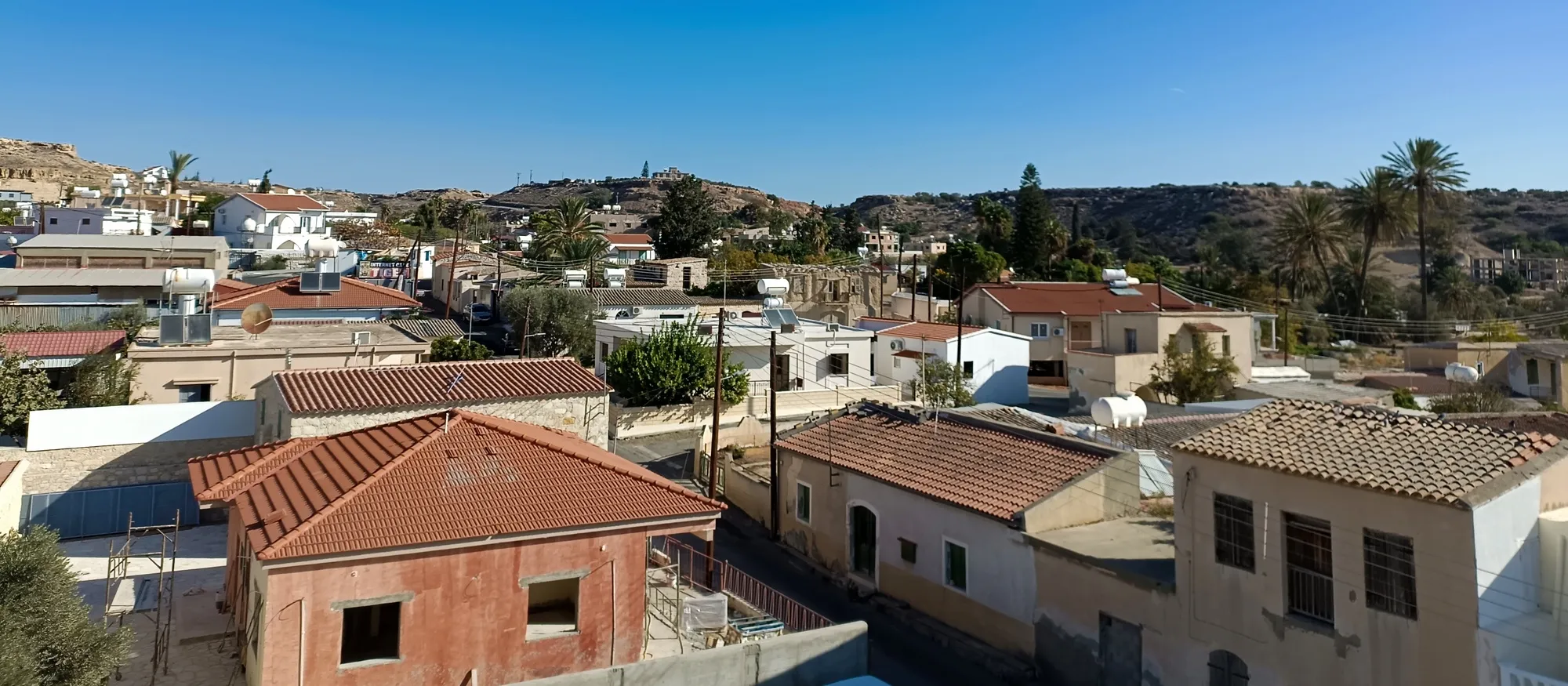
Pyla is a village of about 3,900 people in the Larnaca district, 13 km by road north-east of Larnaca, and it is the only place in Cyprus where Greek Cypriots and Turkish Cypriots still live in the same village. It sits inside the UN buffer zone, is run by the Republic of Cyprus and is patrolled by UN peacekeepers. It is also two places under one name: the old village inland, and a strip of large beach hotels on the coast road about 4 to 5 km below it. You can visit both freely, a bus runs from Larnaca every half hour on weekdays, and the village takes an hour or two.
Search for Pyla and you get map sites, Facebook pages and hotel listings. None of them explains why a hotel on the beach and a square with a mosque and a church share a name, or what the buffer zone means for someone who just wants to look round. This guide works from the community council, the Larnaka Tourism Board, the Deputy Ministry of Tourism, the bus operator and the UN Secretary-General’s 2026 reporting.
Where Pyla is
Pyla lies at the eastern end of Larnaca Bay, where the coastal plain meets a line of low, pale hills. The British Sovereign Base Area of Dhekelia is immediately to the east, and the ceasefire line is just to the north. The Larnaka Tourism Board gives the distance from Larnaca town centre as 12 km; the open-source OSRM routing engine makes it 13.3 km from the village square to the Finikoudes seafront.
| From Pyla village square | Distance | Drive |
|---|---|---|
| Pyla beach and hotel strip | about 4.5 km | about 7 minutes |
| Larnaca seafront (Finikoudes) | 13.3 km | about 20 minutes |
| Larnaca Airport terminal | 26.5 km | about 24 minutes |
| Ayia Napa | 36 km | about 33 minutes |
| Nicosia (Solomou Square) | 55 km | about 48 minutes |
Road distances and times from the open-source OSRM routing engine, without traffic or stops.
The name is usually traced to the Greek word for gate, because the village stands where the route from the sea climbs onto the Mesaoria plain. The Turkish name is Pile.
Why Pyla is different: one village, two communities, the UN in the middle
Most mixed villages in Cyprus stopped being mixed between 1963 and 1975. Pyla did not. The community council’s history says the village has had both Greek and Turkish residents since the Ottoman conquest of 1570 to 1571, and its figures from the Great Cyprus Encyclopaedia show how even the balance once was: 598 Greek Cypriots and 268 Turkish Cypriots in 1946, 618 and 343 in 1960, 586 and 488 in 1973.
After 1974 the ceasefire lines left Pyla between the two sides, in the buffer zone the UN peacekeeping force (UNFICYP) controls. It is one of four villages in that zone, with Athienou, Troulloi and Deneia, and the only one where both communities stayed. In law it is administered by the Republic of Cyprus like any other Larnaca community. In practice the UN is the visible authority: the Secretary-General’s 2026 report says UNFICYP keeps up community-oriented foot patrols throughout the village.
The council describes separate schools and places of worship but shared shops and public spaces, and calls the arrangement a model of coexistence for the rest of the island. For a visitor that means a village with churches and a mosque, two languages on the signs and UN patrols as part of the street scene.
The Republic’s census shows how fast the village has grown, helped by its position between Larnaca and the motorway and by the university that opened here in 2012:
| Census | Population of Pyla |
|---|---|
| 1992 | 867 |
| 2001 | 1,379 |
| 2011 | 2,771 |
| 2021 | 3,869 |
Statistical Service of Cyprus census figures, as reproduced by citypopulation.de.
What there is to see in the village
Pyla is a place to walk round, not a place with ticket desks. Nothing here has published opening hours, so treat everything as something to see from outside unless you find it open.
The tower. The landmark is a square stone tower in the old centre. The two official descriptions disagree about it. The Larnaka Tourism Board lists it as one of the four Venetian watchtowers of the Larnaca region, built to warn of raids from the sea. The community council calls it a medieval tower that probably belonged to the de Brie family and later the de Giblet family, who held Pyla as a private fief under the Lusignan kings, and says it was part of the area’s defences. Both can be partly true, since a Frankish tower could well have been reused by the Venetians, but nobody should tell you its date with confidence. The photograph at the top of this page was taken from its roof in October 2025, so it is sometimes possible to go up; there is no official word on when.
The churches. The council lists three. Agios Georgios, the large main church near the square, is modern. Archangelos Michail in the centre dates from about 1500 and has an icon screen and wall paintings of the archangel. Panagia Asprovouniotissa, on the east side, was built around 1200 as a monastery church, served as the main church for centuries and was rebuilt in 1850. A ruined chapel of the Holy Cross, dated to about 1400, stands beside the primary school.
The mosque and the old police station. The village also has a Turkish Cypriot mosque. The police station from the British colonial period has been restored under a UN programme and is used as a cultural centre.
The older sites. The council says the area has been lived in since the Early to Middle Bronze Age. A built tomb of the Classical period south-east of the village was excavated in 1934 by the Cypriot archaeologist Porphyrios Dikaios, and its reliefs are in the Cyprus Museum in Nicosia. Pyla-Kokkinokremos, on a plateau towards the coast, is a Late Bronze Age settlement that was abandoned after a short occupation and is well known to archaeologists. It is an excavation site, not a visitor attraction, and no official listing gives access details or hours.
An hour covers the centre comfortably. Add lunch and you have a half day, which pairs well with Larnaca’s old town or an afternoon on the beach below.
The other Pyla: the beach and the hotel strip
If your booking confirmation says Pyla, you are almost certainly not staying in the village. The community’s land runs down to the sea, and the council describes about 3 km of coast there with organised beaches, a linear park, large hotels, restaurants, car hire offices and supermarkets. This is the stretch of the Larnaca to Dhekelia road that tour operators sell simply as Larnaca, and it is where several of the area’s biggest beach hotels stand.
The Deputy Ministry of Tourism’s listing for Pyla Beach describes fine grey sand and clean, calm, shallow water that suits families with small children. Facilities include toilets, showers, changing rooms, sunbeds and umbrellas, a children’s playground, beach volleyball and beach tennis courts, beach bars and water sports, with disabled access and lifeguards on duty from June to October. Pyla does not appear on the 2026 national Blue Flag list, where Larnaca’s three flags are all in town. Our Larnaca beaches guide compares it with Finikoudes, Mackenzie and the rest.
The official Visit Cyprus restaurant directory lists ten venues under Pyla, and the mix says a lot about the place: two Lebanese restaurants, an Indian one, a bar called Shamrock and the Queen’s Arms pub alongside the rest, which reflects a customer base of hotel guests, students and the British base next door. The community council’s own map of the village picks out one taverna, Vlachos.
The buffer zone in 2026: what a visitor should know
For most of the past fifty years Pyla was known as the quiet exception. Since 2023 it has also been in the news.
In August 2023 Turkish Cypriot crews began building a road across the buffer zone to link Pyla with Arsos, a village on the northern side, and UN peacekeepers who blocked the works were injured in the confrontation. In October 2023 the UN announced an understanding covering the road, housing plots and a solar farm. According to the Secretary-General’s July 2026 report, as reported by the Cyprus Mail, that understanding has been frozen since November 2023.
The same report describes the situation around Pyla as fragile. It says Turkish Cypriot police have restricted civilian access on part of the plateau above the village since February 2026, that tension peaked in April, and that UNFICYP has increased patrols and keeps a permanent presence there. It also criticises the other side of the ledger: the university campus operating in the buffer zone without UNFICYP authorisation, and what it calls the criminality associated with 11 illegal casinos and one illegal nightclub in the village.
What that means in practice for a visitor is limited but worth knowing:
- The dispute is on the plateau, not in the square. The village, the road from Larnaca and the beach strip are ordinary public places. Do not walk or drive onto tracks leading north out of the village.
- Do not photograph UN posts, patrols or anything military. The UK Foreign Office warns that photographing sensitive sites in Cyprus can lead to arrest. Its Cyprus advice did not mention Pyla specifically when checked on 16 November 2026.
- Pyla is not a crossing point. The nearest authorised crossing is Pergamos, a few kilometres to the north-east inside the Dhekelia base area. Our Green Line crossing guide covers documents and hire-car insurance, and north or south Cyprus explains the wider picture.
- Your phone may pick up a Turkish network this close to the line. Our guide to using your phone in Cyprus explains how to stop that costing you money.
Things can change quickly in a place like this, so check the news before you go.
Getting to Pyla without a car
Pyla has a better bus than most Cypriot villages, because the route also serves the hotel strip and the university. Cyprus Public Transport route X424 runs from Larnaca Station through the town centre, along the seafront road past Oroklini and the Dhekelia road hotels, then inland to Pyla village, ending at the university stop.
| X424, checked 16 November 2026 | Monday to Friday | Saturday and Sunday |
|---|---|---|
| Larnaca Station to Pyla | every 30 minutes, 06:00 to 22:30 | hourly, 07:00 to 22:00 |
| Pyla (university) to Larnaca Station | every 30 minutes, 07:00 to 23:00, plus one at 06:30 | hourly, 07:30 to 22:30 |
Departure times from the operator’s live route page. Timetables change, so confirm on the day.
Stops along the way include the tourist beach, Pyla Beach Park and the main hotels, so the same bus links the strip with both the village and Larnaca. A single costs 2.70 euros in cash on board or 2 euros with a Motion card, and the night fare of 4.70 euros in cash applies from 21:00. Route 425 also runs the Dhekelia road to Larnaca and the airport, and there is a night route through Oroklini and Pyla to Finikoudes and Mackenzie. Our public transport guide explains the tickets and cards.
By car, follow the coast road east from Larnaca and turn inland at the Pyla sign, or come off the A3 motorway, which passes just south of the village.
Who Pyla suits
Go to the village if the island’s division interests you and you want to see the one place where it took a different course, in a visit that needs no passport and no guide. Combine it with Famagusta or Varosha on another day for the fuller story.
Stay on the strip if you want a large beach hotel with a direct bus into Larnaca, and you do not mind grey sand or a setting that is more main road than old town. If you want to walk out of the door into streets and restaurants, stay in central Larnaca instead; things to do in Larnaca covers the town.
The short answer
Pyla is the only village in Cyprus still shared by Greek and Turkish Cypriots, sitting inside the UN buffer zone 13 km from Larnaca. Visit the square, the tower and the churches in an hour or two, treat the hotel beach 4 to 5 km below as a separate place with the same name, take the X424 if you have no car, and keep to the village and the roads.
Sources for changing details: the Pyla Community Council history and sights pages (in Greek); the Larnaka Tourism Board’s Pyla listing; the Visit Cyprus Pyla Beach page; the CYMEPA 2026 Blue Flag list; Cyprus Public Transport routes and timetables and fares; census figures via citypopulation.de; the Cyprus Mail’s 12 July 2026 report on the UN Secretary-General’s findings; and the UK Foreign Office Cyprus travel advice. All checked on 16 November 2026.
Hero photograph: “Blick auf Pyla” (view of Pyla from the tower) by Knowledge2need, Wikimedia Commons, licensed CC BY-SA 4.0. Cropped for this page.

Quick answers
Frequently asked questions
Where is Pyla in Cyprus?
Pyla is a village in the Larnaca district, in the south-east of Cyprus, about 13 km by road north-east of Larnaca seafront and 26 km from Larnaca Airport. The village itself sits inland inside the UN buffer zone, next to the British Dhekelia base area. Its community land also reaches the sea, so the hotel strip on the Larnaca to Dhekelia road, about 4 to 5 km below the square, has a Pyla address too.
Is Pyla in north or south Cyprus?
Neither side of the line in the usual sense. Pyla lies inside the UN buffer zone that separates the two. It is administered by the Republic of Cyprus like any other community in the Larnaca district, and you reach it from Larnaca without passing a crossing point, but the UN peacekeeping force patrols it. It is the one village on the island where Greek Cypriots and Turkish Cypriots still live side by side.
Can tourists visit Pyla?
Yes. Pyla is an ordinary lived-in village reached by public road and by a regular bus from Larnaca, and you do not need a passport to go there from the Republic. Stay on the roads and in the village, do not photograph UN or military posts, and do not wander onto the plateau north of the village, which is where the UN reported tension in 2026.
Is there a bus from Larnaca to Pyla?
Yes. Cyprus Public Transport route X424 runs from Larnaca Station along the seafront road and the Dhekelia hotel strip to Pyla village, ending at the university. When checked on 16 November 2026 it left Larnaca Station every 30 minutes from 06:00 to 22:30 on weekdays and hourly from 07:00 to 22:00 at weekends. A single ticket is 2.70 euros in cash or 2 euros with a Motion card.
Does Pyla have a beach?
Yes, but not in the village. Pyla Beach is on the Larnaca to Dhekelia road, roughly 4 to 5 km from the village square. The Deputy Ministry of Tourism describes fine grey sand and calm, shallow water, with sunbeds, showers, a playground, beach volleyball and beach tennis courts, water sports and lifeguards from June to October. It is not on the 2026 Blue Flag list.