Places · The east coast's medieval port
Famagusta, Cyprus: a visitor's guide to the walled city
Famagusta (Gazimağusa) in northern Cyprus: the Venetian walls, Lala Mustafa Pasha Mosque, which sights are open or closed in 2026, drive times from Ayia Napa, Protaras and Larnaca, and how it fits with Varosha and Salamis.
- Filed under
- Places
- Updated
- 15 October 2026
- By
- The editors
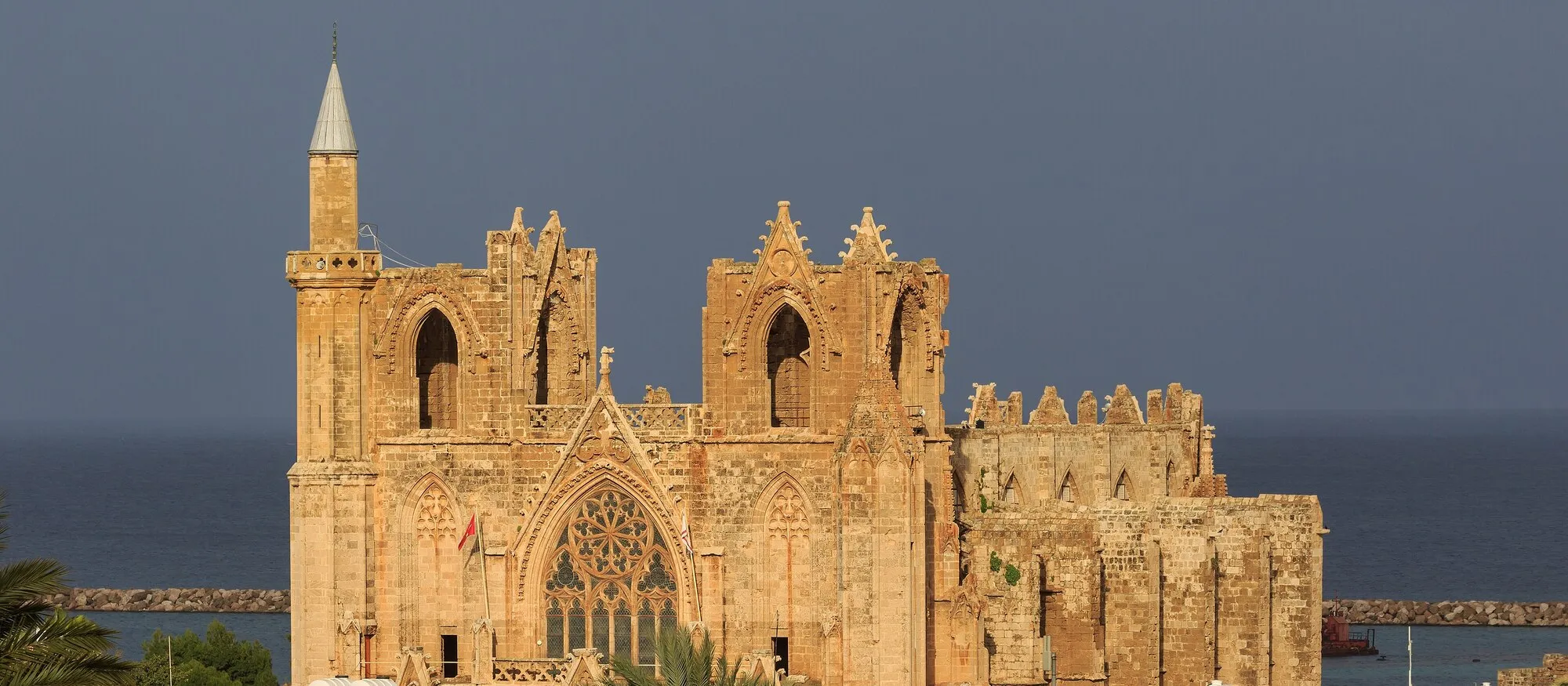
Famagusta, called Gazimağusa in Turkish and Ammochostos in Greek, is a port city on the east coast of northern Cyprus, just 10 minutes’ drive from the Deryneia crossing near Protaras. Its draw is the walled old town: Venetian ramparts around a medieval core whose Gothic cathedral is now Lala Mustafa Pasha Mosque. The walls and the mosque are free to visit, but Othello Castle, the sight most guides lead with, is listed as closed for restoration in 2026.
Famagusta is the easiest part of the north to reach from a holiday in Ayia Napa or Protaras, and it is often lumped together with the fenced resort of Varosha, which sits just south of the walls. This guide is about the old city itself: what you can see, what is shut this year, how long it takes to get there and how it fits into a day with Varosha and ancient Salamis.
Famagusta at a glance
| Where | East coast of Cyprus, north of the Green Line |
| Name | Famagusta in English, Gazimağusa in Turkish, Ammochostos in Greek |
| Administration | Turkish Cypriot |
| Population | 55,648 in the municipality (2019) |
| Currency | Turkish lira |
| Main sights | Venetian walls, Lala Mustafa Pasha Mosque, Gothic church ruins |
| Closed in 2026 | Othello Castle and Canbulat Museum, both for restoration |
| From the Deryneia crossing | About 8 km, 10 minutes by car |
| From Larnaca Airport | About 63 km, 1 hr 15 min by car via Strovilia, plus the checkpoint |
What to see in the walled city
The old town is compact, flat and best seen on foot. Allow two to three hours for an unhurried loop, more if you stop for lunch.
The walls. The Venetians rebuilt Famagusta’s defences in the late 15th and 16th centuries to hold off the Ottomans, and Britannica puts them at 15 metres high and 8 metres thick in places. They held out for 13 months during the siege of 1570 to 1571 before the garrison surrendered, and the Venetian commander, Marco Antonio Bragadin, was flayed alive afterwards. The circuit is still almost complete, with a dry moat round the landward side. The Land Gate at the south-west corner, beside the Ravelin bastion, is where most visitors walk in, and the Sea Gate on the harbour side still has its iron-clad door and a carved lion.
Lala Mustafa Pasha Mosque. This is the building on every postcard. It was built as the Latin cathedral of St Nicholas between 1298 and about 1312 and consecrated in 1328, and the Lusignan kings of Cyprus came here to be crowned kings of Jerusalem. After the Ottoman conquest of 1571 it became a mosque, and a minaret was added to one of the broken towers. The west front, with its three deep portals and rose window, is some of the finest Gothic architecture in the eastern Mediterranean. It is still a working mosque. Entry is free, but go outside prayer times, dress with shoulders and knees covered, and expect to take off your shoes.
Othello Castle, from the outside. The citadel in the north-east corner was built by the Lusignans in the 14th century to guard the harbour and remodelled by the Venetians, who set the Lion of St Mark over the entrance with the date 1492. Its name comes from Shakespeare’s Othello, which is set in “a seaport in Cyprus”. An EU-funded restoration reopened it in July 2015, but the 2026 schedule from the Turkish Cypriot Department of Antiquities and Museums lists it as closed for restoration again. You can still walk round the outside and see the lion over the gate.
The ruined churches. Famagusta was once said to have a church for every day of the year, and the shells of many still stand among the houses. The roofless church of St George of the Greeks, east of the mosque, keeps fragments of its frescoes; St George of the Latins stands opposite the castle; and the Twin Churches north-west of the mosque were built for the Knights Templar and the Knights Hospitaller. Wikivoyage notes that the former church of St Peter and St Paul, later the Sinan Pasha Mosque, now serves as a cultural centre.
Namık Kemal Museum. The prison cell of the 19th-century Turkish poet and writer Namık Kemal, just west of the mosque, is the one paid museum in the walls currently open. It runs on weekdays only.
Opening hours and tickets in 2026
The walls, the streets and the church exteriors are open all the time and free. The paid sites in and around Famagusta are run by the Turkish Cypriot Department of Antiquities and Museums, whose visiting-hours page gives this summer 2026 schedule, valid from 1 April to 31 October:
| Site | Status and hours | Last entry | Full ticket |
|---|---|---|---|
| Othello Castle | Closed for restoration | ||
| Canbulat Museum | Closed for restoration | ||
| Namık Kemal Museum | 08:00 to 15:30, weekdays only | 15:00 | 100 TL |
| Salamis | 08:00 to 19:00, daily | 18:00 | 150 TL |
| St Barnabas Icon and Archaeological Museum | 08:00 to 18:00, daily | 17:00 | 150 TL |
| Royal Tombs | Closed |
Student tickets are 50 lira. At the European Central Bank reference rate on 14 October 2026, 150 lira is about £2.30 or €2.70, and 100 lira about £1.55. Several older guides quote much lower lira prices or describe Othello Castle as open, so trust the official page over anything more than a season old.
The summer timetable ends on 31 October, and the winter hours had not been published when we checked on 15 October 2026. The clocks go back on 25 October, after which it is dark by about 17:00, so plan an earlier start. Our Cyprus time zone guide has the details.
Getting to Famagusta from the south
The Deryneia crossing, between Paralimni and Famagusta, is the closest for anyone staying on the east coast and takes both cars and pedestrians. There is also a vehicle crossing at Strovilia, on the edge of the British base at Dhekelia, west of the city. These are driving estimates on the public road network to the walled city, routed through Deryneia, and they leave out the checkpoint queue:
| From | Distance | Drive time |
|---|---|---|
| Deryneia crossing | 8 km | 10 min |
| Ayia Napa | 19 km | 30 min |
| Protaras | 21 km | 30 min |
| Larnaca Airport | 75 km | 1 hr 20 min |
| North Nicosia (no crossing needed) | 61 km | 1 hr |
| Limassol | 123 km | 1 hr 50 min |
| Paphos Airport | 181 km | 2 hr 40 min |
| Varosha entrance | 3 km | 5 min |
| Salamis | 10 km | 17 min |
From Larnaca and further west, the Strovilia crossing is a little quicker: Larnaca Airport to the walled city is about 63 km and 1 hr 15 min that way, against 1 hr 20 min through Deryneia.
By car. The UK Foreign Office warns that cars hired in the Republic are often not insured in the north. Insurance can be bought at some crossings, but that does not mean your hire company allows the trip, so ask before you book. Our car hire guide covers what to check.
Without a car. Wikivoyage reports buses from north Nicosia about every 30 minutes, taking around an hour, and free municipal buses within Famagusta, including a line from the Deryneia checkpoint to the old city. We could not confirm that route on the municipality’s own site, so check locally before relying on it; a taxi from the crossing is the fallback. From Protaras or Ayia Napa, many visitors simply take an organised day trip that handles the crossing for them.
Read our Green Line crossing guide before you go. It covers the passport check, which crossings take cars and the customs limits on what you bring back.
What changes on the north side
- Money. Famagusta uses the Turkish lira. Cafés and shops often quote euros too, but official sites charge in lira. See our Cyprus currency guide.
- Phones. The north is on the Turkish +90 network, outside EU roaming, so data can be expensive. Our phone guide explains the options.
- Health cover. EHIC and GHIC are not valid in the north, so make sure your travel insurance covers it.
- Arriving by air. If you fly into the north’s Ercan airport, the Republic of Cyprus treats that as illegal entry, according to the Foreign Office. Fly into Larnaca or Paphos and cross by land.
Our north or south Cyprus guide sets out the bigger picture.
Famagusta, Varosha and Salamis in one day
From the east coast, the three fit comfortably into one crossing. A sensible order is Salamis at 08:00 while it is cool, then the walled city for lunch and the mosque in the early afternoon, finishing with a walk or a bike ride through the open section of Varosha, a five-minute drive south. Our Varosha guide covers what is open inside and the rules, and the Salamis guide covers the ruins and St Barnabas. With a second day, the coast road north continues to the Karpas peninsula, and Kyrenia on the north coast is about an hour and a quarter away.
Famagusta is hot in summer. Wikipedia’s 2017 to 2024 normals put the average high at over 34°C in July and August, and there is little shade on the walls, so autumn and spring are the most comfortable seasons for walking. October is ideal before the clocks change.
Is Famagusta worth visiting?
- Staying in Protaras, Ayia Napa or Paralimni: yes. It is half an hour away and the walled city is one of the best-preserved medieval towns in the eastern Mediterranean.
- Staying in Larnaca or Nicosia: worth a full day, ideally combined with Salamis.
- Staying in Limassol or Paphos: a long day of driving. A tour, or a night on the east coast, makes more sense.
- Coming mainly for Othello Castle: wait until it reopens, or treat it as an outside view on a wider walk.
Sources for changing details: Famagusta-area hours, ticket prices and closures from the Turkish Cypriot Department of Antiquities and Museums visiting-hours page, checked 15 October 2026. Sterling and euro conversions at the European Central Bank reference rate of 14 October 2026. History, population and climate from the Famagusta, Lala Mustafa Pasha Mosque and Othello Castle reference pages; wall dimensions from Britannica. Bus and church details from Wikivoyage. Entry, hire-car and consular points from the UK Foreign Office Cyprus travel advice. Driving distances and times are OpenStreetMap routing estimates and exclude checkpoint queues.
Hero photo: Lala Mustafa Pasha Mosque, by A.Savin, via Wikimedia Commons, licensed Free Art License. Cropped.

Quick answers
Frequently asked questions
Can you visit Famagusta from the south of Cyprus?
Yes. Famagusta is in the north, under Turkish Cypriot administration, and visitors staying in the Republic cross the Green Line with a passport or EU ID card. The Deryneia crossing near Protaras is the closest, and from there the walled city is about 8 km and 10 minutes by car, plus any queue at the checkpoint.
Is Othello Castle open?
No. The Turkish Cypriot Department of Antiquities and Museums lists Othello Castle as closed for restoration in its 2026 summer schedule, and the nearby Canbulat Museum is closed too. You can still see the castle's walls and the Lion of St Mark over its gate from the outside.
Is Famagusta the same as the ghost town?
Not quite. Famagusta is a living city of around 55,000 people with a walled medieval old town at its heart. The ghost town is Varosha, the modern resort quarter just south of the walls, which was fenced off in 1974 and partly reopened to visitors in October 2020.
How much does it cost to visit Famagusta's old town?
Walking the walled city costs nothing, and Lala Mustafa Pasha Mosque is free to enter outside prayer times. The paid sites nearby use Turkish lira: Salamis and the St Barnabas museum cost 150 TL each in summer 2026, about 2.30 pounds, and the Namik Kemal Museum costs 100 TL on weekdays.
Is Famagusta in Turkey or Cyprus?
Famagusta is on the island of Cyprus, in the north. Since 1974 it has been run by the Turkish Cypriot administration, which only Turkey recognises. Internationally it is part of the Republic of Cyprus, so you will see it called Ammochostos in Greek and Gazimagusa in Turkish.