Places · Limassol district
Akrotiri Salt Lake: flamingos, where to watch them and what has changed at Limassol's salt lake
Where Akrotiri Salt Lake is, when the flamingos come and how many, where to watch without disturbing them, the weekday-only hours of the free visitor centre and telescopes, and why the counts collapsed after 2021.
- Filed under
- Places
- Updated
- 22 November 2026
- By
- The editors
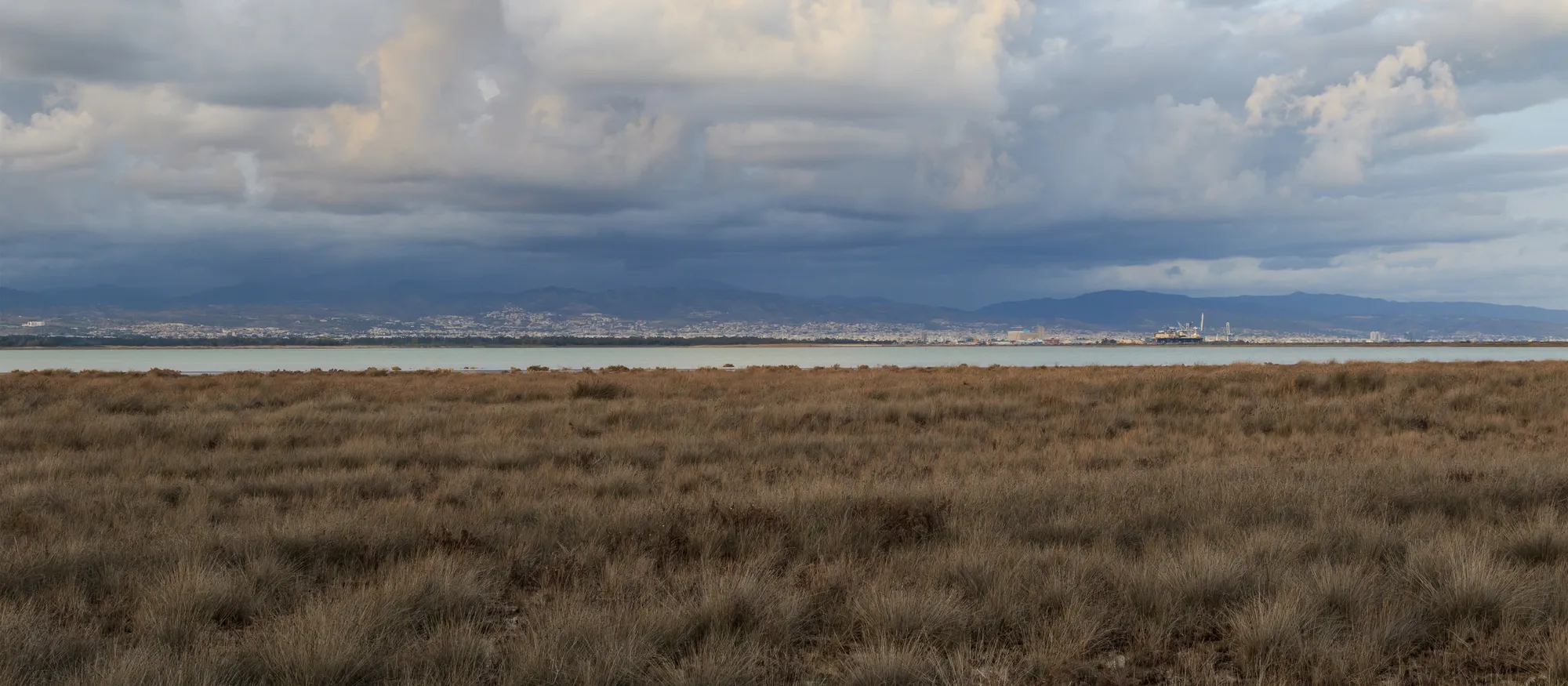
Akrotiri Salt Lake is the largest inland body of water in Cyprus, a shallow lagoon of 10.65 square kilometres on the peninsula south-west of Limassol. Flamingos use it in winter, and more than a thousand were back by 12 November 2026. The best place to watch them is the free Akrotiri Environmental Education Centre, which has telescopes trained on the water but opens on weekday mornings only. Go expecting a wide, quiet wetland seen from a distance, and know that the flock is far smaller than it was five years ago.
The first page of search results for the lake is a Wikipedia summary, review listings and stock photographs of pink birds, with nothing on the visitor centre’s hours, the hide that is unusable or the flamingo counts. This guide works from the Deputy Ministry of Tourism, the Sovereign Base Areas Administration, BirdLife Cyprus and dated press reports.
Sources for changing details: the Visit Cyprus pages for Akrotiri Salt Lake and the education centre; the Sovereign Base Areas Administration’s centre page and designations page; BirdLife Cyprus on the flamingos and on the state of the wetland; the Cyprus Mail of 12 November 2026 and 21 February 2025; Politis of 30 December 2025 and 7 July 2026; and EMEL, the Limassol bus operator. Everything was checked on 22 November 2026.
Where the lake is
The Akrotiri peninsula is the blunt hook of land that closes Limassol’s bay on the west. The salt lake fills its middle. Limassol’s port, a shopping mall and the casino resort lie to the north and north-east, Lady’s Mile beach runs down the eastern side, Akrotiri village is on the southern shore and RAF Akrotiri occupies the tip beyond the village.
Visit Cyprus gives the area as 10.65 square kilometres and says more than half the lake is under 30 cm deep, with about a metre of water at the deepest point and a bed that drops to 2.7 metres below sea level. It is also called Limassol Salt Lake, and it is not the lake next to Larnaca Airport: that one has its own Larnaca Salt Lake guide, and the two are about 89 km apart by road.
The lake is inside the Western Sovereign Base Area, which is British territory. For a visitor that changes little: the roads are public, the village has tavernas and a bus stop, and the area is policed by the Sovereign Base Areas Police, as at Kourion Beach a few kilometres west. The RAF station is closed to the public, and British government travel advice for Cyprus warns against taking photographs near military buildings.
Driving distances below come from the open-source OSRM routing engine and are rounded.
| From the education centre in Akrotiri village | Distance | Drive |
|---|---|---|
| Agios Nikolaos ton Gaton (cat monastery) | about 3 km | about 5 minutes |
| Akrotiri Marsh | about 4 km | about 7 minutes |
| Lady’s Mile beach | about 6.5 km | about 14 minutes |
| Kolossi Castle | about 8.5 km | about 10 minutes |
| Kourion | about 12.5 km | about 15 minutes |
| Limassol old port | about 15.5 km | about 24 minutes |
| Paphos harbour | about 68 km | about 64 minutes |
When the flamingos come
The three bodies that ought to know give three slightly different windows. Visit Cyprus says migrating birds are on the lake between November and March. BirdLife Cyprus says greater flamingos usually appear in November and stay until late February. The woman who monitors them at the education centre told the Cyprus Mail this month that they usually stay between October and February, and added that there is no way of telling how long they will stay.
The reason is water. BirdLife Cyprus explains that depth decides how many birds arrive and how long they remain: too deep or too shallow and they move on. Visit Cyprus names the small fairy shrimp Branchinella spinosa as the base of the lake’s food chain and says that when the birds cannot find it they leave for Larnaca or carry on towards Africa.
This winter has started well. On 12 November 2026 the centre’s manager, Dr Thomas Hadjikyriakou, said more than a thousand flamingos had returned after recent rain and that numbers were rising daily. Among them was Melani, a black female that has visited since 2015. Her colour comes from melanism, a genetic mutation, and he described her as probably the only melanistic flamingo in the world.
How many flamingos, and why far fewer than before
Most pages about the lake still promise thousands of birds. The counts say otherwise.
| Period | Flamingos recorded at Akrotiri | Source |
|---|---|---|
| A typical year in the past | 2,000 to 5,000; long-term average about 3,800 | Cyprus Mail; BirdLife Cyprus |
| 2020 | about 13,000 | Politis |
| 2021 | about 6,000 | Politis |
| January 2025 | about 30, the lowest since counts began in 1992 | BirdLife Cyprus |
| 2025 as a whole | about 200 | Politis |
| 12 November 2026 | more than 1,000 and rising | Akrotiri Environmental Education Centre |
A count of 47 for January 2026 was also reported from a session of the House environment committee, but we could not find the committee’s own record, so treat that figure with care.
BirdLife Cyprus and the Game and Fauna Service blame the water, not the birds. The land north of the lake was citrus groves twenty years ago and is now one of the fastest-growing parts of Limassol. Sealed ground and drainage channels send water into the lake faster and at the wrong times of year. BirdLife recorded extensive standing water in November 2025 during a drought, and tests found raised levels of E. coli. Politis reports that by 2022 the lake had stopped drying out in summer, which a salt lake needs to do. A senior Game and Fauna Service officer told the Cyprus Mail that water in the lake used to mean flamingos, and that at Akrotiri this is no longer true.
Kourion Municipality and the British Bases set up a technical committee in February 2025 with a 36-month plan that runs to early 2028. In July 2026 BirdLife Cyprus said it had private funding to begin restoration work that September at Makria Lake, also called Zakaki Lake, which feeds polluted water into the salt lake. We found no report of that work being finished.
One thousand birds in November 2026 is good news. It is also less than a third of the old average, so do not plan a trip round a promise of pink water.
Where to watch
The lake is wide and flat and the birds feed well out from the shore, so where you stand matters.
| Place | What you get | The catch |
|---|---|---|
| Akrotiri Environmental Education Centre | Observation deck with four telescopes facing the lake, exhibition, free entry | Weekday mornings only |
| Akrotiri Marsh hides | Two birdwatching hides built in a 2015 to 2017 restoration project, on the reed marsh north-west of the lake | Marsh birds and reedbeds, not the open salt lake |
| Lady’s Mile side | The lake is about 1.5 km inland from the beach, with small pools behind the shore | Distant views; no facilities facing the lake |
| Zakaki (Makria Lake) hide | A hide on the smaller lake near Zakaki, north-east of the salt lake | Reported choked by reeds and unsuitable for birdwatching in July 2026 |
The education centre, and the hours problem
The centre stands on Queen Elizabeth Street in Akrotiri village and has been in its present building since 2014. The Sovereign Base Areas Administration, which runs it, lists exhibition rooms, a library, a botanic garden, a playground and an observation area with telescopes and binoculars, all accessible to wheelchair users. Entry is free.
The Administration gives the opening hours as Monday to Friday, 07:30 to 13:30, closed at weekends and on public holidays. Visit Cyprus lists Monday to Friday from 08:00 to 13:30. Either way the telescopes are not available on a Saturday or Sunday, which is when most visitors from the city would think of going. The phone number on both pages is +357 25 826 562, and it is worth a call before a special trip.
One more warning. Visit Cyprus still gives the centre’s website as akrotirienvironment.com. When we opened that address on 22 November 2026 it showed an unrelated page in Japanese about credit cards, so the domain appears to have lapsed. Use the Administration’s page linked in the sources above.
Watching without doing harm
The centre’s manager asked visitors this month not to walk into the lake or try to approach the birds. BirdLife Cyprus adds drones to the list, and explains why: wintering flamingos need to rest and feed before breeding, and each time they are put to flight they spend energy they need for migration. Around 200 nests were counted at Akrotiri after the wet winters of 2018 to 2020, though no chicks were seen.
Getting there
By car from Limassol the road to the village runs west of the port through Asomatos and past the Fasouri citrus country, about 25 minutes from the old port. From Paphos or Kourion, come in through Kolossi, which is ten minutes from the village.
By bus, EMEL route 19A runs from the Leontiou station in Limassol through Trachoni, Asomatos and Fasouri and ends at the Akrotiri Community Board stop, about 300 metres from the centre on OpenStreetMap. EMEL’s route page lists the stops but no timetable, so check departure times with the operator before relying on it for a centre that shuts at 13:30. EMEL’s tickets page listed a single paper ticket at €2.50 when we checked. Our guide to public transport in Cyprus covers how the island’s bus companies fit together.
What to combine it with
Agios Nikolaos ton Gaton. The convent of St Nicholas of the Cats is five minutes from the village on Cape Gata. Visit Cyprus tells the legend that cats were shipped in to clear the cape of snakes; our guide to snakes in Cyprus has the facts. It is listed as open daily from 07:00 to 12:00 and 14:00 to 17:00, free, with a note that the church itself is temporarily closed for technical reasons while the rest of the convent stays open.
Lady’s Mile. The 5 km beach on the eastern side of the peninsula has shallow water and fish restaurants, and is covered in our Limassol beaches guide. In winter it is a walk, not a swim.
Kolossi and Kourion. Kolossi Castle is ten minutes north of the village and Kourion fifteen minutes west. Do the centre first, because of its hours.
The other flamingo lakes. If you are choosing between wetlands, the counts favour the east. In the 2025 census quoted by the Cyprus Mail, Larnaca’s salt lakes held 1,065 flamingos and Paralimni Lake 1,062, against 27 at Akrotiri. Larnaca also has a marked trail beside the water.
Summer, and whether to go at all
Visit Cyprus says the lake usually dries up in summer, but not always. Either way the migrating birds have gone and the peninsula is a beach destination. Our Cyprus in winter guide has more on what the cooler months are good for.
Go between November and February, on a weekday, before lunch. Stay off the lake bed. If the flock is small or far out on the day, the exhibition explains why, and that is part of what there is to see here now.
Hero photograph: “View of Limassol Salt Lake from Akrotiri near Limassol, Cyprus” by A.Savin, taken on 5 January 2017, via Wikimedia Commons, released under the Free Art License. Cropped for this page.

Quick answers
Frequently asked questions
Where is Akrotiri Salt Lake?
It is on the Akrotiri peninsula, south-west of Limassol, and it is the largest inland body of water in Cyprus at 10.65 square kilometres. The lake lies inside the British Western Sovereign Base Area, but public roads and a public bus reach Akrotiri village on its southern shore. The visitor centre in the village is about 15 km and 25 minutes by car from Limassol's old port.
When can you see flamingos at Akrotiri Salt Lake?
Winter. Visit Cyprus gives November to March, BirdLife Cyprus says the birds usually arrive in November and stay until late February, and staff at the Akrotiri visitor centre say October to February. On 12 November 2026 the centre reported more than a thousand flamingos back on the lake after rain. Numbers depend on water depth and food, so no date is guaranteed.
Is Akrotiri Salt Lake worth visiting?
Yes on a winter weekday morning, when the free Akrotiri Environmental Education Centre is open and its telescopes bring the flock close. Outside those hours you are looking at distant birds across a very wide, flat lake. It is a half-day trip that pairs well with Kolossi Castle or Kourion, not a destination in itself, and in summer there is little to see.
Can you walk on Akrotiri Salt Lake or get close to the flamingos?
No. The centre's manager asked visitors in November 2026 not to walk into the lake or approach the birds, and BirdLife Cyprus asks people not to fly drones over them. Disturbed flamingos burn energy they need for migration and may abandon a feeding area. Watch from the centre's observation deck or from a bird hide.
Do you need a pass to visit Akrotiri because it is a British base?
Not for the lake, the village, the marsh or Lady's Mile beach, which are reached on public roads inside the Sovereign Base Area. The RAF station itself is closed to the public. British government travel advice for Cyprus warns against photographing military buildings, so keep cameras pointed at the wetland.