Places · Famagusta district
Paralimni, Cyprus: the town behind Protaras, its three-church square, the seasonal lake and the buses
What Paralimni is and how it relates to Protaras, what there is to see in the old centre, why the lake that named the town is in the news, a month-by-month weather table and how the local and intercity buses work in winter 2026 to 2027.
- Filed under
- Places
- Updated
- 17 November 2026
- By
- The editors
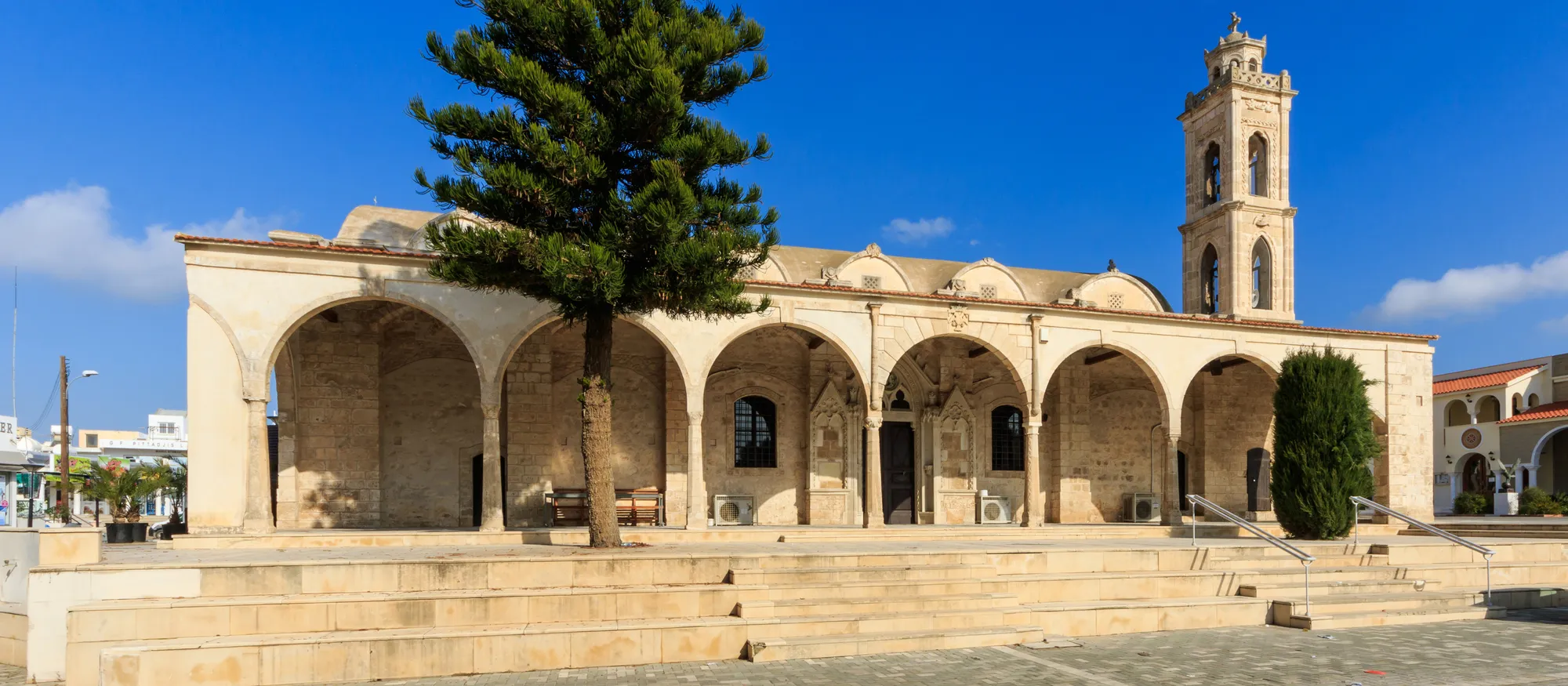
Paralimni is a town of about 19,000 people in the south-east corner of Cyprus, 4 km inland from the beaches of Protaras, which is its seaside district rather than a separate place. It is the largest town in the government-controlled part of the Famagusta district and the place where much of this coast lives, shops and goes to school. For a visitor it is a two-hour detour, not a holiday base: three churches on one square, two small museums, a protected seasonal lake on the western edge, and more buses than anywhere else in the area.
Search for Paralimni and you mostly get beach photographs, because every hotel and villa between Kapparis and Konnos has a Paralimni address. This guide is about the town itself, and works from the Deputy Ministry of Tourism (Visit Cyprus), the Famagusta regional tourism board, the census, BirdLife Cyprus and the two bus operators’ current timetables.
Where Paralimni is, and how it relates to Protaras
The name means “by the lake” in Greek, after the shallow seasonal lake on the town’s western side. The town sits on flat red farmland at the eastern end of the island, with the Protaras coast to the east, Ayia Napa to the south and the ceasefire line to the north.
Protaras, Pernera and Kapparis are all districts of Paralimni. None has its own council, which is why the official 2026 Blue Flag list files Fig Tree Bay and thirteen other Protaras beaches under Paralimni. Since the local government reform of July 2024 the town has been part of the merged Paralimni-Deryneia municipality, which also takes in Deryneia, Frenaros and Vrysoules.
| From Paralimni town centre | Distance | Drive |
|---|---|---|
| Kapparis | 4.7 km | about 7 minutes |
| Deryneia crossing point | 4.9 km | about 7 minutes |
| Ayia Napa (monastery square) | 6.8 km | about 10 minutes |
| Pernera | 7.5 km | about 11 minutes |
| Fig Tree Bay, Protaras | 8.8 km | about 12 minutes |
| Konnos Bay | 12.1 km | about 19 minutes |
| Larnaca seafront | 47 km | about 46 minutes |
| Larnaca Airport terminal | 62 km | about 52 minutes |
| Nicosia (Solomou Square) | 88 km | about 74 minutes |
Road distances and times from the open-source OSRM routing engine, measured from the old Agios Georgios church, without traffic or stops.
One correction while we are here: several reference pages put Paralimni 110 km from Nicosia. By road it is 88 km.
A town that has more than doubled
Census figures from the Statistical Service show how recently Paralimni became a town of this size.
| Census | Residents |
|---|---|
| 1982 | 7,749 |
| 1992 | 7,721 |
| 2001 | 11,091 |
| 2011 | 14,963 |
| 2021 | 19,037 |
Until 1974 this was a farming village in the orbit of Famagusta, about 10 km to the north. Famagusta is now on the other side of the ceasefire line, and Paralimni has taken over its role for this corner of the island. It also houses much of the workforce for the hotels of Protaras and Ayia Napa. Visit Cyprus still lists it under villages, and notes the hundreds of windmills in the surrounding fields, put up to pump groundwater for the crops.
Very little of the old village is left. Outside the few streets round the square, Paralimni is a modern, low-rise town of houses, supermarkets and wide roads.
The square: three churches side by side
The centre of Paralimni is Agios Georgios Square, and its oddity is that it holds three churches from three different periods within a few steps of each other. The regional tourism board, Visit Famagusta, describes them as follows.
- The old church of Agios Georgios. The low limestone building with the arcaded porch in the photograph above. A marble inscription dates it to 1859, and it stands on the remains of an earlier Byzantine church, parts of which were built into it. A large fresco on the north wall shows St George killing the dragon.
- The metropolitan church of Agios Georgios. The big domed church that dominates the square, built between 1963 and 1966 in a traditional Byzantine style and painted inside with modern frescoes, including Christ Pantocrator in the dome.
- Agia Anna. The oldest of the three, a 13th-century chapel of local limestone that was originally dedicated to the Virgin Mary. Visit Cyprus describes it as two-aisled and decorated with unusual 18th-century porcelain plates. It now serves as a small ecclesiastical museum, with icons from the 16th to the 19th centuries, relics and old manuscripts.
St George is the town’s patron saint, and Visit Cyprus says his feast on 23 April is marked with a festival of stalls, music, food and drink that visitors are welcome to join.
We could not find published opening hours for the Agia Anna museum on any official page, so do not build a day round getting inside. Dress as you would for any working Orthodox church: shoulders and knees covered. Ayia Napa Monastery, ten minutes away, does publish its hours.
Two small museums
Both are a short walk from the square, and both keep office hours rather than tourist hours.
| Museum | Address | Hours listed by Visit Cyprus | Entry |
|---|---|---|---|
| Folkloric Museum (Traditional House) | Agias Marinas 5 | Monday to Friday 07:00 to 15:00; closed weekends and public holidays | Free |
| Municipal National History Museum | Makariou III 6 | Monday to Friday 08:00 to 14:00, Saturday 09:00 to 14:00; closed Sundays and public holidays | €3 from age 12 |
The Traditional House is a restored 19th-century home with stone arches and a courtyard. Three rooms are set out with the furniture, household goods and farm tools of a rural family, and the building doubles as a venue for civil weddings. The Visit Cyprus accessibility listing records ramps and an accessible toilet but no disabled parking. The history museum covers Greece and Cyprus from 1821 to 1974, with some medieval exhibits.
Both listings give the same telephone number, +357 23 741826, and warn that times and fees can change without notice, so ring before making a special trip.
The lake that named the town
Paralimni Lake lies just west of the town, between Paralimni and Sotira. It is a natural seasonal wetland of about 350 hectares that fills with winter rain and shrinks or dries in summer. According to BirdLife Cyprus it is one of very few such wetlands left on the island, and it matters for two reasons.
The first is birds. At least 186 species have been recorded there, flamingos among them, and spur-winged lapwing, black-winged stilt and Kentish plover nest on its edges. The second is the Cyprus grass snake, a harmless water snake found only on this island, for which the lake is described as the most important remaining habitat. It appears in our guide to snakes in Cyprus.
The lake was named an Important Bird Area in 2004 and a Natura 2000 site in 2009. Protection on paper has not meant protection in practice. BirdLife Cyprus calls it probably the most degraded wetland on the island, citing building pressure, a shooting range inside the protected area and uncontrolled access. In 2012 the European Court of Justice ruled against Cyprus for failing to protect it.
The argument is still live. On 12 May 2026 Politis reported BirdLife’s complaint that part of the embankment holding back the water had been removed and the lake was being drained in the middle of the breeding season. The reasons given were mosquito control and salinity in the aquifer, and the organisation said the municipality had pressed for it. What works against the insects is in our mosquitoes in Cyprus guide.
For a visitor, the lake is best between December and April, when it holds water. None of the official sources lists a hide, a marked path or a visitor centre, so treat it as something to look at from the public roads round the edge. Stay off the lakebed, where waders nest on the ground.
Eating and shopping
This is where Paralimni is most useful to people staying on the coast. Central Protaras closes down heavily from November to March, while the town carries on as normal, with supermarkets, bakeries, pharmacies and banks open all year.
We have not eaten our way round the town, so rather than invent recommendations, here are places in the Visit Cyprus catering directory with a Paralimni town address: Platia on Agios Georgios Square, Tselingas Tavern at 34 Archbishop Makarios Street, Syntrivani at 88 1st April Avenue, Clock Cafe at 54 1st April Avenue and Tsipouraki Mezedaki No. 2 at 11 Poseidonos Street. A listing means the business is licensed, not that it has been reviewed, so check recent reviews and winter opening first.
As for whether Paralimni is lively: it is busy in the way a working town is busy. The clubs and late bars are in Ayia Napa, and how the two resorts compare is covered in Protaras or Ayia Napa.
Paralimni weather, month by month
There is no weather station in Protaras or Ayia Napa. The nearest Meteorological Service station is at Paralimni, so these long-run averages are the ones that apply to the whole coast.
| Month | Average high | Average low | Rainfall | Days with rain |
|---|---|---|---|---|
| January | 16.0°C | 8.6°C | 70 mm | 8 |
| February | 16.1°C | 7.9°C | 62 mm | 6 |
| March | 18.7°C | 9.7°C | 35 mm | 5 |
| April | 22.2°C | 12.5°C | 15 mm | 4 |
| May | 26.8°C | 16.8°C | 8 mm | 1 |
| June | 30.8°C | 20.6°C | 3 mm | 0 |
| July | 33.1°C | 23.4°C | 1 mm | 0 |
| August | 33.3°C | 23.7°C | 0 mm | 0 |
| September | 31.2°C | 20.9°C | 1 mm | 1 |
| October | 27.7°C | 18.0°C | 25 mm | 3 |
| November | 21.7°C | 13.4°C | 45 mm | 5 |
| December | 17.3°C | 10.1°C | 87 mm | 7 |
Meteorological Service of Cyprus averages for the Paralimni station, as reproduced on Wikipedia’s Paralimni page from the Service’s climatological reports. Rainfall and rain days rounded.
About 350 mm of rain falls in a year, nearly all of it between October and March, and summer afternoons are a few degrees hotter here than on the west coast. Sea temperatures are in our Cyprus sea temperature guide.
Getting to Paralimni and getting around
From the airport. Larnaca is the airport to use. The shared Kapnos shuttle serves stops on Pernera Avenue and Protaras Avenue rather than the town, as explained in our Larnaca Airport to Protaras guide. For the town itself, a taxi, a hire car or a bus via Larnaca are the options.
Local buses. OSEA, the Famagusta district operator, uses Paralimni as the hub of its network. Its winter timetable runs from 16 November 2026 to 31 March 2027.
| Route | Where it goes | Winter 2026 to 2027 departures from Paralimni |
|---|---|---|
| 102 | Pernera, Protaras, Konnos, Cape Greco, Ayia Napa waterpark (75 minutes) | 53 a day, every 15 to 30 minutes from 05:20 to midnight |
| 101 | The same route in reverse, ending in Paralimni | From Ayia Napa every 10 to 30 minutes, 06:05 to 01:00 |
| 301 | Circle: St George Square, Kapparis, Protaras Avenue and back (40 minutes) | Hourly from 08:15 to 21:15, with no 13:15 |
| 711 | Kapparis, Protaras, Konnos, Ayia Napa, Larnaca, Metropolis Mall (150 minutes) | 05:20, 07:15, 08:00, 09:45, 10:30, 13:00, 14:15, 15:30, 17:00, 18:45 |
A single costs €2 between 04:00 and 21:00 and €3 at night. A day ticket is €6, five days €20, seven days €25 and thirty days €50. The summer timetable is a separate document, so check the OSEA routes page for your dates.
Intercity buses. Intercity Buses runs the long-distance services from what it calls the New Famagusta Central Bus Station in Paralimni. Its route pages showed the following when checked on 17 November 2026.
| To | Journey | Departures from Paralimni |
|---|---|---|
| Larnaca (Nicolaides Building) | about 1 hour 15 minutes | 16 on weekdays, 15 at weekends, 05:55 to 21:15 |
| Nicosia (Solomou Square) | about 2 hours | 15 to 20 a day depending on the day, some via Protaras |
| Limassol (New Port) | about 2 hours | 07:45 and 13:30 daily; back at 10:30 and 16:30 |
| Paphos (Karavella) | about 3 hours | 07:30 daily; back at 16:00 |
These routes also serve Ayia Napa. Times change, so confirm on the operator’s route pages before you travel. The once-a-day Paphos coach is described in our Paphos to Ayia Napa guide, and how the island’s networks fit together is in the Cyprus public transport guide.
The crossing. The Deryneia crossing point to the north is about 7 minutes’ drive from the centre and is the usual way from this coast to Varosha and Famagusta. Read our Green Line crossing guide first, particularly on car insurance.
Tourist information. The Deputy Ministry of Tourism’s office for the area is on the coast, not in the town: Protara 14, Protaras, Monday to Friday 08:30 to 16:00, +357 23 832 865.
Is Paralimni worth it, and for whom?
- Staying in Protaras, Pernera or Kapparis for a week: yes, for a morning. Take the 101 or the 301, see the square and the Traditional House, and have lunch.
- Visiting in winter: more so. The shops and kitchens are open when the strip is shut, and the lake holds water.
- Birdwatchers: the lake is the reason to come, from the roadside, in winter and spring.
- Looking for a beach or an old stone village: no. The beaches are on the coast and covered in the Protaras guide; for old streets try one of the best villages in Cyprus instead.
- Thinking of living here: this is the year-round town of the coast. See best places to live in Cyprus.
Sources for changing details: Visit Cyprus listings for Paralimni village, the Folkloric Museum, the Municipal National History Museum and the catering directory; Visit Famagusta’s Protaras and Paralimni page; the Paralimni-Deryneia municipality (in Greek); census figures via City Population; BirdLife Cyprus on Paralimni Lake and Politis, 12 May 2026; the CYMEPA 2026 Blue Flag list; the OSEA winter timetable, 16 November 2026 to 31 March 2027; Intercity Buses route pages; and OSRM for road distances. All checked on 17 November 2026. Opening hours, fares and timetables change, so confirm anything you are relying on.
Hero photograph: “Old church of St. George in Paralimni, Cyprus” by A.Savin, Wikimedia Commons, licensed under the Free Art License. Cropped for this page.

Quick answers
Frequently asked questions
Where is Paralimni in Cyprus?
Paralimni is in the south-east corner of Cyprus, in the part of the Famagusta district controlled by the Republic of Cyprus. The town centre is about 4 km inland from the Protaras coast, 7 km from Ayia Napa, 62 km by road from Larnaca Airport and 88 km from Nicosia. It had 19,037 residents at the 2021 census, which makes it by far the largest town in this corner of the island.
Is Paralimni the same as Protaras?
They are two parts of one place. Paralimni is the town, set inland. Protaras is its seaside district, along with Pernera and Kapparis, and has no council of its own. That is why hotels and villas on the coast carry a Paralimni address, and why the Blue Flag list files Fig Tree Bay and the other Protaras beaches under Paralimni. Since July 2024 the town has been part of the merged Paralimni-Deryneia municipality.
Is Paralimni worth visiting?
For a couple of hours, yes, if you are staying in Protaras, Pernera, Kapparis or Ayia Napa. The centre has three churches on one square, including a 13th-century chapel that is now an ecclesiastical museum, a free folk museum in a 19th-century house and a small history museum, plus year-round shops and places to eat. It is a working town rather than a resort, so do not expect a beach or a preserved old quarter.
What is the closest airport to Paralimni?
Larnaca Airport, 62 km away by road, which the open-source OSRM routing engine times at about 52 minutes without traffic. The shared airport shuttle serves stops on the Protaras coast rather than Paralimni town. Intercity Buses runs from Paralimni to Larnaca town about 16 times a day, where you change for the airport. Paphos Airport is on the far side of the island.
Is Paralimni Greek or Turkish?
Paralimni is a Greek Cypriot town in the area controlled by the Republic of Cyprus, so it is in the EU and uses the euro. It lies close to the ceasefire line. The Deryneia crossing point to the north of the island is about 5 km from the town centre, and Famagusta, which was the district's main town until 1974, is about 10 km to the north on the other side of that line.