Planning · Two former British islands, very different sizes
Cyprus or Malta: which island suits your holiday?
Cyprus or Malta? Station climate normals, satellite sea temperatures, Eurostat price levels, 2025 visitor numbers and UK entry rules on how the two islands really differ, and who each one suits.
- Filed under
- Plan your trip
- Updated
- 28 September 2026
- By
- The editors
Choose Cyprus for a beach holiday, for autumn, winter or spring sun, and for space: it is about two degrees warmer than Malta from October to May, has a far drier autumn and five times as many Blue Flag beaches. Choose Malta for a short flight, a city break with history on every street and easy day trips without a hire car. The two cost almost exactly the same to eat and sleep in, so price should not decide it.
The two islands look alike on paper. Both were British until the 1960s, both drive on the left, both use UK three-pin plugs, both use the euro and in both you can get by entirely in English. That is why so many people end up choosing between them. The differences are in size, weather, beaches and paperwork, and this comparison uses official data for each.
The quick answer
| Cyprus | Malta | |
|---|---|---|
| Size | 9,251 km² (whole island) | 316 km² (Malta, Gozo and Comino) |
| Tourists in 2025 | 4,534,073 | 4,022,310 |
| October average high | 27.0°C (Paphos Airport) | 25.0°C (Luqa) |
| August average high | 31.0°C (Paphos) to 33.7°C (Limassol) | 32.0°C (Luqa) |
| October rainfall | 21.7 mm (Paphos) | 81.8 mm (Luqa) |
| August sea | About 28°C | About 26°C |
| Blue Flag beaches | 56 (2026) | 11 on the national list |
| Restaurants and hotels price level (EU = 100) | 89.0 | 88.7 |
| Straight-line distance from Gatwick | About 3,190 km (Paphos) | About 2,060 km |
| Time difference from UK | +2 hours | +1 hour |
| Schengen area | No | Yes |
Size changes the whole holiday
Cyprus is about 29 times the size of Malta. The three Maltese islands together cover 316 km², a little smaller than the Isle of Wight, and yet they received 4,022,310 tourists in 2025 according to Malta’s National Statistics Office. Cyprus received 4,534,073 in the same year, according to its Statistical Service, spread across an island with two mountain ranges, forests and several separate resort areas.
That is the practical difference. In Malta almost everywhere is a short bus or taxi ride away, you can see Valletta, Mdina and a Gozo day trip in one week without driving, and the main island feels built-up from one end to the other. In Cyprus the resorts are far apart: Paphos to Ayia Napa is 178 km, about two and a half hours on the motorway, and the painted churches and wine villages of the Troodos mountains are about an hour inland. Most visitors to Cyprus choose one base and hire a car, which our driving in Cyprus guide covers.
Is Cyprus warmer than Malta?
For most of the year, yes. In high summer, not always.
The fairest comparison is between the two main coastal airport stations. The figures below are average daily highs for 1991 to 2020: Paphos Airport from the World Meteorological Organization normals, and Malta’s Luqa station, next to the international airport, from the Meteo Climate compilation of the same period.
| Month | Paphos, Cyprus | Luqa, Malta | Difference |
|---|---|---|---|
| January | 17.3°C | 15.7°C | Cyprus +1.6 |
| April | 21.8°C | 20.0°C | Cyprus +1.8 |
| May | 24.9°C | 24.2°C | Cyprus +0.7 |
| July | 30.4°C | 31.7°C | Malta +1.3 |
| August | 31.0°C | 32.0°C | Malta +1.0 |
| October | 27.0°C | 25.0°C | Cyprus +2.0 |
| November | 23.1°C | 20.8°C | Cyprus +2.3 |
| December | 19.3°C | 17.2°C | Cyprus +2.1 |
Two things stand out. First, Malta is not the cooler choice in July and August. Luqa runs about a degree hotter than Paphos in high summer, although Limassol, at 33.7°C in August, is hotter than both. If you dislike heat, the west of Cyprus is the more comfortable of the three.
Second, Malta’s autumn is much wetter. Luqa records 60.7 mm of rain in an average September and 81.8 mm in October. Paphos records 4.2 mm and 21.7 mm. In other words, Malta’s rainy season begins about two months before Cyprus’s. Over a whole year Luqa gets 580.7 mm against 393.3 mm at Paphos. For an October half-term, that is the single strongest reason to pick Cyprus. Our guide to Cyprus in November shows how long the season carries on.
The sea: about two degrees warmer around Cyprus
NOAA satellite averages, as published by Sea Temperature, put the water off Limassol above the water off Valletta in every month:
| Month | Limassol | Valletta |
|---|---|---|
| May | 20.8°C | 18.7°C |
| June | 24.4°C | 22.6°C |
| August | 27.8°C | 26.1°C |
| October | 24.8°C | 23.4°C |
| November | 21.9°C | 21.2°C |
The gap is widest in late spring and early summer, when Cyprus is close to two degrees ahead, and narrows in the autumn. A May swim is noticeably more comfortable in Cyprus. Every month is in our Cyprus sea temperature guide.
Beaches: sand in Cyprus, rock in Malta
This is where the islands differ most. Cyprus received 56 Blue Flag beaches plus two marinas for 2026. Most of them are sand or fine shingle, from the shallow, sheltered bays around Protaras and Ayia Napa to the long municipal beaches of Larnaca and Limassol and the coves near Paphos. Our best beaches in Cyprus guide picks the best of them.
Malta’s coast is mostly limestone cliff and rock shelf. The national Blue Flag list, checked on 28 September 2026, shows 11 beaches, and only a handful of Maltese bays are proper sand: Golden Bay, Għajn Tuffieħa and Mellieħa Bay on the main island and Ramla Bay on Gozo. Much Maltese swimming is from rock platforms and lidos into deep, very clear water, with the Blue Lagoon on Comino as the famous day trip. Strong swimmers and snorkellers often love it. Families with toddlers usually prefer Cyprus.
Is Malta or Cyprus cheaper?
Neither, in any way you would notice. Eurostat’s price level indices for 2024, which compare what the same basket costs in each country, put restaurants and hotels at 89.0 in Cyprus and 88.7 in Malta, where the EU average is 100. The overall consumer price level is 95.1 in Cyprus and 93.1 in Malta. Supermarket food is where Malta is dearer, at 110.9 against 104.8, which matters if you are self-catering.
So the price of the holiday comes down to when you go, where you stay and how you travel. Our guide to whether Cyprus is expensive breaks down realistic daily costs.
Getting there
Malta is much closer. In a straight line it is about 2,060 km from Gatwick, against about 3,190 km for Paphos and 3,250 km for Larnaca. That is more than 1,100 km less, which saves well over an hour in the air each way. Direct flights to Cyprus take about 4 hours 35 minutes from London, as our guide to flight times sets out. Malta is also only one hour ahead of the UK.
For a long weekend, that shorter flight is a real advantage. For a week or more, it matters less than the weather and the beaches.
Paperwork: Malta is in Schengen, Cyprus is not
Both islands are in the EU. Their entry rules differ in one way that matters to frequent travellers.
Malta is in the Schengen area. Days there count towards the 90 days in any 180 that British passport holders can spend visa-free across all Schengen countries. The Foreign Office says the EU’s Entry/Exit System is now operating in Malta, so you may be asked to register fingerprints and a photo at a booth on arrival. Your passport must have been issued within the last 10 years and be valid for at least three months after you leave.
Cyprus is not in Schengen. It runs its own 90-day allowance and time there does not reduce your Schengen days. For a one-week holiday this makes little difference. For anyone who winters abroad, or has already spent much of this year in Spain or France, it can settle the question. Our Cyprus entry requirements guide covers the details.
Character: what each island feels like
Malta is dense, urban and historic. Valletta is a fortified capital built by the Knights of St John, and within a short ride you have the silent city of Mdina, the Three Cities across the Grand Harbour and prehistoric temples older than the pyramids. It suits people who want history, architecture and evenings in town squares more than long beach days.
Cyprus spreads its history across a bigger landscape: Roman mosaics at the Paphos Archaeological Park, the clifftop theatre at Kourion, Byzantine painted churches in the mountains and the divided capital at Nicosia, where you can cross the Green Line on foot. Each country has three UNESCO World Heritage Sites. English is an official language in Malta; in Cyprus it is not official but it is very widely spoken.
If you are thinking of living there
Some people searching this are weighing a move rather than a holiday. The weather and space differences above apply even more over a whole year, but tax, residency and property rules need their own research. Our guides to moving to Cyprus from the UK and the cost of living in Cyprus are the place to start.
Which one should you book?
- October to May: Cyprus. It is about two degrees warmer, and far drier in autumn.
- A beach holiday with young children: Cyprus, for sandy, shallow Blue Flag bays. Our family holiday guide helps you choose a base.
- A long weekend or city break: Malta, for the shorter flight and Valletta.
- History without driving: Malta.
- July or August, and you dislike heat: the west of Cyprus, around Paphos. Avoid Limassol and Larnaca.
- Several trips a year into Europe: Cyprus, to protect your Schengen days.
If Cyprus is the answer, the next decision is where to stay. Our best place to stay in Cyprus matches each resort to a type of trip, and the best time to visit Cyprus picks the month. If you are also weighing a Greek island, see our Cyprus or Crete comparison.
Sources for changing details: Paphos Airport 1991 to 2020 normals from NOAA/WMO and Limassol 1991 to 2020 normals from the Meteorological Service (Cyprus), as reproduced on the Paphos and Limassol reference pages. Luqa 1991 to 2020 normals from Meteo Climate, as reproduced on the Valletta reference page. Sea temperatures are NOAA satellite averages from Sea Temperature for Limassol and Valletta. 2025 tourist arrivals from the Cyprus Statistical Service and NSO Malta. Price levels from Eurostat dataset prc_ppp_ind, 2024 reference year, retrieved 28 September 2026. Cyprus’s 2026 Blue Flags from Sigmalive, 12 June 2026, and Malta’s from the national operator’s Blue Flag Malta list, checked 28 September 2026. Entry rules from the UK Foreign Office pages for Malta and Cyprus, checked 28 September 2026. Flight distances are great-circle distances between airport coordinates. Entry rules and schedules change, so check them for your own dates.
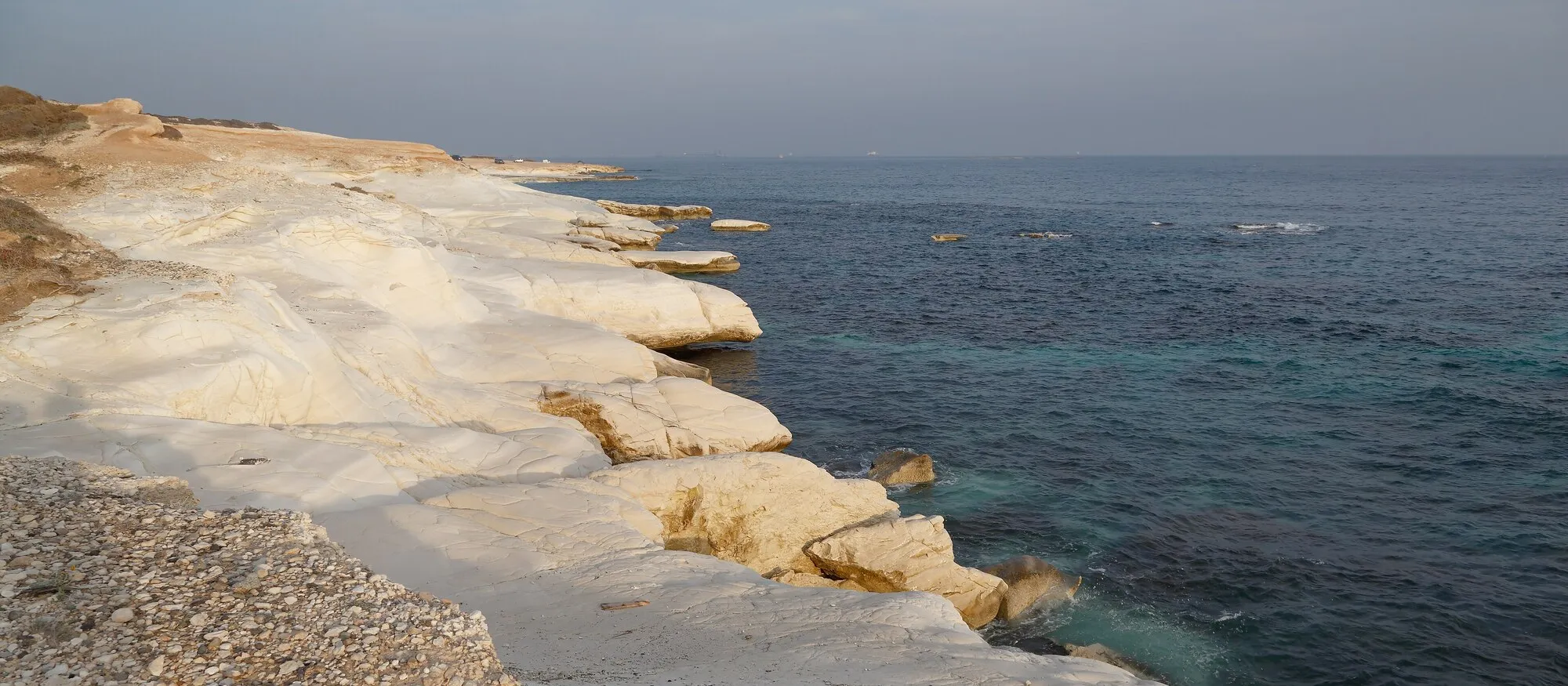
Hero photo: Governor’s Beach, Cyprus, by Dm Bsg, via Wikimedia Commons, licensed CC BY 3.0. Cropped.
.jpg)
Quick answers
Frequently asked questions
Is Malta or Cyprus cheaper?
For a holiday, they cost almost exactly the same. Eurostat's 2024 price level index for restaurants and hotels puts Cyprus at 89.0 and Malta at 88.7, where the EU average is 100. Supermarket food is a little dearer in Malta, at 110.9 against 104.8. Your dates, your resort and your flight will move the total far more than the choice of island.
Is Cyprus warmer than Malta?
From October to May, yes, by about two degrees. Paphos averages 27.0C in October against 25.0C at Malta's Luqa station, and 17.3C in January against 15.7C. In July and August it reverses on the west coast of Cyprus: Luqa averages 32.0C in August against 31.0C at Paphos, although Limassol, at 33.7C, is hotter than both. The sea around Cyprus is about 1.5 to 2 degrees warmer for most of the year.
Does time in Malta count towards the Schengen 90 days?
Yes. Malta is in the Schengen area, so days there count towards the 90 days in any 180 that UK passport holders can spend visa-free across Schengen countries, and the EU Entry/Exit System now registers fingerprints and photos on arrival. Cyprus is outside Schengen, so days there do not count.
Is the flight to Malta shorter than the flight to Cyprus?
Yes, by a long way. Malta is about 2,060 km from Gatwick in a straight line, against about 3,190 km for Paphos and 3,250 km for Larnaca. That is more than 1,100 km less, which saves well over an hour in the air each way. Malta is also one hour ahead of the UK, while Cyprus is two hours ahead.
Does Cyprus or Malta have better beaches?
Cyprus, for most beach holidays. It has 56 Blue Flag beaches for 2026 and long stretches of sand on the east coast and around Paphos and Coral Bay. Malta's coast is mostly rock, with a handful of sandy bays such as Golden Bay, Mellieha Bay and Ramla Bay on Gozo, and its national Blue Flag list shows 11 beaches. Malta's swimming is often from rock platforms into very clear water.