Planning · Two big islands, one sea, different calendars
Cyprus or Crete: which island suits your holiday?
Cyprus or Crete? Official station climate normals, satellite sea temperatures, 2026 Blue Flag counts and UK entry rules on how the two islands really differ, and who each one suits.
- Filed under
- Plan your trip
- Updated
- 27 September 2026
- By
- The editors
Choose Cyprus if you are travelling in spring, autumn or winter, or if you want easy driving and UK plugs: it runs two to three degrees warmer than Crete outside high summer, and the sea around it is about two degrees warmer from June to November. Choose Crete for a shorter flight, a far bigger choice of Blue Flag beaches and a landscape of high mountains and gorges. In July and August the weather will not decide it, because the west of Cyprus and the north coast of Crete are almost exactly as hot as each other.
Most of the search results for this question are forum threads and Facebook groups. The top Reddit thread asks about “Cyprus or Crete for first time visiting Greece”, which is the first thing to clear up: Cyprus is not in Greece. It is a separate country, with its own driving side, its own plugs and its own entry rules. The rest of this comparison uses official station data rather than opinion.
The quick answer
| Cyprus | Crete | |
|---|---|---|
| Country | Republic of Cyprus, independent EU member | Greece |
| Size | 9,251 km² (whole island) | 8,336 km², 260 km end to end |
| October average high | 27.0°C (Paphos Airport) | 24.0°C (Heraklion Airport) |
| August average high | 31.0°C (Paphos) to 33.7°C (Limassol) | 30.2°C (Heraklion Airport) |
| August sea | About 28°C | About 26°C |
| Blue Flags, 2026 | 56 beaches | 154 |
| Straight-line distance from Gatwick | About 3,190 km (Paphos) | About 2,680 km (Heraklion) |
| Time difference from UK | +2 hours | +1 hour |
| Drive on the | Left | Right |
| Plugs | UK three-pin (Type G) | European two-pin (Types C and F) |
| Schengen area | No | Yes |
Is Cyprus warmer than Crete?
Only for part of the year, and the part that matters depends on when you travel.
The fairest comparison is between the two islands’ coastal airport stations, which sit at similar heights near the sea. The figures below are average daily highs: Paphos Airport from the World Meteorological Organization’s 1991 to 2020 normals, and Heraklion Airport from the Hellenic National Meteorological Service.
| Month | Paphos, Cyprus | Heraklion, Crete | Difference |
|---|---|---|---|
| January | 17.3°C | 15.2°C | Cyprus +2.1 |
| April | 21.8°C | 20.1°C | Cyprus +1.7 |
| May | 24.9°C | 24.3°C | Cyprus +0.6 |
| July | 30.4°C | 30.3°C | Level |
| August | 31.0°C | 30.2°C | Cyprus +0.8 |
| October | 27.0°C | 24.0°C | Cyprus +3.0 |
| November | 23.1°C | 20.1°C | Cyprus +3.0 |
The pattern is clear. In high summer the two are level. From October to April, Cyprus is noticeably warmer, and the gap is biggest in the autumn. Late October in Paphos feels like late September in Heraklion.
Rain follows the same pattern. The Heraklion station records 43.1 mm in an average October against 21.7 mm at Paphos, so Crete’s autumn turns wet about a month earlier. In midwinter they are much the same, with around 80 to 100 mm a month at both.
One caution about Cyprus in summer: Paphos is the coolest part of the Cypriot coast. Limassol’s 1991 to 2020 average high for August is 33.7°C, three and a half degrees above Heraklion. If you are going in July or August and dislike heat, the west of Cyprus or the north coast of Crete are the comfortable choices. Our Limassol or Paphos comparison and Larnaca or Paphos comparison set out how much the Cypriot resorts differ from each other.
Crete has one summer factor Cyprus mostly does not: the meltemi, the strong northerly wind of the Aegean. It keeps the north coast fresher than the temperature suggests but can also bring days of choppy sea on north-facing beaches, which is when Cretans head south.
The sea: about two degrees warmer around Cyprus
NOAA satellite averages, as published by Sea Temperature, put the water at Limassol about 2°C above Heraklion for most of the swimming season:
| Month | Limassol | Heraklion |
|---|---|---|
| May | 20.8°C | 19.3°C |
| July | 27.2°C | 25.4°C |
| August | 27.8°C | 25.9°C |
| October | 24.8°C | 22.8°C |
| November | 21.9°C | 20.1°C |
A two-degree difference is noticeable when you get in. In practice, the Cyprus sea season lasts longer at both ends: November water off Cyprus is about as warm as the Cretan sea in early June. Our Cyprus sea temperature guide has every month.
Beaches: Crete has three times the Blue Flags
For 2026, Greece received 624 Blue Flag beaches and Crete held the most of any Greek region, with 154. Cyprus received 56 beaches plus two marinas. Crete has about 1,046 km of coast and a long south coast facing Africa, so the choice is simply larger, and it includes famous lagoons and pink-sand beaches in the far west.
Cyprus’s beaches are more concentrated. Most of the flags are on the east coast around Ayia Napa and Protaras, where the water is shallow and sheltered, and around Paphos and Coral Bay in the west. Our best beaches in Cyprus guide covers the pick of them. If you want to spend a fortnight moving along a coast finding a new beach every day, Crete wins. If you want one excellent family beach within walking distance of the hotel, Cyprus does that just as well.
Getting there and getting around
Crete is closer. In a straight line, Heraklion is about 2,680 km from Gatwick and Chania about 2,600 km, while Paphos is about 3,190 km and Larnaca about 3,250 km. That is roughly half an hour less flying each way. Direct flights to Cyprus take 4 hours 35 minutes from London, as our guide to flight times sets out. Crete is also one hour ahead of the UK rather than two, which gives you a slightly earlier arrival.
On the ground, the differences favour UK visitors in Cyprus. The Republic of Cyprus drives on the left, uses UK three-pin plugs and has English on most road signs, a legacy of British rule that ended in 1960. Crete drives on the right and uses European two-pin sockets. Neither is difficult, but in Cyprus you can take your own chargers and drive a hire car without adjusting. See driving in Cyprus and Cyprus plugs for the details.
Crete’s shape makes a difference too. It is 260 km long and narrow, so the main towns sit along one northern road, and Chania to Sitia at the eastern end is 272 km, about four and a half hours by car. Cyprus is more compact: Paphos to Ayia Napa, the longest drive most visitors make, is 178 km and about two and a half hours on the motorway, and the Troodos mountains are about an hour inland from Limassol.
Paperwork: one island is in Schengen, the other is not
Both islands are in the EU and both use the euro. Their entry rules are not the same.
Greece is in the Schengen area. Days in Crete count towards the 90 days in any 180 that British passport holders can spend visa-free across all Schengen countries. The EU’s Entry/Exit System now runs across Schengen, although the Foreign Office says Greek authorities have indicated they will not collect fingerprints and photos from UK travellers under it.
Cyprus is not in Schengen. It runs its own 90-day allowance, the Foreign Office says it is not affected by the Entry/Exit System, and time spent there does not reduce your Schengen days. For a one-week holiday this makes no difference. For anyone who winters abroad, or has already used much of their Schengen allowance in Spain or France this year, it can decide the question. Our Cyprus entry requirements guide covers passport validity and stamping.
Character: what each island feels like
Crete feels like a small country of its own. It has a population of 624,408 (2021 census), two sizeable cities in Heraklion and Chania, the Minoan palace at Knossos, peaks above 2,400 m and a south coast of gorges and villages that are hard to reach. It suits a road trip, walkers, and people who want to see more of the island than their resort.
Cyprus combines layers in a smaller space. Roman mosaics at the Paphos Archaeological Park and the clifftop theatre at Kourion, Byzantine painted churches and wine villages in the Troodos mountains, and the only divided capital in the EU at Nicosia, where you can cross the Green Line on foot. English is widely spoken. Cyprus also stays open in winter: it still welcomed 112,100 visitors in January 2025, according to the Statistical Service, and Paphos and Limassol are working towns all year.
Which one should you book?
- Travelling October to April: Cyprus. It is warmer, drier in autumn and has a busier winter.
- A first beach holiday with young children: Cyprus, for sheltered bays, left-hand driving and UK plugs. Our family holiday guide helps you choose a base.
- July or August, and you dislike heat: a draw between the west of Cyprus and the north coast of Crete. Avoid Limassol and Larnaca.
- A road trip, hiking and gorges: Crete.
- The widest choice of beaches: Crete.
- Several trips a year into Europe: Cyprus, to protect your Schengen days.
If Cyprus is the answer, the next decision is where to stay. Our best place to stay in Cyprus matches each resort to a type of trip, and the best time to visit Cyprus picks the month.
Sources for changing details: Paphos Airport 1991 to 2020 normals from NOAA/WMO, and Limassol 1991 to 2020 normals from the Meteorological Service (Cyprus), as reproduced on the Paphos and Limassol reference pages. Heraklion Airport normals from the Hellenic National Meteorological Service, as reproduced on the Heraklion reference page. Sea temperatures are NOAA satellite averages from Sea Temperature for Limassol and Heraklion. Crete’s 2026 Blue Flags from GTP Headlines, 15 May 2026, and Cyprus’s from Sigmalive, 12 June 2026. Entry rules from the UK Foreign Office pages for Greece and Cyprus, checked 27 September 2026. Crete’s area and population from the Crete reference page (Hellenic Statistical Authority 2021 census). Flight distances are great-circle distances between airport coordinates, and driving distances and times are from OSRM routing, retrieved 27 September 2026. Entry rules and schedules change, so check them for your own dates.
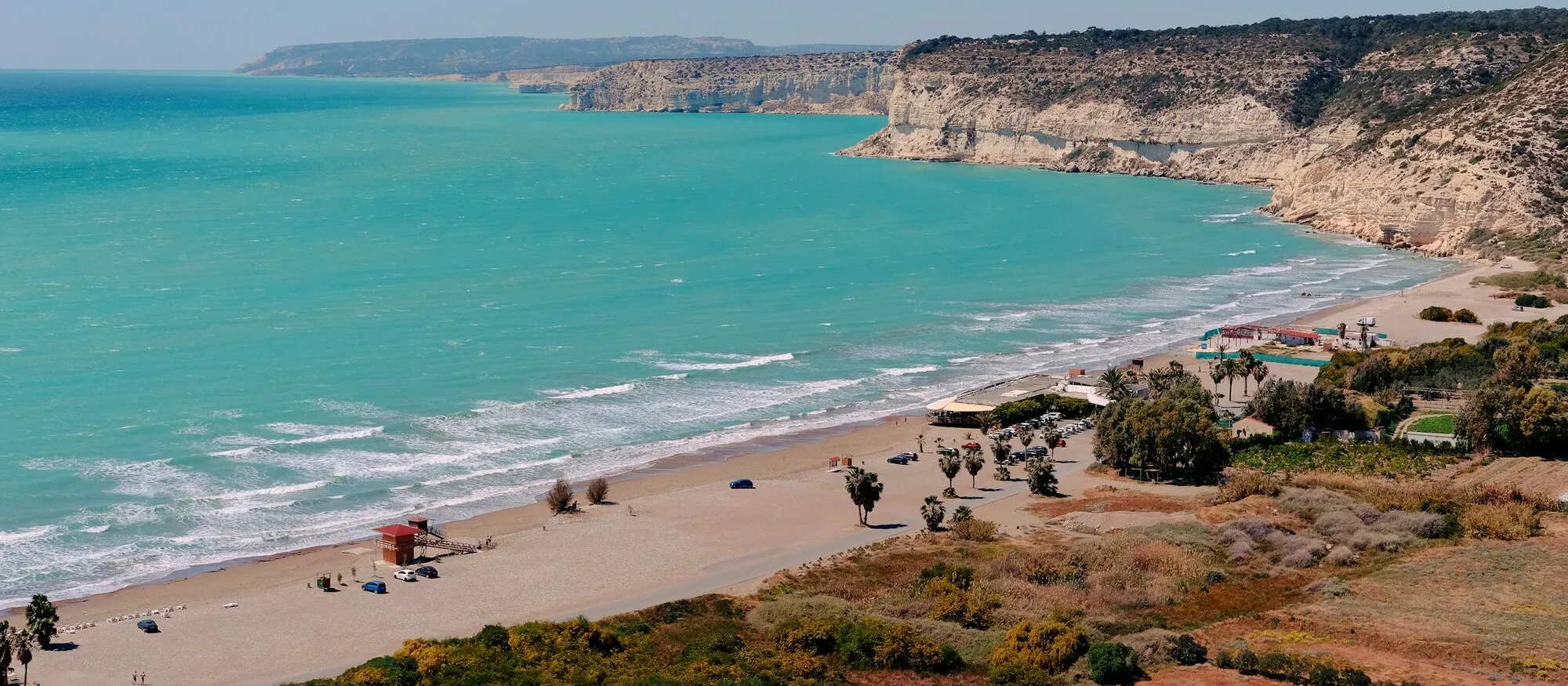
Hero photo: south coast of Cyprus, via Unsplash.
Quick answers
Frequently asked questions
Is Cyprus warmer than Crete?
In spring, autumn and winter, yes, by two to three degrees. Paphos Airport averages 27.0C in October against 24.0C at Heraklion Airport, and 17.3C in January against 15.2C. In July and August the two are almost level on the west coast of Cyprus, at about 30 to 31C, while Limassol and Larnaca run hotter than either. The sea around Cyprus is also about two degrees warmer from June to November.
Is Cyprus part of Greece?
No. The Republic of Cyprus is an independent country and a separate EU member state, although Greek is one of its official languages and most of its people are Greek Cypriots. Crete is part of Greece. That matters in practice: Cyprus drives on the left and uses UK-style three-pin plugs, while Crete drives on the right and uses two-pin European plugs.
Is the flight to Crete shorter than the flight to Cyprus?
Yes. Heraklion is about 2,680 km from Gatwick in a straight line, against about 3,190 km for Paphos and 3,250 km for Larnaca. That is roughly 500 to 570 km less, which works out at around half an hour less in the air. Crete is also one hour ahead of the UK, while Cyprus is two hours ahead.
Is Cyprus or Crete better in October?
Cyprus, if warmth and swimming are the priority. October averages 27C at Paphos against 24C at Heraklion, the sea is about 25C against 23C, and the Cyprus station recorded about half the October rainfall of the Crete one. Crete in October suits walking and sightseeing more than beach days.
Does time in Crete count towards the Schengen 90 days?
Yes. Greece is in the Schengen area, so days in Crete count towards the 90 days in any 180 that UK passport holders can spend visa-free across Schengen countries. Cyprus is not in Schengen, so days there do not count. This matters most for people who travel often or spend long winters abroad.