Places · Larnaca district
Oroklini, Cyprus: the hillside village, the bird lake and the beach strip 3 km below
What and where Oroklini is, why it is also called Voroklini, how the old village, the lake and the Dhekelia road beach fit together, what happened to Yanathes beach's 2026 Blue Flag, when to see birds at Oroklini Lake and which buses run from Larnaca this winter.
- Filed under
- Places
- Updated
- 27 November 2026
- By
- The editors
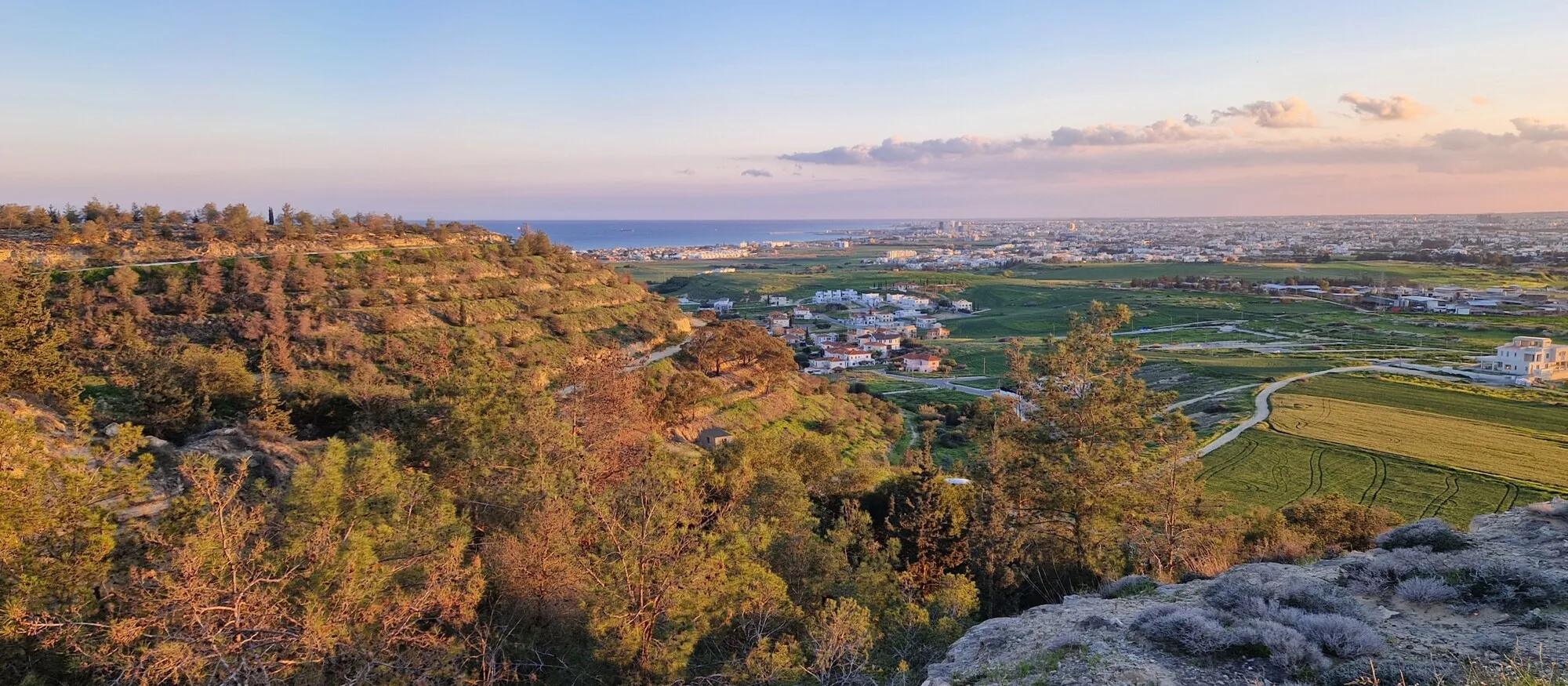
Oroklini is a former village of about 7,600 people in the Larnaca district, 9 km by road north-east of central Larnaca and 22 km from the airport. Its official name is Voroklini. It is really three places under one name: an old stone village at the foot of a hill, a small protected lake below it, and a strip of hotels, apartments and beach on the Larnaca to Dhekelia road about 3 km from the village square. Most visitors only ever see the third.
Search for Oroklini and you get short videos, a Tripadvisor page, a property developer’s article and a site that shows you where it is on a map. None of them says which bus goes to the village and which to the beach, how many people live here now, or why the Blue Flag awarded to the beach in June 2026 was missing from the list of flags flying a month later. This guide works from the Deputy Ministry of Tourism, BirdLife Cyprus, the census, the bus operator’s live timetable, 2026 press reports and archived copies of the community council’s website.
That last source needs a word of warning. The council’s old address, voroklini.org, which Wikipedia and several directories still link to, no longer shows the council’s site. When we checked on 27 November 2026 it was serving unrelated gambling content. The council pages quoted below come from Internet Archive copies made in late 2025.
Where Oroklini is, and which name to use
The old village stands about 50 m above sea level at the foot of a long, low hill, with Livadia to the west, Pyla to the north-east and the sea to the south. The hill, which Visit Cyprus calls Gerakomoutis, reaches 207 m.
Both names are in daily use. Voroklini is the one on official documents: the census, the Deputy Ministry of Tourism’s beach and cycling pages, and the former community council. Oroklini is what the road signs, the bus stops and nearly every hotel listing say. The council’s history page lists older spellings (Porocumi, Voroclini) and offers two competing explanations for the name, one from brackish springs and one from the Greek for mountain, without choosing between them.
Until 2024 Oroklini was a community with its own council. Since the local government reform of July 2024 it has been a municipal district of Larnaca Municipality, with its own deputy mayor. It has also grown faster than almost anywhere in the district:
| Census | Population |
|---|---|
| 1982 | 1,315 |
| 1992 | 1,957 |
| 2001 | 3,310 |
| 2011 | 6,134 |
| 2021 | 7,575 |
Wikipedia’s article still gives the 2011 figure. The Cyprus Mail described Oroklini in September 2025 as home to residents of 33 nationalities.
Driving distances below were calculated with OSRM on the public road network from the church of Archangel Michael in the old village.
| From Oroklini village to | Distance | Driving time |
|---|---|---|
| Yanathes beach | 3.1 km | about 6 minutes |
| Oroklini Lake bird viewpoint | 3.2 km | about 7 minutes |
| Pyla village | 7.5 km | about 10 minutes |
| Finikoudes, central Larnaca | 9.0 km | about 17 minutes |
| Larnaca Airport terminal | 22 km | about 23 minutes |
| Ayia Napa | 39 km | about 35 minutes |
| Nicosia | 50 km | about 47 minutes |
If you are staying on the coast road, as most holidaymakers are, you are about 3 km closer to the sea and no further from Larnaca, but the old village is a drive or a bus ride away, not a stroll.
The old village
The core of the village is small and mostly 19th century. The council’s architecture page says the oldest surviving houses were built before 1882 and describes two-storey stone buildings with arched gateways along Eirinis and Agias Aikaterinis streets, a medieval fountain where three lanes meet, and a holy spring dedicated to St Catherine at the western edge. A manor house on Agias Aikaterinis street is known locally as the “consulate”; the council suggests, cautiously, a link with a British consul of the 1860s.
Archangel Michael, the old parish church, is described by the council as a 17th-century building enlarged in 1867, when the villagers paid to have its carved icon screen gilded. A larger church of the same dedication was built in the village centre between 1984 and 1986. The feast days are 6 September and 8 November.
The coffee shops are on Anexartisias street, and the Cyprus Mail describes the traditional centre as known for its taverns, galleries and tourist accommodation. A €3.5 million regeneration of the historic core, part-funded by the EU, was due to go to tender in autumn 2025 with work expected during 2026, according to the Cyprus Mail, so expect some streets to be dug up.
One local story is best treated as a story. The council says it is “rumoured” that the French poet Arthur Rimbaud worked in the quarries here. Rimbaud did work at a quarry in Cyprus in 1878 and 1879, and Liopetri makes a similar claim.
Profitis Ilias and the hill
The small stone chapel of the Prophet Elias sits on the hill above the village and is the picture most people take away. The council dates the original building to the 16th century, says it was rebuilt and raised in the 20th century with the old church kept as the sanctuary, and that it was restored in 1994. It holds about 60 people and is used for services only three or four times a year, the main one being the saint’s feast, which the Orthodox calendar puts on 20 July. On other days expect to find it locked and come for the view, which takes in the whole of Larnaca Bay.
Beside it is a picnic area that Visit Cyprus lists as having access ramps. The council reported in September 2021 that it had widened and gravelled the road from the end of the pavement up to the chapel, so the last stretch is unsurfaced. Visit Cyprus also lists the hill as a mountain-bike area on unpaved ground, “various levels of difficulty”, needing a bike with front suspension. Go late in the afternoon in summer; there is little shade on the way up.
Oroklini Lake
The lake lies between the village and the coast road and is easy to drive past. BirdLife Cyprus describes it as the smallest Natura 2000 site in Cyprus, about 50 hectares, protected under both the EU Birds and Habitats directives. A total of 190 bird species have been recorded. It is the best nesting site on the island for the black-winged stilt, one of the main breeding sites for the spur-winged lapwing, a species for which Cyprus holds more than half the EU’s breeding population, and, according to the council, the only place in Cyprus where the red-crested pochard nests.
Between 2012 and 2014 an EU LIFE project fenced the lake to keep vehicles out, cleared invasive plants, and built an information kiosk and a raised wooden hide. We found no published opening hours for the kiosk. The hide is an open, two-storey timber structure, OpenStreetMap marks a bird viewpoint on the lake’s southern edge, and route 419 has a stop named Oroklini Lake.
Flamingos do turn up, but in small numbers. The Cyprus Mail reported 95 at Oroklini in the February 2025 count, against 1,065 at the Larnaca salt lakes, and named the lake among five wetlands where the first birds of the following winter had arrived by early December 2025. For a big flock, the salt lake by the airport is the better bet; for stilts and lapwings at close range in spring, this one is. Stay outside the fence, and bring repellent at dusk in the warmer months, as you would at any wetland. Our mosquito guide covers what works.
The beach and the Dhekelia road
The coast here is a long, narrow run of sand behind a line of offshore breakwaters, backed by the hotels and apartment blocks of the Larnaca to Dhekelia road. The council describes more than 2.5 km of shore and an 850 m lit walkway along it.
The organised part is Yanathes, which you will also see written Yiannades, Yiannathes and Giannades. Visit Cyprus describes a 300 m strip of fine brown and beige sand with calm, shallow water, toilets, showers, changing rooms, sunbeds, umbrellas and lifeguards from June to October. The Deputy Ministry’s accessible-beaches list puts both Yanathes and the neighbouring Voroklini municipal beach in its “fully accessible” group, each with a floating wheelchair. Our Larnaca beaches guide compares it with the town beaches.
Three things about 2026 are worth knowing before you book around it.
The Blue Flag. Yanathes was on the list of 56 beaches awarded a Blue Flag for 2026, and Larnaca Municipality named it as one of its four after the June ceremony. But when the national operator, CYMEPA, published the list of 46 beaches actually flying the flag on 17 July 2026, Larnaca had three: Finikoudes, Kastella and Mackenzie. Yanathes was not on it. We could not find an official explanation or a later update, so do not assume the flag is flying in 2027.
Erosion. In April 2026 the deputy mayor and the municipality’s technical services told the Cyprus Mail that erosion was occurring “along the entire length of the walkway” and had worsened after a jetty near the Lebay Hotel was removed. They reported subsidence and said safety measures were in place that some people were ignoring. If a section of the path or beach is fenced off, it is for that reason.
Currents by the breakwaters. On 18 June 2026 two women drowned at Oroklini after being swept away by currents near a breakwater at about 19:30, according to the police account in the Cyprus Mail. Shallow water behind the breakwaters is calm; the gaps and the outer side are not. Swim in the lifeguarded section and during lifeguard hours.
The road itself is finally finished. The four-lane rebuild of 3.25 km of the Larnaca to Dhekelia road, with cycle lanes, opened to traffic on 24 July 2026 after years of works. Service roads alongside were due by the end of October 2026; we found no report confirming that.
Offshore, the Larnaka Tourism Board’s artificial reef includes the LEF1, a wreck in 13 m of water that it describes as suitable for snorkellers. Our Zenobia guide covers the bay’s dive sites.
Getting there without a car
Two different sets of buses serve the two halves of Oroklini, and they do not meet in the village.
For the old village and the lake, take route 419 from Larnaca Station. The timetable on the operator’s site on 27 November 2026 showed:
| From Larnaca Station | From Oroklini village | |
|---|---|---|
| Monday to Friday | 06:25, 07:25, 08:45, 09:55, 11:05, 12:45, 13:55, 15:05, 16:10, 17:20, 18:35, 19:35, 21:00 | 06:40, 07:45, 09:05, 10:15, 11:25, 13:05, 14:15, 15:25, 16:30, 17:40, 18:55, 19:55, 21:20 |
| Saturday and Sunday | 07:20, 09:55, 12:45, 15:05, 17:20, 19:35, 21:55 | 07:40, 10:15, 13:05, 15:25, 17:40, 19:55, 22:15 |
It stops at Oroklini Lake, the elementary school, Archangel Michael church and the stadium.
For the beach strip, take the X424 (Larnaca Station to Pyla, every 30 minutes on weekdays and hourly at weekends) or the 425, both of which run along the coast road and stop at Yanathes Beach. The 425 continues through Larnaca to the airport. Night route 445 links Oroklini and Pyla with Finikoudes and Mackenzie.
A single costs €2.70 in cash on board or €2 with a Motion card. From 21:00 the night fare applies: €4.70 in cash or €3.50 by card. Our public transport guide explains the cards.
Weather
There is no weather station in Oroklini. The nearest long record is Larnaca Airport, about 20 km away on the same coast, and its 1991 to 2020 normals are a fair guide.
| Month | Average high | Average low | Rainfall |
|---|---|---|---|
| January | 17.1°C | 7.8°C | 83 mm |
| April | 23.0°C | 12.1°C | 16 mm |
| July | 33.0°C | 22.6°C | 1 mm |
| August | 33.3°C | 23.0°C | 0 mm |
| October | 28.3°C | 17.5°C | 16 mm |
| December | 18.9°C | 9.7°C | 95 mm |
The airport’s annual rainfall is about 350 mm; the council’s own figure for the village is about 340 mm. Winter nights at the airport run cold because the station is on open ground, so expect the built-up coast road to be a degree or two milder.
Who Oroklini suits
Stay on the coast road if you want a beach hotel or apartment with a half-hourly bus into Larnaca, shallow water for small children and an airport transfer of under half an hour. Stay in or near the old village if you have a car and want somewhere quieter with tavernas and a view. If you want to walk out of the door into a town, stay in central Larnaca; things to do in Larnaca and our old town guide cover it.
The short answer
Oroklini and Voroklini are the same place: a fast-growing district of Larnaca Municipality with 7,575 residents at the last census, 9 km from the town centre. The old village, the hilltop chapel of Profitis Ilias and the bird lake are inland; the beach and hotels are on the Dhekelia road about 3 km below. Bus 419 serves the village and the lake, the X424 and 425 serve the beach. Yanathes beach is shallow, accessible and lifeguarded in summer, but check the Blue Flag for yourself and keep clear of the breakwater gaps.
Sources for changing details: Visit Cyprus on Yanathes beach, the Voroklini hill cycling route, the Oroklini picnic area and its accessible beaches list; BirdLife Cyprus on the Oroklini Lake project; the Larnaka Tourism Board’s Voroklini page; the former community council’s history, religious sites, architecture, beach and natural environment pages, read from Internet Archive copies dated November and December 2025; census figures as reproduced by City Population; the Cyprus Mail on the 2026 Blue Flag awards, the flags flying on 17 July 2026, coastal erosion, the June 2026 drownings, the Dhekelia road opening, the municipal projects and flamingo counts; Politis on Larnaca’s four 2026 flags; CYMEPA’s list of flags flying; Cyprus Public Transport for routes, times and fares; Larnaca Airport climate normals from the World Meteorological Organization via NOAA, as reproduced on Wikipedia’s Larnaca page; OpenStreetMap for stop names and locations; OSRM for driving distances. Checked on 27 November 2026. Timetables, fares and beach awards change, so confirm them before you travel.
Hero photograph: “Oroklini, Cyprus, view from hill to Larnaca” by Gerda Arendt, taken in March 2026, via Wikimedia Commons, released under CC0. Cropped for this page.

Quick answers
Frequently asked questions
Is it Oroklini or Voroklini?
Both names mean the same place. Voroklini is the official name used by the community council, the Deputy Ministry of Tourism and the census, and Oroklini is the everyday name used on road signs, bus stops and hotel listings. The council's own history page records older spellings such as Voroclini and Porocumi and says the origin of the name is not settled.
Where is Oroklini in Cyprus?
Oroklini is in the Larnaca district on the south-east coast, about 9 km by road north-east of Finikoudes in central Larnaca and about 22 km from Larnaca Airport. The old village sits at the foot of a 207-metre hill about 3 km inland, with Oroklini Lake and the Larnaca to Dhekelia coast road below it. Since July 2024 it has been a district of Larnaca Municipality.
Does Oroklini have a beach?
Yes, but it is about 3 km from the old village, on the Larnaca to Dhekelia road. The organised section is Yanathes, also written Yiannades or Giannades, a 300-metre strip of brown-beige sand with shallow water, lifeguards from June to October and a floating wheelchair. It was awarded a Blue Flag for 2026 but was not among the flags flying when the national operator published its list on 17 July 2026.
Can you see flamingos at Oroklini Lake?
Sometimes, in winter. Oroklini Lake was one of five wetlands where the first flamingos of the season were reported in December 2025, and the February 2025 count recorded 95 there against 1,065 at the Larnaca salt lakes. The lake matters more for its nesting black-winged stilts and spur-winged lapwings, and 190 bird species have been recorded.
Is there a bus from Larnaca to Oroklini?
Yes. Cyprus Public Transport route 419 runs from Larnaca Station to Oroklini village 13 times a day on weekdays, between 06:25 and 21:00, and seven times a day at weekends. For the beach strip use the X424 or 425 along the coast road instead. A single costs 2.70 euros in cash or 2 euros with a Motion card.