Paphos district · A free church, a free museum, a protected sweet and a beach 3 km down the hill
Geroskipou, Cyprus: the loukoumi town beside Paphos, its five-domed church and its beach
Geroskipou (Yeroskipou) is a town of about 8,600 people 3 km east of Paphos, known for its 9th-century five-domed church, a free folk art museum and EU-protected loukoumi. Opening hours, the three Blue Flag beaches, which bus goes where, taxi costs and who it suits.
- Filed under
- Places
- Updated
- 14 November 2026
- By
- The editors
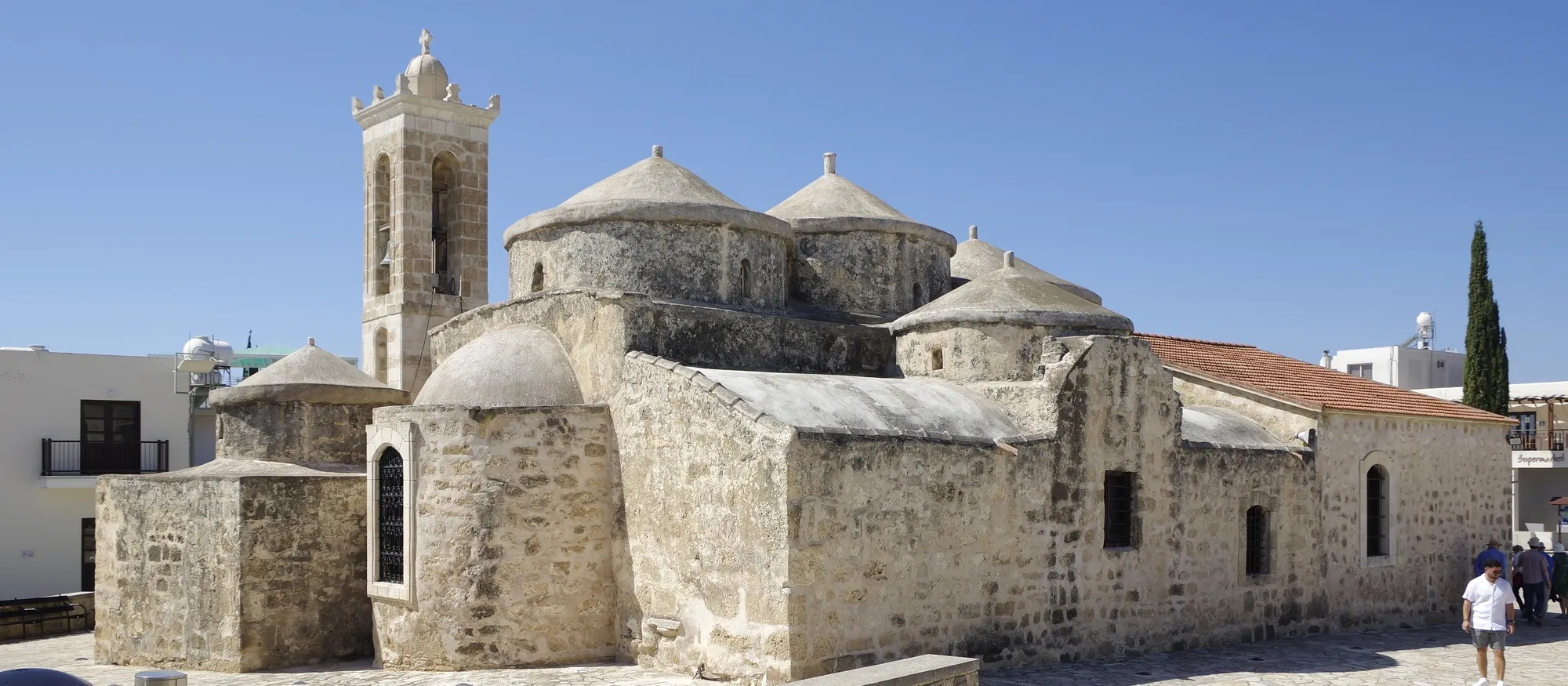
Geroskipou is a town of about 8,600 people 3 km east of Paphos, on the old road to Limassol. Visitors come for three things within a few minutes’ walk of each other: Agia Paraskevi, a 9th-century church with five domes, a folk art museum in an 18th-century mansion, and the shops that make loukoumi, the only Cypriot sweet with EU protected status. Both the church and the museum are free. The beach is a separate trip, 3 km down the hill.
It is also a place with three names: Geroskipou on road signs, Yeroskipou in older guidebooks and, since October 2024, Ierokipia on the council’s letterhead.
Geroskipou at a glance
| Where | Paphos district, 3 km east of Paphos town, between the town and the airport |
| Population | 8,579 at the 2021 census |
| Local authority | Ierokipia Municipality since 2024, with Geroskipou as its administrative centre |
| Main sights | Agia Paraskevi church and the Folk Art Museum, both free |
| Known for | Loukoumi Geroskipou, a Protected Geographical Indication since 2007 |
| Beaches | Three Blue Flags in 2026, about 3 km south of the centre |
| Paphos harbour | 6.3 km, 10 minutes by car |
| Paphos Airport | 11.5 km, 16 minutes by car |
| Buses | 613 and 601 through the centre, 606 from the centre to the beach, 611 along the coast |
Where Geroskipou is and what it is like
Geroskipou sits on the low plateau immediately east of Paphos. There is no gap between the two towns: the buildings simply continue. The old centre lies along Archbishop Makarios III Avenue, which is the old Paphos to Limassol road, and the square around Agia Paraskevi is the heart of it.
The census shows how fast it has grown: 2,634 residents in 1982, 5,763 in 2001 and 8,579 in 2021. This is a working town, and most of what you see away from the square is modern. The climate is that of Paphos Airport, 11.5 km away on the same plain, whose 1991 to 2020 normals give a mean daily maximum of 31.0°C in August and 19.3°C in December; our best time to visit Cyprus guide has the month-by-month picture.
Like Chloraka on the other side of Paphos, Geroskipou comes in two parts. The centre is inland. The coast, about 3 km to the south along Poseidonos Avenue, is a strip of large hotels, the municipal beach and the waterpark. The two halves are served by different buses.
Geroskipou, Yeroskipou or Ierokipia?
Geroskipou and Yeroskipou are two ways of writing the same Greek name. Geroskipou is the spelling on road signs.
Ierokipia is newer. Geroskipou was a municipality in its own right until the local government reform of 1 July 2024, which merged it with four neighbouring communities: Acheleia, Agia Marinouda, Konia and Timi. The new authority began life as East Paphos Municipality. Its council voted on 1 August 2024 to change the name, and a decree published in the Official Gazette on 18 October 2024 made it Ierokipia Municipality. The municipality’s own site describes Geroskipou as its administrative centre. Some online maps still say East Paphos, which is out of date. Either way, Geroskipou is not part of Paphos Municipality.
Why it is called the sacred garden
The name comes from the Greek ieros kipos, “sacred garden”. According to the tradition repeated by Visit Cyprus and the Department of Antiquities, the gardens of Aphrodite lay to the south of the present town, towards the sea, at the point where ancient pilgrims set out from Paphos for the goddess’s sanctuary at Palaipafos, today’s Kouklia, 17 km to the east.
There is some archaeology behind the story. In July 2019 the then Geroskipou council recorded that a Department of Antiquities excavation at the coastal site of Pachyammos had uncovered a large sanctuary complex of the Hellenistic period, with cisterns and water installations that point to a grove and gardens connected with worship. It is not an organised site with opening hours.
Agia Paraskevi church
Agia Paraskevi is the reason to stop. Visit Cyprus describes it as a 9th-century, three-aisled, barrel-vaulted basilica with five domes, one of only two such churches on the island. The other is at Peristerona, west of Nicosia. Three larger domes run along the central aisle and two smaller ones sit over the side aisles.
Inside, the wall paintings span the 8th or 9th to the 15th centuries. The oldest is a plain reddish cross painted straight onto the stone, uncovered during conservation between 1974 and 1977. In the eastern dome is a jewelled cross with no figures, which the municipality calls the only aniconic composition known in Cyprus. The church also holds a double-sided 15th-century icon, with the Virgin on one face and the Crucifixion on the other.
A note on dates. Some online encyclopaedias give the 11th century. The official bodies say the 9th, and the municipality argues from the figureless cross that the church was standing before 843, the end of the Iconoclast period. Whether it stands on an earlier temple of Aphrodite has, in its words, not been established.
The two official sources do not quite agree on opening hours.
| Visit Cyprus listing | Municipality listing | |
|---|---|---|
| Days | Monday to Saturday; Sunday visits by arrangement | Not stated |
| Hours | 08:30 to 13:00 and 14:00 to 16:30 | 08:00 to 13:00 and 14:00 to 16:00 in winter, to 17:00 in summer |
| Entrance | Free | Free |
| Telephone | +357 26 821 000 | Not given |
The safe reading is Monday to Saturday, 08:30 to 13:00 or 14:00 to 16:00. Either way the church shuts for lunch. It is a working parish church, so cover shoulders and knees.
The Folk Art Museum
A short walk from the church, at 7 to 9 Athinon Street, the Local Ethnographic Museum of Geroskipou fills an 18th-century mansion known as the House of Hadjismith. It belonged to Andreas Zimboulakis, a wealthy man appointed British consular agent for western Cyprus. The Department of Antiquities explains the odd name: the family was close to the British admiral Sir Sidney Smith, and one of them had made the pilgrimage to the Holy Land, which earned the prefix “Hadji”.
It has been a museum since 1978. The collection comes from all over Cyprus and covers daily life and rural crafts of the 19th and early 20th centuries: pottery, weaving, rope making and the silk production the island was once known for.
| 16 September to 15 April | Daily, 08:30 to 16:00 |
| 16 April to 15 September | Daily, 09:30 to 17:00 |
| Entrance | Free, according to the Department of Antiquities and Visit Cyprus |
| Closed | Public holidays |
| Access | Not wheelchair accessible |
| Telephone | +357 26 306 216 |
The fee needs a caveat. The Department of Antiquities page and the Visit Cyprus listing both said “free entrance” on 14 November 2026, but the municipality’s directory still quotes an older charge of €2.50, with children up to 14 free. Carry a few coins in case.
The municipality’s directory also lists a sculpture park a few minutes’ walk north-east of the church, a municipal art gallery and an ecclesiastical museum, but publishes no opening hours for them.
Loukoumi: the sweet with its own EU protection
Loukoumi is the soft, sugar-dusted sweet that English speakers usually call Turkish delight and Cypriots sell as Cyprus delight. The version made here has a paper trail. According to the European Commission’s account, Sophocles Athanasiou came home to Geroskipou in 1895 with a recipe he had refined abroad and opened a small factory and shop near the square. His descendants still run the business, as Aphrodite Delights, and other makers in the town follow the same specification.
In 2007 Loukoumi Geroskipou became the first Cypriot product registered as a Protected Geographical Indication, and the Commission says it is the only loukoumi anywhere with that status. The rules are specific: it must be made within Geroskipou, it contains neither glucose nor gelatine, and flavours come from an approved list that runs from rose, bergamot and mandarin to pistachio.
The town has a second protected sweet. Koufeta Amygdalou Geroskipou, sugar-coated almonds, were registered in 2012. Boxes of both are sold in the shops around the square. Our Cyprus food guide covers what else to try.
Geroskipou beaches
The coast is about 3 km and 5 minutes by car from the square. On the national 2026 Blue Flag list from CYMEPA, three beaches are entered under Geroskipou: the Municipal Beach, the Laiki beach and Pachyammos 2.
- Geroskipou Municipal Beach is the main one. Visit Cyprus describes 400 metres of sand, calm and shallow water, toilets, showers, changing rooms, sunbeds, umbrellas, water sports, a children’s playground, parking and disabled access, with lifeguards from April to October.
- Laiki beach is next to it, also sandy and shallow, with toilets, showers, sunbeds and the same lifeguard season.
- Pachyammos is further west, towards Paphos. Visit Cyprus describes its Pachyammos 1 section as a quieter 50-metre beach with sunbeds and water sports; the 2026 flag is listed against Pachyammos 2.
Our Paphos beaches guide compares these with Coral Bay and the town beaches.
Two other things sit on this stretch. Paphos Aphrodite Waterpark is a few hundred metres from the municipal beach and is the terminus of bus 611. Offshore, the fisheries department’s Geroskipou marine protected area is one of the west coast’s dive sites, covered in our scuba diving guide.
Where to eat
The centre has everyday tavernas, grills and cafes around Archbishop Makarios III Avenue, and Visit Cyprus notes restaurants, fish taverns and kiosks around the municipal beach. Its gastronomy directory listed Acropolis Restaurant, Elea Restaurant, Kati Psinete stin Geroskipou and Afroditi Snack Bar on 14 November 2026. A directory entry is not a recommendation, so check before making a special trip. For the wider choice ten minutes away, see our Paphos restaurants guide.
Getting to Geroskipou
By car
Distances are from the square at Agia Paraskevi.
| To | Distance | Drive time |
|---|---|---|
| Geroskipou Municipal Beach | 3.0 km | 5 min |
| Paphos old town (Ktima) | 3.7 km | 6 min |
| Paphos, Karavela bus station | 4.4 km | 7 min |
| Paphos harbour | 6.3 km | 10 min |
| Paphos Airport | 11.5 km | 16 min |
| Coral Bay | 15.9 km | 25 min |
| Kouklia, Sanctuary of Aphrodite | 17.0 km | 17 min |
| Petra tou Romiou | 23.1 km | 21 min |
Geroskipou is a natural first stop on a day east from Paphos: church and museum in the morning, then Kouklia and Aphrodite’s Rock. For hire terms and road rules, see our car hire and driving in Cyprus guides.
By bus
Five Pafos Buses routes touch Geroskipou, and they do different jobs. These details are from the operator’s route pages on 14 November 2026.
| Route | Runs between | Part of Geroskipou | How often |
|---|---|---|---|
| 613 | Karavela station and Paphos Airport | Centre, Archbishop Makarios III Avenue | Daily, 12 each way |
| 601 | Karavela station and Mandria, via Timi and Anarita | Centre | Monday to Friday 7 out and 8 back; Saturday 2 each way; no Sunday service listed |
| 631 | Paphos harbour, Kouklia and Petra tou Romiou | Poseidonos Avenue, then the centre | Daily, 10 a day from April to November, 7 from December to March |
| 606 | Geroskipou centre, the municipal beach, Kings Avenue Mall and the harbour | Centre and beach | Monday to Saturday, 9 from Geroskipou and 8 from the harbour |
| 611 | Tombs of the Kings, the harbour and Geroskipou beach | Coast only | Daily, every 10 to 15 minutes for most of the day |
In practice:
- From Paphos old town, take the 613 from Karavela. It leaves at 05:20, 07:25, 09:30, 11:00, 13:00, 16:00, 17:30, 18:30, 19:30, 21:30, 22:30 and 23:30, with return departures from the airport between 05:50 and midnight.
- From the harbour and Kato Paphos hotels, the 606 goes to the centre. It leaves the harbour at 08:05, 09:15, 10:25, 12:35, 14:55, 16:05, 17:20 and 18:30, and leaves Geroskipou, opposite the Royal Clinic, at 07:30, 08:40, 09:50, 11:00, 14:20, 15:30, 16:45, 17:55 and 19:05. There is no Sunday timetable; the 631 is the alternative.
- For the beach and the waterpark, the 611 is the frequent one, with night buses from April to November until about 01:00. The 606 skips the beach stop from 1 December to 31 March.
- Onwards to Kouklia and Aphrodite’s Rock, the 631 follows more or less the ancient pilgrims’ route.
Fares are €2 for a single, €3 after 21:00 and €6.50 for a day ticket, bought on the bus. Public holiday timetables differ, so check the route page before relying on a departure. Our public transport guide explains the network, and the Paphos Airport to Paphos guide covers the airport routes in more detail.
By taxi
The official urban meter tariff is €3.80 plus €0.95 per kilometre by day and €4.80 plus €1.10 at night. On that basis the square to Paphos harbour comes to about €10 by day and €12 at night, and the square to Paphos Airport to about €15 by day and €17.50 at night, before luggage, waiting or public-holiday supplements. Our Cyprus taxi guide explains the extras.
Should you stay in Geroskipou?
Most visitors who “stay in Geroskipou” are on the coast, where the municipality’s directory lists twelve hotels. That strip suits a beach-and-pool holiday: sand on the doorstep, the waterpark nearby, the airport a quarter of an hour away and the 611 into Kato Paphos every 10 to 15 minutes. For a wider choice in the evening, take the bus or a taxi to the harbour.
The centre works better for a longer stay or for living, with shops, a health centre and a daily bus to both the airport and Paphos, and it appears among the areas weighed up in our best places to live in Cyprus guide.
As a half-day it is easy to recommend. Allow an hour for the church and museum, buy a box of loukoumi, and either carry on east to Kouklia or drop down to the beach. Our Paphos guide covers everything else within reach.
Sources for changing details: church hours and fee from the Visit Cyprus listing and the Ierokipia Municipality directory; museum hours and fee from the Department of Antiquities and the Visit Cyprus listing; beach facilities from the Visit Cyprus beach listings and the 2026 Blue Flag list from CYMEPA; bus times and fares from Pafos Buses route and ticket pages, all read 14 November 2026. The municipality’s name change is decree K.D.P. 338/2024 in the Official Gazette of 18 October 2024. Population is from the Statistical Service censuses of 1982 to 2021 as tabulated by citypopulation.de. Drive times are car routes calculated with OSRM on OpenStreetMap data and assume normal traffic. Opening hours, fees and timetables change without notice, so confirm before you travel.
Hero image: Agia Paraskevi, Geroskipou by Berthold Werner, Wikimedia Commons, CC BY-SA 4.0, cropped.

Quick answers
Frequently asked questions
Where is Geroskipou in Cyprus?
Geroskipou is in Paphos district on the west of the island, about 3 km east of Paphos town on the old road to Limassol. The centre around Agia Paraskevi church is roughly 6 km and 10 minutes by car from Paphos harbour and 11.5 km and 16 minutes from Paphos Airport. Its beach and hotel strip are about 3 km south of the centre, on the coast road.
Is Geroskipou the same place as Yeroskipou and Ierokipia?
Geroskipou and Yeroskipou are two spellings of the same town. Ierokipia is the name of the municipality it now belongs to. In the local government reform of 1 July 2024, Geroskipou was merged with Acheleia, Agia Marinouda, Konia and Timi as East Paphos Municipality, and a decree published on 18 October 2024 renamed it Ierokipia Municipality. Geroskipou is its administrative centre.
What is Geroskipou famous for?
Three things. Agia Paraskevi, a 9th-century church with five domes that is one of only two of its type in Cyprus. Loukoumi Geroskipou, the local sweet, which in 2007 became the first Cypriot product registered as a Protected Geographical Indication in the EU. And the tradition that this was the site of Aphrodite's sacred gardens, which is where the name comes from.
Does Geroskipou have a beach?
Yes, but not in the old centre. The coast is about 3 km and 5 minutes by car to the south. Three beaches under Geroskipou held a Blue Flag in 2026: the Municipal Beach, the Laiki beach next to it and Pachyammos 2. Visit Cyprus describes the Municipal Beach as 400 metres of sand with shallow water, lifeguards from April to October and disabled access.
How do you get from Paphos Airport to Geroskipou?
Pafos Buses route 613 runs from the airport through Timi and Acheleia to Archbishop Makarios III Avenue in Geroskipou and on to Karavela station, twelve times a day, every day. A single is 2 euros, or 3 euros after 21:00. By taxi, the official meter tariff works out at about 15 euros by day for the 11.5 km before any extras.