Paphos district · A ridge village, a hotel coast and a marina that is not there yet
Kissonerga, Cyprus: the village between Paphos and Coral Bay, its coast and how to get around
Kissonerga is a village of about 2,300 people, 9 km north of Paphos harbour and 5 km short of Coral Bay. What the village and its coast road each offer, the Mosfilia prehistoric site, Potima bay and the coastal walkway, why there is still no marina, bus 615 and 607 times, taxi costs and who it suits.
- Filed under
- Places
- Updated
- 12 November 2026
- By
- The editors
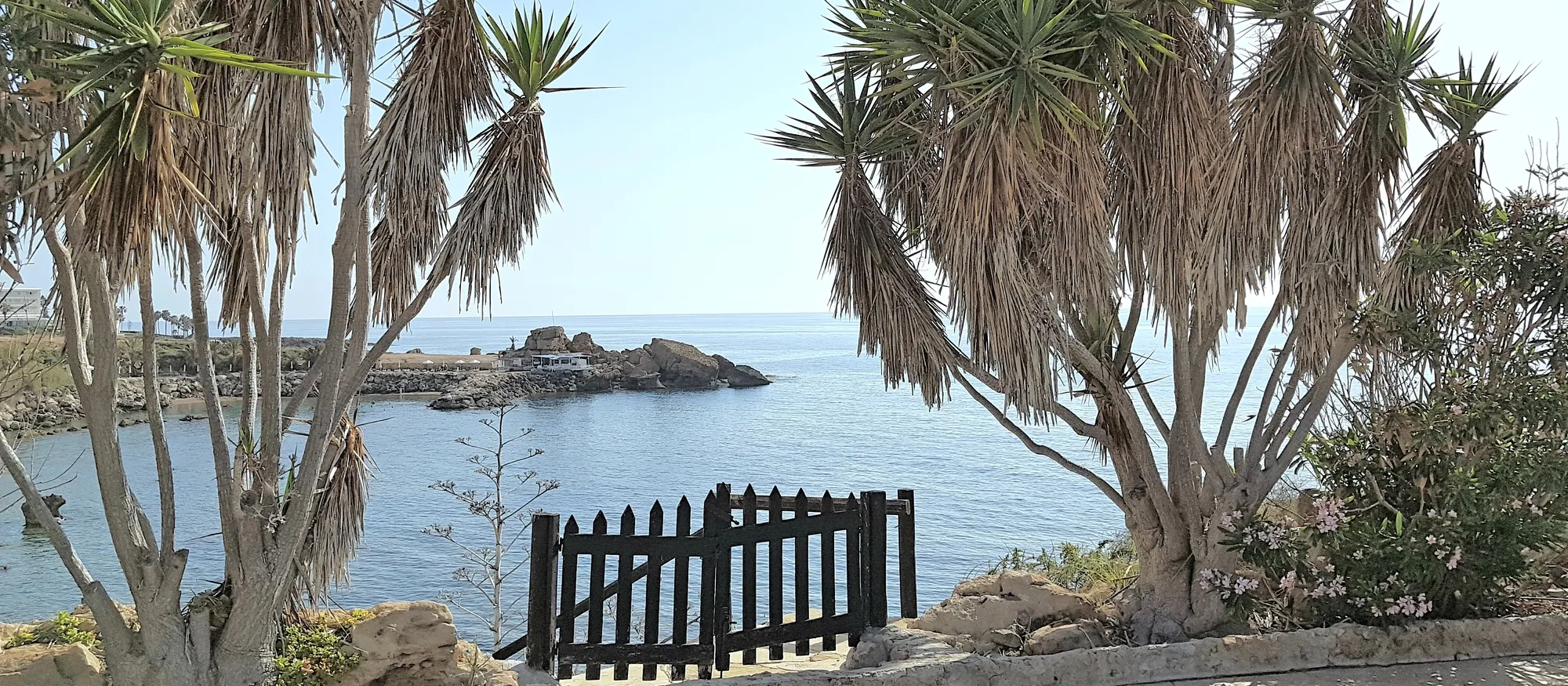
Kissonerga is a village of about 2,300 people on the west coast of Cyprus, 9 km and 15 minutes by car north of Paphos harbour and 5 km short of Coral Bay. It comes in two parts: an old centre on a ridge about 70 metres above the sea, and a coast road of hotels, villas and banana plantations 1.5 to 2 km below. There is no Blue Flag beach and, despite what some maps and brochures suggest, no marina yet.
It works best as a quiet base between two busier places. Whether it works for you depends mostly on which half you book, because the frequent bus runs along the coast and only a handful of buses climb to the village.
Kissonerga at a glance
| Where | West coast, between Chloraka and Lemba to the south and Peyia to the north |
| Population | 2,292 at the 2021 census |
| Local authority | Akamas Municipality since 1 July 2024 |
| Village centre to the coast road | 1.6 to 1.8 km, about 4 minutes by car |
| Paphos harbour | 9.2 km, 15 minutes |
| Coral Bay | 5.0 km, 9 minutes |
| Blue Flag beaches in 2026 | None in Kissonerga |
| Buses | 615 along the coast (frequent), 607 through the village (six on weekdays) |
| Postal code | 8574 |
Where Kissonerga is, and the two halves
The main Paphos to Coral Bay road runs along the coast, and for most visitors that road is Kissonerga: a string of hotels, apartment blocks, minimarkets, bars and tavernas, with plantations in the gaps between them. The Cynthiana Beach and Queen’s Bay hotels both sit on this stretch of coast.
The village proper is inland and uphill. Its main street, Christou Kelli, runs along a ridge with the church, the school and the everyday shops. It is where people live all year, and it has a different pace from the coast road in August.
The two are close on a map and less close on foot. The walk up from the coast is 1.5 to 2 km and climbs about 60 metres, which is fine in February and hard work on a July afternoon. If you want to be able to stroll to dinner and the sea, book on the coast road. If you have a car and want a village, book up top.
A village that has doubled in 30 years
Census figures from the Statistical Service show how quickly Kissonerga has grown: 1,092 residents in 1992, 1,404 in 2001, 2,004 in 2011 and 2,292 in 2021. That is slower than neighbouring Peyia and Chloraka, which each have more than 6,000 people, and it is one reason Kissonerga still feels like a village between two small towns.
Until 2024 it ran its own affairs as a community council. The local government reform that took effect on 1 July 2024 folded it into the new Akamas Municipality, whose seat is in Peyia. In practice that means the beaches, the coastal path and any new development on the Kissonerga shore are now municipal projects decided together with Peyia’s.
What to see in the village
Kissonerga is not a sightseeing village in the way that Omodos or Lefkara are. An hour covers it, and it is a pleasant hour.
- Church of the Transfiguration (Metamorfosi tou Sotiros). The large modern parish church at the top of the village. The feast of the Transfiguration falls on 6 August.
- Agia Zinaida and Agia Filonilli. The ruin of a small chapel near the main church, dedicated to two early Christian sisters whom local tradition links to St Paul’s time in Paphos.
- The EOKA memorial. By the playground opposite the school, a monument commemorates two young men of the village who died in the 1955 to 1959 campaign against British rule. One of them, Christos Kkelis, gave his name to the main street, which is why the bus stop in the village is listed as Christou Kelli.
- The square. The old football ground beside it is where the village holds its summer festival. In 2026 that was a free open-air concert on 1 August.
Kissonerga-Mosfilia: a 4,500-year-old house, rebuilt beside its ruins
The most interesting thing in Kissonerga is easy to drive past. Mosfilia is a prehistoric settlement on the slope between the village and the sea, about 700 metres from the centre, excavated over many years by a University of Edinburgh team under Professor Edgar Peltenburg.
What you see is a fenced site with the stone footings of round houses and, beside them, a full-size mudbrick roundhouse built in 2010 with authentic materials. It is a replica of the so-called Pithos House, which dates to around 2800 to 2400 BC. According to the Department of Antiquities, the original was 9 metres across, burned down with its contents in place, and yielded about 280 objects, including at least 37 storage jars, faience beads, evidence of copper working and what may be the earliest known olive press on the island. The replica serves as a small visitor centre with bilingual information panels, and was repaired in 2021 by the department and the Cyprus American Archaeological Research Institute after rain damage.
Two practical points. The department publishes no opening hours or entrance fee for Mosfilia, and there is no ticket office, so treat it as a short, unstaffed stop and do not plan a day around it. And the finds themselves are not here: material from the Kissonerga excavations is in the Archaeological Museum of the Pafos District in Paphos town.
The same team excavated a second site, Mylouthkia, on the northern side of the village, where they found wells dug roughly 10,000 years ago, among the oldest known anywhere. There is nothing to visit there. For a fuller picture of the period, the reconstructed Chalcolithic houses at Lemba, the next village south, are five minutes away by car. For the later, grander archaeology of the district, see our Paphos Archaeological Park and Tombs of the Kings guides.
The coast: coves, Potima bay and the walkway
The Kissonerga shore is mostly low rock broken by small coves, with a longer bay at Potima at the northern end, about 1.7 km from the village centre. Hotels on this stretch rely on pools and terraces as much as on the sea.
There is no Blue Flag beach in Kissonerga. The national 2026 list from CYMEPA gives Akamas Municipality three flags, at Coral Bay (Maa), Laourou and Kafizis, and all three are in Peyia. If your holiday depends on a lifeguarded sandy beach with sunbeds, Coral Bay is 3.3 km and five minutes by road from Potima, or a few stops on the 615. Our Paphos beaches guide compares the options to the south.
What Kissonerga does have is the start of a coastal walkway. The municipality is building a pedestrian route that is meant to run about 14 km from Potima to the fishing harbour at Agios Georgios in Peyia. The first 2 km phase, a €2.5 million project with a small amphitheatre, outdoor gym, basketball court and playground, was opened in 2024. In December 2025 the Cyprus Mail reported that the full route was due for delivery during 2026. We found no report of the whole route being finished by 12 November 2026, so expect good paved sections with gaps between them, not an unbroken path to Agios Georgios.
Why there is still no marina
Search for Kissonerga and you will meet references to “Paphos Marina” or “Potima marina”, sometimes written as though it exists. It does not. A marina for about 1,000 boats on state land at Potima has been planned for more than 30 years and has still not been built. Speaking at a fish festival at Agios Georgios in Peyia, Deputy Minister of Tourism Kostas Koumis said the contract signing was expected in January 2027. Separately, in January 2026 the municipality signed a €134,000 agreement for studies and designs for visitor infrastructure in the Potima area.
For a visitor in the next year or two, that means Potima is a bay with a beach, not a harbour. If you want boats, the working harbours are Paphos, Latchi and Agios Georgios.
The bananas
The plantations you see from the coast road, many of them wrapped in netting, are bananas. The strip between Kissonerga and Peyia is the island’s banana country, the one area where the Department of Agriculture’s guide to the crop places commercial growing. It gives this stretch of the Paphos coast a greener, more agricultural look than the resort strips either side of it.
Eating and staying
The coast road has the choice: tavernas, bars and cafes aimed at holidaymakers, most of them within a short walk of the hotels. In the village itself the Visit Cyprus gastronomy directory lists Tweedies Restaurant, at 1 Spyrou Kyprianou Street. Places change hands and close for winter, so check current hours before you set out; for a wider choice, our Paphos restaurants guide covers the town.
Accommodation is a mix of beach hotels on the coast road and private villas and apartments on the slopes behind. Anything on the slopes is easier with a car.
Getting to Kissonerga
By car
| From the village centre to | Distance | Drive time |
|---|---|---|
| Mosfilia prehistoric site | 0.7 km | 3 min |
| Coast road hotels | 1.6 to 1.8 km | 4 min |
| Potima bay | 1.7 km | 4 min |
| Coral Bay beach | 5.0 km | 9 min |
| Paphos, Karavela bus station | 6.3 km | 10 min |
| Peyia square | 7.7 km | 12 min |
| Paphos harbour | 9.2 km | 15 min |
| Paphos Airport | 18.3 km | 28 min |
| Larnaca Airport | 139 km | about 2 h |
Arriving by air, our Paphos Airport to Coral Bay guide covers the same road and passes through Kissonerga. For hire terms, see the Cyprus car hire guide.
By taxi
The official urban meter tariff is €3.80 plus €0.95 per kilometre by day and €4.80 plus €1.10 at night. On that basis the 9 km to Paphos harbour comes to about €12.50 by day and €15 at night, and the 18 km to Paphos Airport to about €21 by day, before luggage, waiting or public-holiday supplements. Our Cyprus taxi guide explains the extras.
By bus
Two Pafos Buses routes serve Kissonerga, one for each half. These were the times on the operator’s route pages on 12 November 2026.
| Route | Where it stops | When it runs |
|---|---|---|
| 615 Tombs of the Kings station to Coral Bay | The coast road, including Potima | Daily. In school term on weekdays, every 10 minutes from 08:00 to 11:30 and every 10 to 15 minutes for most of the afternoon, to 17:45; at weekends and in holidays, every 10 to 15 minutes from 08:20 to 17:50. Evening buses every 20 minutes from 18:00 to 23:40 between April and November, then 00:15 and 00:40; every 30 minutes from 18:00 to midnight from December to March |
| 607 Karavela station, Chloraka, Lemba, Kissonerga, Pegeia | Christou Kelli in the village, then the coast road at Potima | Weekdays from Karavela at 06:00, 08:10, 09:50, 11:30, 15:10 and 18:00; from Pegeia at 06:30, 09:00, 10:30, 12:10, 16:00 and 18:40. Saturdays from Karavela at 07:20, 11:20, 13:30 and 16:20; from Pegeia at 08:10, 12:00, 14:20 and 17:00. No Sunday service listed |
A hotel on the coast road therefore has a bus to Paphos or Coral Bay every few minutes until late, while a villa in the village has six a day and none on Sundays. The 615 ends at the Tombs of the Kings station, where you change for the harbour; our Paphos to Coral Bay guide walks through that connection.
Fares are €2 for a single, €3 after 21:00 and €6.50 for a day ticket, bought on the bus. Children up to five travel free and under-12s pay half. Public holiday timetables differ, so check the route 615 and route 607 pages before relying on a particular departure.
Kissonerga weather
There is no weather station in Kissonerga. Paphos Airport, 18 km away on the same coast, holds the long-term record: its 1991 to 2020 normals give a mean daily maximum of 31.0°C in August and 19.3°C in December. For the month-by-month picture, see our best time to visit Cyprus guide.
Should you stay in Kissonerga?
Stay on the coast road if you want a pool hotel with the sea in front, a frequent bus in both directions and quieter evenings than Kato Paphos or Coral Bay. Stay in the village if you have a car, are here for weeks and want neighbours, a bakery and a view. Look elsewhere if a sandy beach outside the door is the point of the trip: Coral Bay, five minutes north, does that better.
Kissonerga’s real advantage is position. Paphos harbour is 15 minutes one way and Coral Bay under 10 the other, with Peyia and the road to the Akamas peninsula just beyond. It is also one of the places people weigh up in our best places to live in Cyprus guide, and our Paphos guide covers everything else within reach.
Sources for changing details: bus times and fares from Pafos Buses route and ticket pages, read 12 November 2026; the Mosfilia roundhouse from the Department of Antiquities announcement of 23 April 2021 issued through the Press and Information Office; Blue Flags from the CYMEPA 2026 national list; the walkway from the Cyprus Mail, 23 December 2025; the Potima studies agreement from the Cyprus Mail, 28 January 2026; the marina timetable from Fast Forward; population from Statistical Service census figures as reproduced by citypopulation.de; the restaurant from the Visit Cyprus gastronomy directory; drive distances from OpenStreetMap routing; taxi tariff from official visitor information; climate normals for Paphos Airport from the World Meteorological Organization 1991 to 2020 series.
Hero image: Kissonerga bay by Joostik, Wikimedia Commons, CC BY-SA 4.0, cropped.

Quick answers
Frequently asked questions
Where is Kissonerga in Cyprus?
Kissonerga is a village on the west coast of Cyprus, in Paphos district, roughly halfway between Paphos and Coral Bay. The village centre is about 9 km and 15 minutes by car north of Paphos harbour and 5 km from Coral Bay beach. Its coast road, where the hotels are, runs 1.5 to 2 km downhill from the centre. The postal code is 8574, and since July 2024 the village has been part of Akamas Municipality.
Does Kissonerga have a beach?
It has a coastline of low rock, small coves and a longer bay at Potima on the northern edge, but no Blue Flag beach. The three 2026 Blue Flags in Akamas Municipality, at Coral Bay, Laourou and Kafizis, are all in neighbouring Peyia. Coral Bay is about 3 km and five minutes by road from Potima, or a short ride on bus 615.
How do I get from Paphos to Kissonerga by bus?
For the coast road and its hotels, take Pafos Buses route 615 from the Tombs of the Kings bus station towards Coral Bay. It runs every 10 to 15 minutes for most of the day and continues into the late evening. For the village centre, route 607 from Karavela station stops on Christou Kelli, the main street, with six departures on weekdays, four on Saturdays and none listed on Sundays. A single is 2 euros, 3 euros after 21:00.
How much is a taxi from Kissonerga to Paphos?
On the official urban meter tariff of 3.80 euros plus 0.95 euros per kilometre by day, the 9 km from the village to Paphos harbour works out at about 12.50 euros before any luggage or waiting charges. On the night tariff of 4.80 euros plus 1.10 euros per kilometre it is about 15 euros. Paphos Airport is about 18 km away, so roughly 21 euros by day on the same basis.
Is there a marina at Kissonerga?
Not yet. A marina for about 1,000 boats has been planned for Potima bay, on the northern edge of Kissonerga, for more than 30 years. The Deputy Minister of Tourism has said contracts are expected to be signed in January 2027, so nothing has been built and you will not find berths, quays or a marina village there today.