Places · Famagusta district
Sotira, Cyprus: the red-soil village behind Ayia Thekla, its Byzantine churches and the taro festival
What and where Sotira is, why there are two villages of that name in Cyprus, which medieval churches to look for, how the PDO taro crop and its September festival work, and which buses link the village with Ayia Napa, Paralimni and Larnaca in winter 2026-27.
- Filed under
- Places
- Updated
- 23 November 2026
- By
- The editors
Sotira is a farming village of about 5,900 people in the Famagusta district, 4 km west of Paralimni and 10 km by road from the centre of Ayia Napa. It has more residents than Ayia Napa town itself, a handful of small medieval churches, a taro crop with EU protected status and a strip of coast 7 km to the south that holds Ayia Thekla beach. It is a place for a short, quiet visit, not a holiday base, and it is not the only Sotira on the island.
Search for Sotira and you get property listings, map sites and villa owners’ blogs. None of them says how far the village is from the beach that carries its name in listings, which churches are which, or that a bus runs to Ayia Napa every day. This guide works from the Deputy Ministry of Tourism, the Famagusta regional tourism board, the census, the EU register of protected food names and the bus operator’s winter timetable.
Where Sotira is
Sotira sits on the flat red-earth plain behind the south-east coast, with Paralimni to the east, Deryneia to the north, Frenaros to the north-west, Liopetri to the west and Ayia Napa to the south-east. Paralimni’s seasonal lake lies between the two towns. The village is one of the Kokkinochoria, the “red-soil villages”, and the Deputy Ministry of Tourism says it was founded in the Byzantine period and named after Christ the Saviour, Sotiros in Greek.
It was a municipality in its own right until the local government reform that took effect on 1 July 2024, which merged Sotira and Ayia Napa into one municipality together with the communities of Liopetri, Avgorou and Achna. Visit Famagusta now calls Sotira a municipal quarter of Ayia Napa.
The census shows a village that has almost doubled in forty years: 3,015 residents in 1982, 4,258 in 2001, 5,474 in 2011 and 5,905 in 2021. That makes Sotira larger than Ayia Napa town (4,716 in 2021) and larger than Liopetri (4,908). Wikipedia still quotes the 2011 figure.
Driving distances below come from the open-source OSRM routing engine, measured from Eleftheria Square in the middle of the village, and are rounded.
| From Sotira (Eleftheria Square) | Distance | Drive |
|---|---|---|
| Paralimni old town | about 4 km | about 6 minutes |
| Deryneia | about 4.5 km | about 8 minutes |
| Liopetri | about 6.5 km | about 10 minutes |
| Ayia Thekla beach | about 7 km | about 10 minutes |
| Ayia Napa centre (monastery) | about 10 km | about 14 minutes |
| Fig Tree Bay, Protaras | about 13 km | about 16 minutes |
| Larnaca seafront | about 42 km | about 42 minutes |
| Larnaca Airport | about 54 km | about 45 minutes |
There are two Sotiras
Cyprus has two places called Sotira, and search results mix them.
| Sotira, Famagusta district | Sotira, Limassol district | |
|---|---|---|
| Where | Between Paralimni and Ayia Napa | In the hills near Episkopi, west of Limassol |
| 2021 census | 5,905 | 232 |
| Municipality since July 2024 | Ayia Napa | Kourion |
| Known for | Medieval churches, taro, Ayia Thekla beach | The Neolithic site that gave its name to the “Sotira culture” |
The Limassol village matters to archaeologists. Excavations at a hilltop site there, Sotira-Teppes, defined the Ceramic Neolithic period in Cyprus, which followed the abandonment of settlements such as Choirokoitia and is still called the Sotira culture. If you read that “Sotira” is 5,000 or more years old, that is the one meant.
The two are about 128 km and 1 hour 45 minutes apart by road. Before you follow a pin or a booking confirmation, check the district. A postcode beginning 539 is the Famagusta one.
The village and its beach are 7 km apart
Sotira’s land runs south from the village all the way to the sea. That is why Ayia Thekla beach, its white chapel and the villa belt behind it carry Sotira addresses, and why the beach appears on the 2026 Blue Flag list under Ayia Napa. Visit Famagusta lists three beaches under Sotira: Ayia Thekla, the smaller Poseidon Beach and Sirens Beach.
None of them is near the village. From Eleftheria Square to Ayia Thekla is about 7 km, or 10 minutes by car, through fields. So a listing that says “Sotira” can mean two different stays:
- “Sotira, Ayia Thekla” or a villa “near the beach” is on the coast, about 6.5 km west of the centre of Ayia Napa. You will probably never see the village.
- “Sotira village” or “Sotira centre” is inland among the farms, with shops, coffee houses and a bank but no sea.
Our Ayia Thekla guide covers the beach, the rock shelf, the chapel and the buses that stop there.
What to see in the village
Sotira’s sights are churches. The Deputy Ministry of Tourism calls the village significant in Byzantine times and lists several churches “dating between the 13th and 16th centuries”; the regional board dates two of them a century earlier. Where the two official sources disagree, both dates are given below.
Metamorphosis tou Sotiros (Transfiguration of the Saviour). The church the village is named for stands in the centre. Visit Cyprus describes it as a stone-built, single-aisle, vaulted church of the 16th century, raised over the foundations of an earlier Byzantine basilica. Its feast on 6 August is the main religious festival of the year, and the village’s summer Traditional Festival is held in its yard.
The Ecclesiastical Museum. Next door, in the chapel of Saint George, a small museum holds icons, including a 15th-century icon of Christ, old gospels, crosses and liturgical vessels, and what Visit Cyprus says is one of only three portable wooden altars of the 16th century in Cyprus. Entry is free, donations are accepted, and it opens by appointment only (telephone +357 23 823 932), all year except public holidays. Ring before you travel; turning up unannounced will usually mean a locked door.
Agios Mamas. A small domed chapel a few minutes’ walk from the square. Visit Famagusta dates it to the 16th century in the Franco-Cypriot style and points out the founder’s coats of arms, a lion and a fish, on the north-west wall. Most of its wall paintings have faded. The local story is that two men who defaced the icons were blinded by a pomegranate branch as they left.
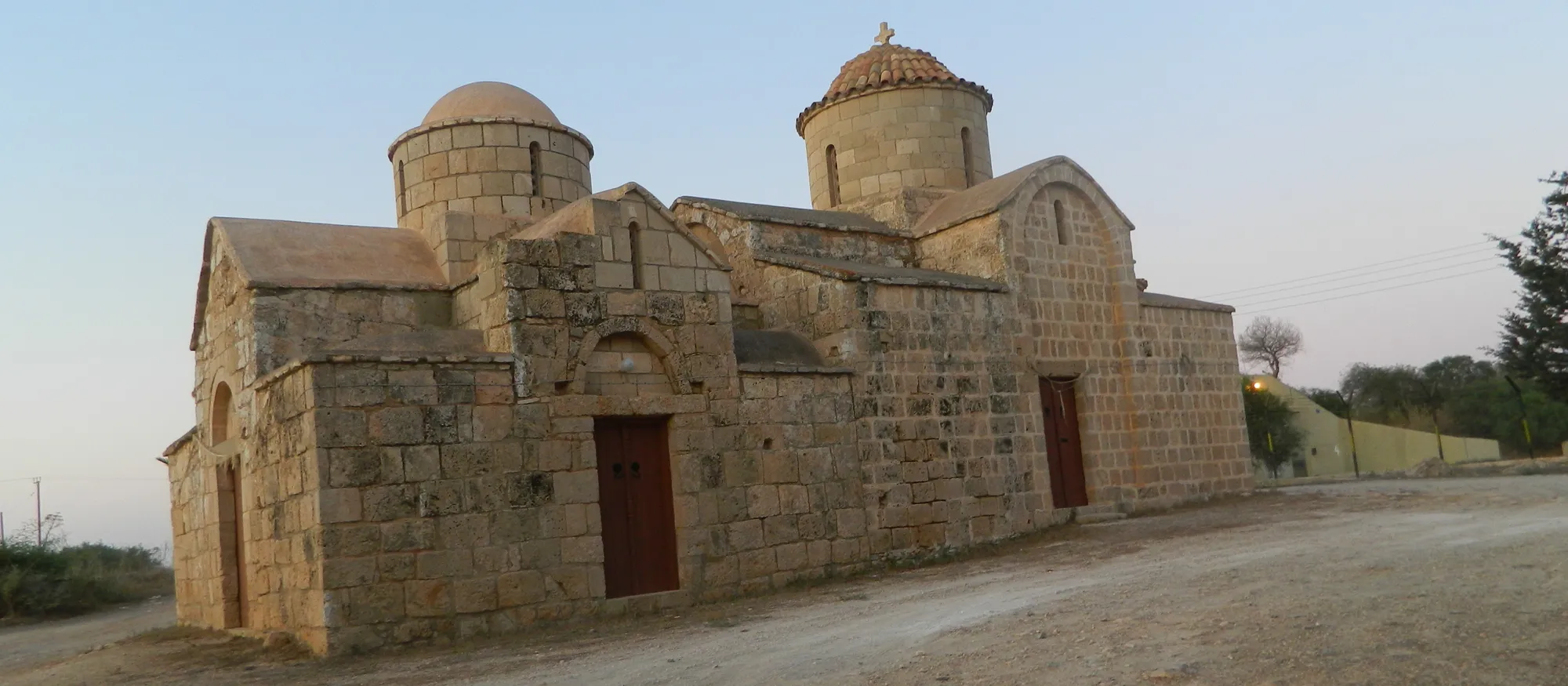
Agios Georgios Chortakion. The church in the photograph at the top of this page stands in open country outside the village, where a small settlement once stood. Visit Famagusta describes it as a cruciform domed church of the early 12th century, with few frescoes left but boats drawn in charcoal on the walls of the narthex.
Panagia Chordakiotissa. Beside the village cemetery, a single-aisle domed church that the regional board dates to the 12th century and identifies as the last surviving part of a monastery.
Agios Theodoros. About 2 km west of the village, a ruin: the main church has collapsed and only the narthex, a later addition, still stands among the fields.
None of the outlying churches has published opening hours, and they are often locked. Treat them as buildings to walk round. If interiors matter to you, the Ayia Napa monastery, 10 km away, keeps posted hours.
OpenStreetMap also marks an EOKA 1955-59 museum and a memorial to the fallen and missing in the village. We found no official listing or hours for the museum, so do not plan a visit round it.
For a rest stop, Visit Cyprus lists the Agios Antonios picnic area in Sotira among its accessible public places, with access ramps and partial signage.
Kolokasi: the crop with its own EU protection
Sotira grows watermelons, potatoes, figs and pomegranates, but its name is attached to kolokasi, the taro root that goes into one of the island’s most distinctive stews. “Kolokasi Sotiras / Kolokasi-Poulles Sotiras” was entered in the EU register as a Protected Designation of Origin by a Commission regulation of 1 August 2016, which means only taro grown in the defined area round the village can be sold under that name. Poulles are the small offset corms that grow round the large main root, and the designation covers both. Our Cyprus food guide explains how kolokasi is served.
The harvest is marked by the Kolokasi Festival in early September. Visit Cyprus’s calendar of traditional festivals listed the 46th edition at the community stadium for 5 September 2026, and a separate taro tasting evening in the churchyard with the date still to be announced. The same calendar listed the 13th Traditional Festival of Sotira for 7 July 2026. Dates move each year, so check the Visit Famagusta events page or ring the municipal quarter office (+357 23 824444) nearer the time.
For lunch in the village, the official gastronomy directory lists Mousikos Tavern at 4 Kyriakou Matsi Street (telephone 23 828833). On the coast, the listed restaurant is Nissaki at Ayia Thekla.
Getting there without a car
Buses in the Famagusta district are run by OSEA. Its winter timetable, valid from 16 November 2026 to 31 March 2027, shows five routes through Sotira. The times are departures from the first stop, so allow for the ride to wherever you board.
| Route | Runs | Departures in the winter timetable |
|---|---|---|
| 709 | Strovilia (Green Line), Vrysoulles, Frenaros, Sotira, Ayia Napa (60 minutes) | Daily. From Ayia Napa: 07:30, 09:00, 11:45, 15:25, 16:00, 17:40, 19:30, 23:00. From Strovilia: 05:35, 06:20, 07:50, 10:15, 13:50, 18:00, 21:30 |
| 710 | Deryneia (Green Line), Sotira, Ayia Napa (50 minutes) | Daily. From Ayia Napa: 08:00, 11:30, 15:30. From Deryneia: 05:50, 11:45, 14:15, 17:45 |
| 714 | Paralimni, Famagusta Hospital, Deryneia, Sotira, Liopetri, Xylofagou, Dhekelia, Larnaca, Metropolis Mall (90 minutes) | From Paralimni: 7 on weekdays (05:50 to 19:05), 5 at weekends (08:00 to 19:05). From Metropolis Mall: 7 on weekdays (08:15 to 21:00), 5 at weekends (10:00 to 21:00) |
| 703 | EAC Dhekelia, Ormideia, Xylofagou, Liopetri, Sotira, Paralimni, Protaras, Konnos (75 minutes) | Daily. From Dhekelia: 05:35, 06:30, 13:50. From Konnos: 07:30, 15:35 |
| 701A | Xylofagou, Liopetri, Sotira, Paralimni | Weekdays only: 06:40 from Xylofagou, 13:45 from Paralimni |
In practice that gives eleven buses a day from Ayia Napa and a handful from Paralimni and Protaras. OpenStreetMap shows the Eleftheria Square stop, in the middle of the village, served by all of them.
Fares are €2 for a single between 04:00 and 21:00, €3 at night, €6 for a day ticket and €25 for seven days. Our public transport guide explains how tickets work across the island.
Three things to know before relying on the bus:
- None of these routes goes to Ayia Thekla beach. The village and the coast are served by different lines; the beach buses are in our Ayia Thekla guide.
- Route 714 is the only direct link with Larnaca, and it does not serve the airport. From Larnaca Airport, take the airport service described in our Larnaca Airport to Ayia Napa guide and change, or hire a car.
- Routes 709 and 710 end at the Green Line, at the Strovilia and Deryneia crossings. If you plan to walk across, read our Green Line crossing guide first.
When to go and how to fit it in
Sotira has no weather station. Paralimni, 4 km away on the same plain, is the nearest, and its Meteorological Service averages run from a daytime high of 16.0°C in January to 33.3°C in August, with almost no rain in high summer. The month-by-month table is in our Paralimni guide.
The plain is at its best from November to April, when the fields are green and it is comfortable to walk between churches. In July and August go early or in the evening; there is little shade at the outlying sites. Early September brings the taro festival and 6 August the feast of the Saviour.
A sensible half day from Ayia Napa or Protaras: ring the museum the day before, see the Metamorphosis church, the museum and Agios Mamas on foot, drive out to Agios Georgios Chortakion, then head south to Ayia Thekla for a swim and a late lunch. Paralimni’s old square is six minutes away and Liopetri about ten if you want to make a day of the red-soil villages, and our best villages in Cyprus list has the mountain alternatives.
The short answer
Sotira is a red-soil farming village of about 5,900 people between Paralimni and Ayia Napa, now part of Ayia Napa Municipality and not to be confused with the Neolithic Sotira in Limassol district. Come for an hour or two among small medieval churches, ring ahead for the museum, try the taro in season, and remember that the beach with a Sotira address, Ayia Thekla, is 7 km south of the village. Buses 709 and 710 run from Ayia Napa every day.
Sources for changing details: the Visit Cyprus Sotira village page, Ecclesiastical Museum listing, Agios Antonios picnic area, Mousikos Tavern listing and 2026 traditional festivals calendar (in Greek); Visit Famagusta’s Sotira and Sotira beaches pages; census figures as reproduced by City Population; Commission Implementing Regulation (EU) 2016/1322 and the UK register’s Kolokasi Sotiras entry on the taro designation; the OSEA route and stop lists and winter 2026-27 timetable; Wikipedia on Sotira, Limassol. All checked on 23 November 2026; confirm times and dates before you travel.
Hero photograph: “Agios Georgios Chortakion” by ant0ni0c, taken in January 2011, via Wikimedia Commons, licensed CC BY-SA 3.0. Cropped for this page.

Quick answers
Frequently asked questions
Where is Sotira in Cyprus?
The Sotira most visitors mean is in the Famagusta district in the south-east, about 4 km west of Paralimni and 10 km by road from the centre of Ayia Napa. It is one of the Kokkinochoria, the red-soil farming villages, and since July 2024 it has been part of Ayia Napa Municipality. A second, much smaller Sotira lies in Limassol district near Episkopi, about 128 km away by road.
Does Sotira have a beach?
Yes, but not in the village. Sotira's land runs south to the coast, where Ayia Thekla beach, Poseidon Beach and Sirens Beach all fall inside the community. Ayia Thekla is about 7 km and 10 minutes by car from the village square, and it appears on the 2026 Blue Flag list under Ayia Napa. The village itself is inland with no sea view.
Is Sotira worth visiting?
For a couple of hours, yes, if you like old churches and working villages. The draw is a cluster of small medieval churches in and around the village, an ecclesiastical museum opened by appointment, and the taro crop that has EU protected status. It is not a resort and has few visitor facilities, so most people combine it with Ayia Thekla beach, Paralimni or Liopetri.
What is Sotira known for?
Two things: Byzantine and medieval churches, and kolokasi, the taro root grown in its red soil. Kolokasi Sotiras has been a Protected Designation of Origin in the EU since August 2016, and the village holds a Kolokasi Festival in early September. Visit Cyprus listed the 46th edition for 5 September 2026.
Is there a bus from Ayia Napa to Sotira?
Yes. In the OSEA winter timetable valid from 16 November 2026 to 31 March 2027, route 709 leaves Ayia Napa for Sotira eight times a day and route 710 three times a day, every day of the week. A single ticket is 2 euros between 04:00 and 21:00 and 3 euros at night. Route 714 links Sotira with Paralimni and Larnaca.