Paphos district · A square, a 12th-century hermitage and a bus that skips Sundays
Tala, Cyprus: the hill village above Paphos, its monastery and how to get there
Tala is a village of about 3,100 people in the hills 8 km north of Paphos, with Agios Neophytos Monastery 2.5 km further up. What the square offers, monastery hours and the 2 euro ticket, the cat sanctuary, bus 604 times, taxi costs, the nearest beach and who Tala suits.
- Filed under
- Places
- Updated
- 13 November 2026
- By
- The editors
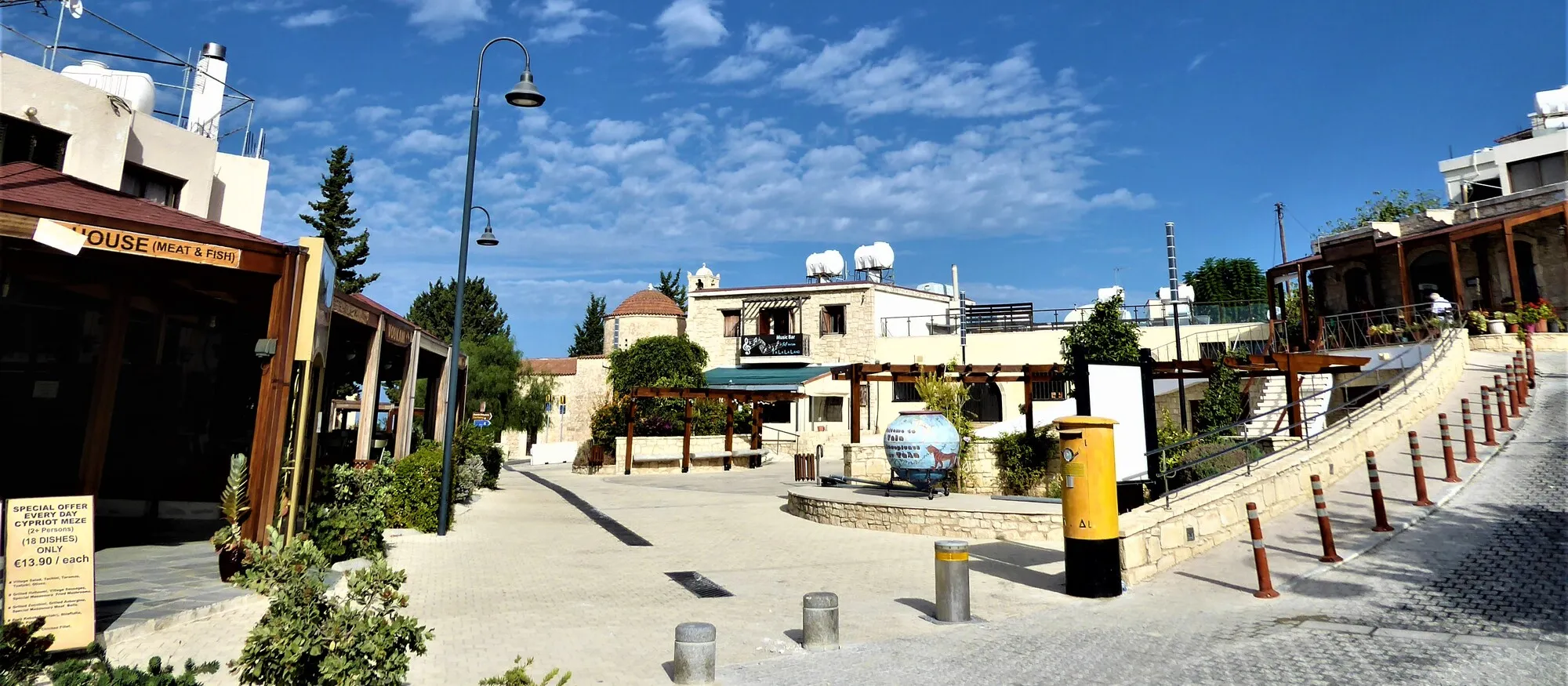
Tala is a village of about 3,100 people in the hills above Paphos, 10.7 km and 18 minutes by car from the harbour. It has a paved square with a handful of tavernas, a 15th-century church and wide views down to the coast, and its one major sight, Agios Neophytos Monastery, stands 2.5 km further up the valley. There is no beach: the sea is 9 minutes away by car and the nearest sandy one about 16.
That mix explains who comes here. Day visitors come for the monastery and lunch on the square. Longer-stay visitors and residents come for a villa with a view, cooler evenings than the coast and a short drive to town. Both groups need to know that the bus runs six times a day and not at all on Sundays.
Tala at a glance
| Where | Paphos district, in the hills above Chloraka, Emba and Kissonerga |
| Population | 3,100 at the 2021 census |
| Height | The square is about 265 to 280 m above sea level; the monastery about 445 m |
| Local authority | Tala Community Council, in the Agios Neofytos cluster of communities |
| Agios Neophytos Monastery | 2.5 km, 6 minutes by car |
| Paphos harbour | 10.7 km, 18 minutes |
| Nearest sandy beach | Coral Bay, 9.1 km, 16 minutes |
| Bus | Route 604, six a day on weekdays, four on Saturdays, none listed on Sundays |
Where Tala is and what it is like
Tala sits on a slope that climbs north-east from the Paphos coastal plain. The community council describes the village as built at an average of 280 metres, with land that runs from about 150 metres at its lower edge to 600 metres on the ridge above the monastery. That height is the point of the place. From the upper streets you look over Emba and Chloraka to the sea, and evenings tend to be fresher than they are down in Kato Paphos.
It is not a museum village. The census counted 730 residents in 1992, 1,605 in 2001, 2,695 in 2011 and 3,100 in 2021, so the population has more than quadrupled in thirty years. The council’s own history is frank about why: after 1974, developers began building houses, villas and holiday complexes across the community’s land, and it now calls Tala “basically a tourist village”. The best known of those complexes is Kamares Village. What you find today is a small traditional core around the square, surrounded by a much larger spread of villas that is popular with British and other foreign residents.
The name is usually traced to the Frankish period. The council’s account is that it comes from the D’Avila family, wealthy medieval landowners in Paphos district whom Cypriot chroniclers called “Tavila”, although no source records them owning the village itself.
Administratively, Tala is still its own community. It was not folded into Paphos Municipality or the new Akamas Municipality in the 2024 local government reform, and it gives its best-known landmark’s name to the cluster of communities it belongs to.
The square and the village centre
The centre of Tala is the pedestrian square on Miltiade Stylianou Street, named after a local man the council lists among the village’s heroes. It is small, stone paved and lined with tavernas and cafes under timber pergolas. This is where the bus stops and where almost every visitor ends up eating.
Three things are worth a few minutes on foot:
- Agia Ekaterini church, whose red dome shows above the square. The council dates the original barrel-vaulted church to the 15th century and its enlargement into the present single-aisled, domed building to the mid-16th century. Traces of a large Last Judgement wall painting survive under whitewash on the west wall.
- The open-air amphitheatre and the Konstantinos Leventis community park, both on the council’s list of sights. The council puts on summer events, including theatre, and announces them on its website; there is no fixed programme.
- The newer Church of the Nativity of the Saviour, built in 2011 and 2012 and consecrated on 26 December 2012.
Outside the centre are three country chapels: Agios Georgios, restored in 1990 on the site of the vanished settlement of Stefani, Agioi Saranta, restored in 1994, and Agia Marina. They open for their feast days and for baptisms, not for visitors on an ordinary day.
Agios Neophytos Monastery
The monastery is why most people drive up this road. It lies inside Tala’s boundary, 2.5 km and about 6 minutes beyond the square, at the wooded head of a valley about 445 metres above sea level.
The short history
Neophytos was born in 1134 in the Lefkara area, fled an arranged marriage at 18 and became a monk at the monastery of Agios Ioannis Chrysostomos at Koutsovendis. After a pilgrimage to the Holy Land he tried to leave for Asia Minor, was arrested at Paphos as a suspected fugitive and was robbed of his fare by the guards. With no money to travel, he walked into the hills and, in 1159, settled in a small natural cave in the cliff here.
He spent years cutting it into a chapel, a cell and his own tomb. This is the Enkleistra, the “place of seclusion”. He was ordained in 1170 and took a disciple, more cells were cut along the cliff, and the walls were painted. In 1197, to escape the visitors his reputation was attracting, he dug a second cell higher up the rock. He also wrote prolifically, including an account of Richard the Lionheart’s seizure of Cyprus in 1191 that is one of the few Greek sources for it. He died some time after 1214.
The main monastery buildings and the large church in the courtyard are later, and the church holds icons of the 16th century. The monastery’s feast days are 24 January and 28 September.
A note on dates, because the official pages disagree with each other. The Visit Cyprus site listing says the monastery was founded “in the second half of the 12th century”, while its museum listing says “around 1200”. The first is right: Neophytos moved into the cave in 1159.
Hours, ticket and what you see
These are the details on the Visit Cyprus listing, read on 13 November 2026.
| November to March | Daily, 09:00 to 16:00 |
| April to October | Daily, 09:00 to 13:00 and 14:00 to 18:00 |
| Ticket | €2, valid for both the museum and the Enkleistra |
| Closed | Christmas Day, New Year’s Day, Green Monday, Orthodox Easter Sunday and 15 August |
| Telephone | +357 26 652 481 |
Note the lunch break in summer: arrive at 13:00 between April and October and you wait an hour. In winter there is no break, but the last hour before 16:00 is short for both parts.
The ticket covers two things. The Enkleistra is the rock-cut hermitage in the cliff. It is small, and its wall paintings, which date from the 12th to the 15th centuries, are the reason art historians come. The museum, under the east wing, has an ecclesiastical section of icons, manuscripts, vestments and silver from the late 12th to the 19th century, including a manuscript of Neophytos’s own homilies, and a second room of Geometric and Archaic pottery from about 900 to 600 BC.
The fee applies to the museum and the Enkleistra only. This is a working monastery, so dress as you would for any Orthodox church, with shoulders and knees covered. Visit Cyprus also publishes a free audio guide to the site.
If monasteries are your interest, Kykkos Monastery in the Troodos is the island’s richest and makes a full day out from Paphos; for the Roman and early Christian remains in town, see our Paphos Archaeological Park guide.
The incense trees
One local curiosity is easy to miss. In the Stefani area of the village the council points to a stand of tall trees with hand-shaped leaves, known locally as kapnismata. Their bark gives a resin that was burned in church in place of frankincense, which is where the name comes from. Village tradition says Neophytos brought them back from the Holy Land, and the council says attempts to transplant them elsewhere have failed.
The Tala cat sanctuary
“Tala cats” is searched for more often than the village square. It refers to Tala Cats, a registered non-profit sanctuary long known as the Tala Monastery Cat Park, which tells you roughly where to look: near the monastery, not on the village square.
The charity says it cares for more than 500 rescued cats at any one time, has rehomed over 1,000 in Cyprus and abroad, and spends about €12,000 a month on food, vet bills and running costs, all from donations. Volunteers are at the park from 08:00 to 14:00 every day, and the charity invites people to drop by. Go in the morning, and take wet or dry cat food if you want to bring something useful. The location map and contact form are on talacats.com.
Where to eat
For a village of 3,100, Tala has a lot of places to eat, most of them on or just off the square. The Visit Cyprus gastronomy directory listed these on 13 November 2026:
| Listing | Type | Address |
|---|---|---|
| Yiannis Restaurant | Restaurant | 8 Miltiade Stylianou Street |
| Talalaland | Snack bar | 7 Miltiade Stylianou Square |
| Casa Luna | Italian restaurant | Miltiade Stylianou Street |
| Marios Restaurant | Restaurant | 2 Griva Digeni Street |
| Stamna Tavern | Tavern | 10 Archiepiskopou Makariou III Street |
| Masa Soura Tavern | Tavern | 4 Mavrovouniou Street |
| Cliff | Cafe | 55 Archiepiskopou Makariou Avenue |
A directory entry is not a recommendation, and places change hands or close midweek in winter, so check before you make a special trip. For what to order, see our Cyprus food guide, and for the wider choice in town, the Paphos restaurants guide.
Is there a beach near Tala?
Not in the village. The closest sea is the Kissonerga coast road, 4.7 km and about 9 minutes downhill, which is rocky coves and hotel frontage with no Blue Flag beach. For sand, sunbeds and lifeguards, Coral Bay is 9.1 km and about 16 minutes away. Our Paphos beaches guide compares the rest.
Getting to Tala
By car
| From Tala square to | Distance | Drive time |
|---|---|---|
| Agios Neophytos Monastery | 2.5 km | 6 min |
| Emba | 3.5 km | 6 min |
| Kissonerga village | 3.8 km | 7 min |
| Paphos, Karavela bus station | 7.7 km | 12 min |
| Paphos old town (Ktima) | 8.2 km | 13 min |
| Coral Bay beach | 9.1 km | 16 min |
| Tombs of the Kings | 9.2 km | 15 min |
| Paphos harbour | 10.7 km | 18 min |
| Paphos Airport | 18.4 km | 27 min |
From the harbour straight to the monastery is 13.2 km and about 24 minutes. Tala is also one of the two signed approaches to Adonis Baths, whose operator asks drivers to follow the road signs from here and not a sat nav. Allow about half an hour for that drive; it is slower than the distance suggests. For hire terms and hill-road rules, see our car hire and driving in Cyprus guides.
By bus
One route serves the village. These were the times on the operator’s route 604 page on 13 November 2026.
| Route 604 | From Karavela station, Paphos | From Agios Neophytos Monastery |
|---|---|---|
| Monday to Friday | 06:30, 09:20, 11:10, 14:20, 16:00, 17:40 | 07:10, 10:00, 11:50, 15:00, 16:40, 18:20 |
| Saturday | 08:10, 10:50, 15:00, 17:40 | 08:50, 11:30, 15:40, 18:20 |
| Sunday | No service listed | No service listed |
The bus leaves Karavela, passes the municipal market in the old town, runs through Chloraka and Emba, stops on Miltiade Stylianou in Tala and ends at the monastery. Each bus turns round at the top about 40 minutes after it left Karavela.
That makes a monastery visit by bus workable on a weekday: the 09:20 from Karavela gets you there for about 10:00, and the 11:50 back leaves time for the Enkleistra and museum. Stay for lunch in Tala on the way down and the 15:00 from the monastery passes through the square a few minutes later. On a Saturday the 10:50 up and 15:40 down is the only comfortable pairing. On a Sunday you need a car or a taxi.
Fares are €2 for a single, €3 after 21:00 and €6.50 for a day ticket, bought on the bus. Children up to five travel free and under-12s pay half. Public holiday timetables differ, so check the route page before relying on a departure. Our public transport guide explains how the Paphos network fits together.
By taxi
The official urban meter tariff is €3.80 plus €0.95 per kilometre by day and €4.80 plus €1.10 at night. On that basis Tala square to Paphos harbour comes to about €14 by day and €16.50 at night, the harbour to the monastery to about €16.50 by day, and Tala to Paphos Airport to about €21 by day, before luggage, waiting or public-holiday supplements. Our Cyprus taxi guide explains the extras.
Tala weather
There is no official weather station in Tala. Paphos Airport, 18 km away at sea level, holds the long-term record: its 1991 to 2020 normals give a mean daily maximum of 31.0°C in August and 19.3°C in December. Tala is 250 metres or more higher, so expect it to run a little cooler than those figures, most noticeably after dark and in winter, when a villa here needs heating.
It is also wetter. The community council puts Tala’s average annual rainfall at about 520 mm, against roughly 420 mm quoted by the council in Chloraka on the coast below. For the month-by-month picture, see our best time to visit Cyprus guide.
Should you stay in Tala?
Stay in Tala if you have a hire car, want a villa with a pool and a view, and like the idea of walking to a village square for dinner. It suits a week or more better than a short break, and it suits winter stays if the property is properly heated.
Look elsewhere if you want the beach on foot, a choice of bars at night or a holiday without driving. Six buses a day, none on Sundays and none in the evening, will not carry a car-free holiday. In that case the coast road in Chloraka or Kissonerga, with a bus every 10 to 15 minutes, is the better base.
As a half-day trip from Paphos it is easy to recommend: the monastery first, while it is quiet, then lunch on the square. Tala is also one of the hill villages people weigh up in our best places to live in Cyprus guide, and our Paphos guide covers everything else within reach.
Sources for changing details: monastery hours, ticket and closures from the Visit Cyprus site and museum listings, and restaurant listings from the Visit Cyprus gastronomy directory, all read 13 November 2026; bus times and fares from Pafos Buses route and ticket pages, read the same day; village history, churches, altitude, rainfall and the incense trees from the Tala Community Council; the sanctuary’s figures from Tala Cats; population from the Statistical Service censuses of 1992 to 2021 as tabulated by citypopulation.de; the 1159 date from Catia Galatariotou’s The Making of a Saint (Cambridge University Press), as cited in Neophytos’s Wikipedia biography. Road distances and times are OpenStreetMap routing estimates in normal traffic, and heights are from open elevation data. Taxi figures are our own calculation from the official tariff, not quotes. Opening hours and fees can change without notice, so telephone the monastery before a special journey.
Hero image: Tala Square, Cyprus by Chris06, Wikimedia Commons, CC BY-SA 4.0, cropped.

Quick answers
Frequently asked questions
Where is Tala in Cyprus?
Tala is a hill village in Paphos district, on the west of the island, about 8 km north of Paphos town. The square is roughly 265 to 280 metres above sea level, 10.7 km and 18 minutes by car from Paphos harbour and 9 km from Coral Bay. The postal code is 8577. It is its own community, not part of Paphos Municipality.
Is there a beach in Tala?
No. Tala is inland and uphill. The nearest sea is the Kissonerga coast road, about 4.7 km and 9 minutes down the hill, which is rocky coves and hotel frontage. The nearest sandy Blue Flag beach is Coral Bay, 9.1 km and about 16 minutes by car.
What are the opening hours of Agios Neophytos Monastery?
Visit Cyprus lists the museum and the Enkleistra, the painted cave hermitage, as open daily from 09:00 to 16:00 between November and March, and from 09:00 to 13:00 and 14:00 to 18:00 between April and October. One 2 euro ticket covers both. The monastery closes on Christmas Day, New Year's Day, Green Monday, Orthodox Easter Sunday and 15 August.
Is there a bus from Paphos to Tala?
Yes. Pafos Buses route 604 runs from Karavela station in Paphos through Chloraka and Emba to Tala square and on to Agios Neophytos Monastery. There are six departures each way on weekdays and four on Saturdays, and no Sunday service is listed. A single is 2 euros, bought on the bus.
How much is a taxi from Tala to Paphos?
On the official urban meter tariff of 3.80 euros plus 0.95 euros per kilometre by day, the 10.7 km from Tala square to Paphos harbour works out at about 14 euros before any luggage or waiting charges. On the night tariff of 4.80 euros plus 1.10 euros per kilometre it is about 16.50 euros. Paphos Airport is 18.4 km away, so roughly 21 euros by day on the same basis.