Planning · Big city or easy town
Limassol or Larnaca: which is the better base for your Cyprus trip?
Limassol or Larnaca? Station climate data, 2026 Blue Flags, census figures and measured drive times show which town suits your Cyprus holiday.
- Filed under
- Plan your trip
- Updated
- 30 September 2026
- By
- The editors
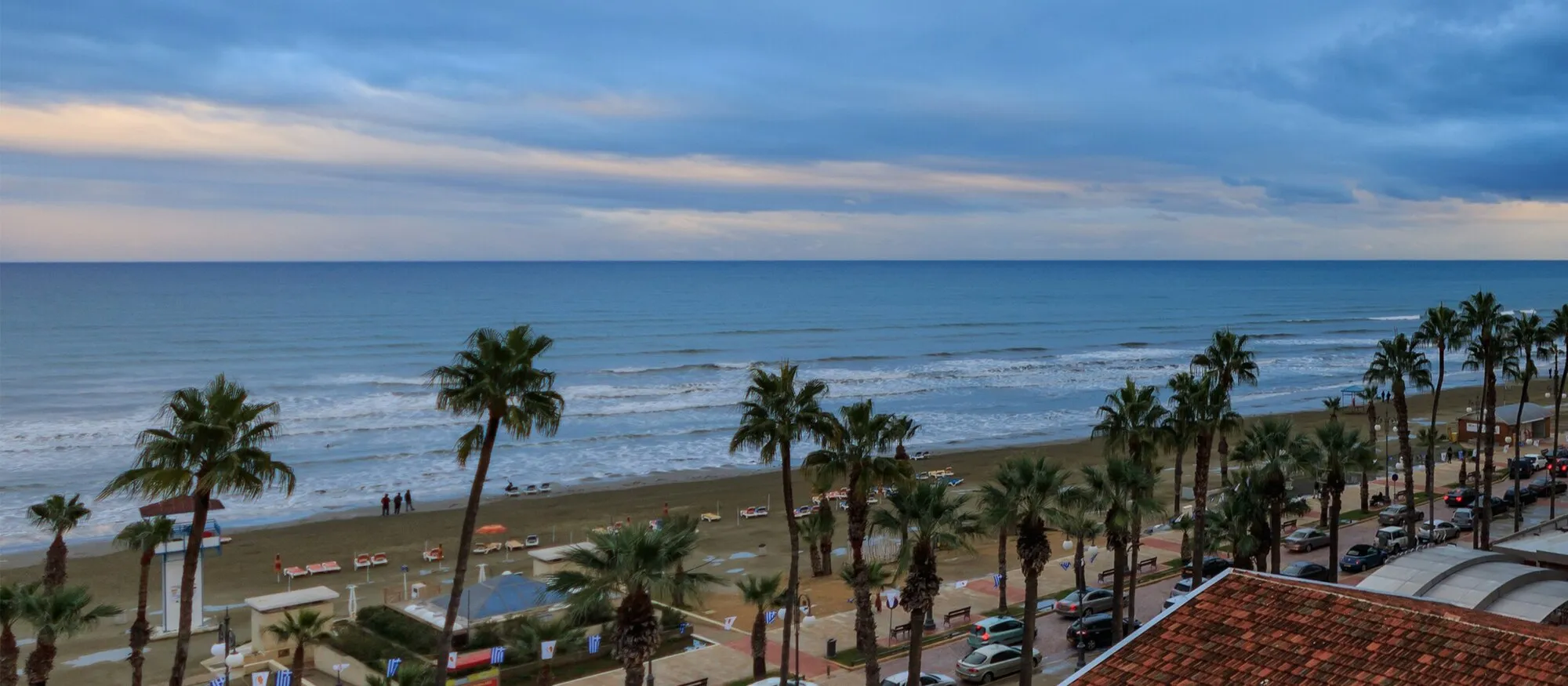
Choose Larnaca for an easy, compact holiday: the airport is twelve minutes from the seafront, the town beach is on the main promenade, and all four of its 2026 Blue Flag beaches are inside the town. Choose Limassol for a proper city, twice Larnaca’s size, with more places to eat and drink and the mountains and Kourion close by. On weather there is almost nothing between them in the afternoon. The difference is at night, when Limassol stays noticeably warmer, especially in winter.
Search this question in Google and the first page is a Facebook expat thread, a boat-trip ticket, an Instagram post and a stock photo library. The answers that do exist repeat the same line: Larnaca is quiet, Limassol is lively. That is true, but it leaves out the numbers that actually decide the trip.
The quick answer
| Limassol | Larnaca | |
|---|---|---|
| Feels like | A big, busy, modern city | A relaxed town built round its promenade |
| Best for | Food, nightlife, mountain and west-coast day trips | Short breaks, walkable beach holidays, the east |
| Urban population, 2021 census | 198,303 | 90,397 |
| August afternoons | 33.7°C | 33.3°C |
| January nights | 11.2°C | 7.8°C |
| Blue Flag beaches in town, 2026 | None | Four |
| From Larnaca Airport | 69 km, about 58 minutes | 8 km, about 12 minutes |
| To the Troodos (Troodos Square) | 48 km, about 65 minutes | 111 km, about 2 hours |
| To Nicosia | 83 km, about 75 minutes | 47 km, about 45 minutes |
Size and feel: a city against a town
Limassol is the bigger place by any measure. The 2021 census put its urban area at 198,303 people and Larnaca’s at 90,397, so Limassol is a little over twice the size. You feel that in the new towers along the coast, the long seafront that runs for kilometres east of the old port, the range of restaurants and the traffic.
Larnaca is the town you can get your head round in an afternoon. The palm-lined Finikoudes promenade, the Church of Saint Lazarus, the castle and the old Turkish quarter all sit within a short walk of each other. Our Larnaca Old Town guide has the route. Limassol’s historic core around the castle and old port is just as walkable, as the Limassol Old Town walk shows, but it is a small part of a large, spread-out city.
If you want choice after dark, Limassol wins easily. Its restaurant guide runs from old-town tavernas to marina fine dining, and the city stays lively all year. If you want to walk out of your hotel to the beach, then to dinner, then back without once thinking about transport, Larnaca is simpler.
Weather: same afternoons, different nights
This is where the usual forum answers fall down. Both towns sit on the south coast, and their afternoons are almost identical. Here are the 1991 to 2020 normals, mean daily maximum and minimum:
| Month | Limassol max | Larnaca max | Limassol min | Larnaca min |
|---|---|---|---|---|
| January | 17.9°C | 17.1°C | 11.2°C | 7.8°C |
| April | 23.4°C | 23.0°C | 14.3°C | 12.1°C |
| July | 33.5°C | 33.0°C | 24.2°C | 22.6°C |
| August | 33.7°C | 33.3°C | 24.5°C | 23.0°C |
| October | 28.2°C | 28.3°C | 19.4°C | 17.5°C |
| December | 19.3°C | 18.9°C | 12.4°C | 9.7°C |
The maximums never differ by more than a degree. In high summer both are hot, and picking one over the other will not make an August afternoon easier. If heat is the worry, the west coast is the answer: Paphos runs two to three degrees cooler, as our Larnaca or Paphos comparison sets out.
The minimums are a different story. Limassol’s recorded nights are about 1.5°C warmer in summer and more than 3°C warmer in midwinter. One caution is fair here: Larnaca’s figures come from the airport weather station, which sits on open, flat ground beside the salt lake, and open ground cools faster at night than a built-up seafront. So the gap in Larnaca town itself is probably smaller than the table suggests. Even so, the pattern is consistent across every month, and for a winter break it tips things towards Limassol. A January evening walk along the sea is more comfortable there. The Cyprus in winter guide covers what else changes between November and March.
Beaches: Larnaca’s are in town, Limassol’s are out of it
On 2026 certification, the two districts look level: at the Cyprus Marine Environment Protection Association’s July count, three beaches were flying the Blue Flag in each. Where those beaches are is what matters.
Larnaca’s are on its doorstep. Larnaca Municipality was awarded four Blue Flags for 2026: Finikoudes, Mackenzie, Kastella and Yiannades. Finikoudes is the town beach below the promenade, and Mackenzie is about 2 km south of it, close to the airport. The sand is fine and greyish-gold rather than white, and the water shelves gently. Our Larnaca beaches guide compares them.
Limassol’s city beaches have no flag this year. Limassol and Amathus municipalities did not submit applications for 2026 after pollution reports during the 2025 season, so Dasoudi and the rest of the city seafront are unflagged. That is not the same as failing a water test, and Dasoudi is still a good city beach. But the district’s flagged beaches are at Governor’s Beach, Parekklisia, Kourion and Pissouri, and most of those mean a drive. The Limassol beaches guide explains which is which.
For a holiday where the beach is the main event and you do not want a hire car, Larnaca is the better choice. If you are driving anyway, Limassol’s out-of-town beaches, especially Kourion under the clifftop ruins, are more scenic than anything on Larnaca’s town seafront.
Getting there: Larnaca is next to the main airport
Larnaca Airport is the island’s main gateway, with 9.9 million passengers in 2025 against 3.8 million at Paphos, and it is only about 8 km and 12 minutes by road from Finikoudes. Local route 425 links the terminal with Larnaca’s bus station, and a taxi is a short hop. After a late arrival, that matters.
Limassol has no airport. It sits between the two, about 69 km and just under an hour from Larnaca Airport, and about 61 km from Paphos Airport. The Limassol Airport Express shuttle runs from both, and our Larnaca Airport to Limassol guide has the current fares and stops. For a long weekend, that hour each way is a real cost. For a fortnight it matters much less.
What each is a base for
The two towns face in opposite directions, and the drive times make it plain:
| From | Limassol | Larnaca |
|---|---|---|
| Kourion | 18 km, 21 min | 83 km, 74 min |
| Troodos Square | 48 km, 65 min | 111 km, 116 min |
| Paphos harbour | 71 km, 63 min | 137 km, 116 min |
| Lefkara | 48 km, 49 min | 40 km, 42 min |
| Nicosia | 83 km, 73 min | 47 km, 45 min |
| Ayia Napa | 113 km, 95 min | 49 km, 46 min |
Limassol looks west and up. Kourion and Kolossi Castle are twenty minutes away, the Troodos mountains are an hour, and Paphos is an easy day trip. Families also get Fasouri Watermania, which the official tourism portal describes as the island’s largest water park, just outside the city.
Larnaca looks east and north. Nicosia is 45 minutes away, which makes a day in the capital and a Green Line crossing easy. Ayia Napa’s beaches and Cape Greco are under an hour. Closer in, the Larnaca Salt Lake and Hala Sultan Tekke are on the airport road, and the flamingos arrive from late autumn.
Lefkara, the lace village, sits almost exactly between the two, so it works from either.
Which should you pick?
- Long weekend or short break: Larnaca. You lose almost no time getting to and from the airport.
- Beach holiday without a car: Larnaca, for the flagged beaches in town.
- Food, bars and a city atmosphere: Limassol.
- Hiring a car to see the mountains and the west: Limassol.
- Winter or shoulder-season break: Limassol, for the warmer evenings and a city that does not wind down.
- Nicosia, the north and Ayia Napa on the list: Larnaca.
For the wider shortlist, including Paphos, Protaras and Ayia Napa, see our where to stay in Cyprus guide. If Paphos is your other option, the Limassol or Paphos comparison covers that choice.
Can you do both?
Easily. The two seafronts are about 70 km apart, a little over an hour by motorway, and Intercity Buses runs a direct coach between the two towns. Check the operator’s current timetable and fare before you travel.
On a week, staying in Larnaca and giving Limassol an evening works well: arrive, walk to dinner on the promenade, and drive or take the coach west for one day. On ten nights or more, a split stay makes sense. Start in Larnaca near the airport, then move to Limassol for the mountains and the west, and fly home from Paphos if the fares allow.
The verdict
Larnaca is the better choice for a short or car-free beach break, and for anyone who wants the airport close and the town on foot. Limassol is the better city, the better base for the mountains and the west, and the better winter choice. If you remember one number, make it the airport: twelve minutes from Larnaca’s seafront, and nearly an hour from Limassol’s.
Sources for changing details: climate figures are 1991 to 2020 normals: for Limassol, the Meteorological Service (Cyprus) figures reproduced on Wikipedia’s Limassol page; for Larnaca Airport, the World Meteorological Organization normals published by NOAA and reproduced on Wikipedia’s Larnaca page. Our Larnaca or Paphos comparison uses an older Meteorological Service table, so its Larnaca figures differ slightly. Airport passenger figures are from Hermes Airports’ traffic statistics for 2025. Population figures are 2021 census urban-area totals as tabulated by City Population. Blue Flag positions are from Larnaca Municipality’s 2026 awards, the Cyprus Mail on 30 May 2026 for the Limassol applications, and CYMEPA as reported by the Cyprus Mail on 17 July 2026 for the district counts. Driving distances and times are road-network estimates from OpenStreetMap routing (OSRM), measured from Limassol Castle and the Finikoudes promenade; real journeys vary with traffic. Flags, fares and timetables change between seasons, so check before you book.
Hero photograph: Finikoudes promenade, Larnaca, by A.Savin, via Wikimedia Commons, licensed under the Free Art License. Cropped.

Quick answers
Frequently asked questions
Is Limassol or Larnaca better for a holiday?
Larnaca is better for a short, easy beach break: the airport is about 12 minutes away, the town beach sits on the main promenade and all four of the town's Blue Flag beaches for 2026 are inside the town. Limassol is better if you want a big city with a wide choice of restaurants and bars, and it is the better base for the Troodos mountains, Kourion and the west of the island.
Is Limassol hotter than Larnaca?
Not in the afternoon. On 1991 to 2020 normals the mean daily maximum in August is 33.7C in Limassol and 33.3C at Larnaca Airport, and the two stay within one degree all year. The difference is at night: Limassol's recorded minimums run 1.5C warmer in August and over 3C warmer in January, partly because Larnaca's station sits at the airport on open flat ground.
How far is Limassol from Larnaca?
About 70 km between the two seafronts, a little over an hour by motorway. Intercity Buses runs a direct coach between the two towns. Limassol is about 69 km, just under an hour, from Larnaca Airport.
Which is bigger, Limassol or Larnaca?
Limassol, by a wide margin. At the 2021 census the Limassol urban area had 198,303 residents against 90,397 for Larnaca, so Limassol is a little over twice the size. That shows in the range of restaurants, shops and nightlife, and in the traffic.
Which has better beaches, Limassol or Larnaca?
For a beach you can walk to, Larnaca. Finikoudes, Mackenzie, Kastella and Yiannades were all awarded Blue Flags for 2026 and all lie within the town. Limassol and Amathus municipalities did not apply for the 2026 season, so the city's own beaches carry no flag this year; the district's flagged beaches are at Governor's Beach, Parekklisia, Kourion and Pissouri, which mostly means a drive.